GUSTAVE LOISEAU
1865 - Paris - 1935
Ref: CD 174
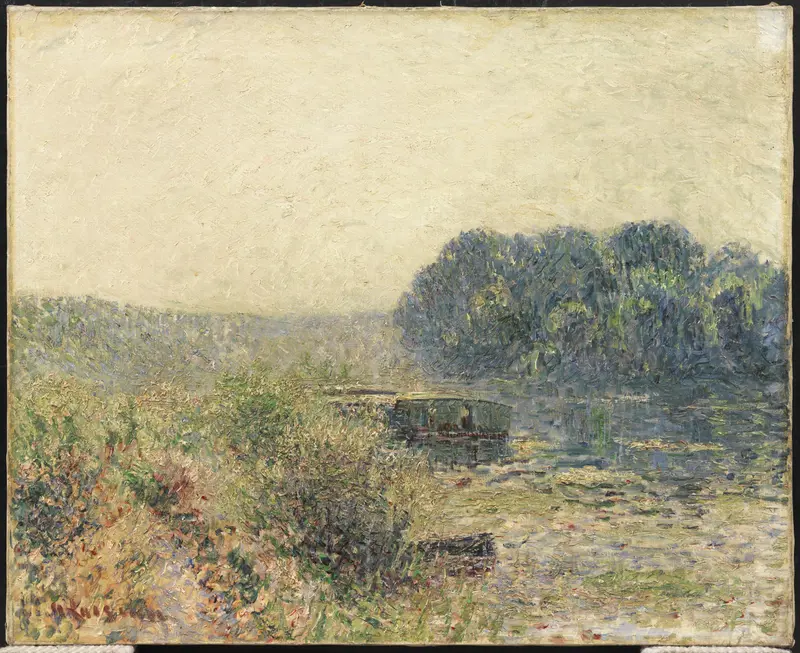
Au bord de la rivière
Signed lower left: G Loiseau
Oil on canvas: 19 ½ x 24 in / 49.5 x 61 cm
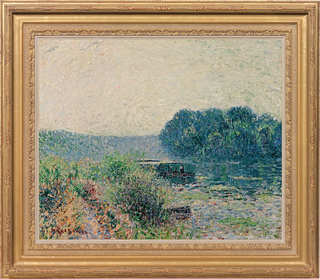
Frame size: 27 x 31 in / 68.6 x 78.7 cm
Painted circa 1905
Provenance:
Private collection, acquired in the 1960s or 1970s;
by descent to a private collection, UK
To be included in the catalogue raisonné of the work of Gustave Loiseau being prepared by Monsieur Didier Imbert, A 2208, Attestation C 1095
Gustave Loiseau commented: ‘I work in my little corner, as best I can, and try my best to translate the impression I get from nature…it is my instinct alone that guides me and I am proud not to resemble anybody’. Loiseau was however influenced by the Pont-Aven School and the Pointillists early in his career before forging his own interpretation of Post-Impressionism.
The radiance that emanates from Loiseau’s paintings is enhanced by his frequent choice of river scenes for his compositions. He has been called the ‘historiographer of the Seine’, the river at the heart of northern French identity, which rises in Source-Seine near Dijon, flows majestically through Paris, and reaches the sea at the busy port of Le Havre. The placid river, in its lush green valley fringed with gentle hills, has inspired countless artists, including Loiseau’s older Impressionist contemporaries Monet, Pissarro and Sisley.
This tranquil view evokes magic from the simplest of elements: the quiet river, a boat, a wooded island. Loiseau weaves blue and blue-green to describe the shadowed trees of the distant bank, contrasting them with the burst of colour from the vegetation at foreground left, mixing dancing brushstrokes of sapphire and emerald with red, pink and ochre. The dreamlike, poetic composition recalls Monet’s paintings of the Seine and its islands near his house at Giverny, in such works as Près de Vernon, Ile aux Orties, 1897 (Metropolitan Museum of Art, New York).
GUSTAVE LOISEAU
1865 – Paris – 1937
Gustave Loiseau is one of the most poetic and sensitive of the Post-Impressionists. His work shows the influence of Impressionist masters such as Alfred Sisley and Camille Pissarro and he briefly took advice from Paul Gauguin, whilst being a great admirer of Corot. Loiseau experimented with Pointillism, but developed his own style. He is considered to be a pure landscape artist, painting from direct observation of nature in a manner which is reminiscent of Claude Monet.
Loiseau was born in Paris, the son of a butcher from Pontoise who had moved to the Ile-Saint-Louis. He was apprenticed in 1880 to a painter and decorator, a job which he despised, but which confirmed his interest in art. Loiseau discovered the countryside of Pontoise when his parents retired there in 1881; a small legacy from his grandmother in 1887 spurred him to devote his life to landscape painting.
Loiseau studied at the Ecole des Arts Décoratifs and in 1889 at the studio of the landscape painter Fernand Quignon. Loiseau rented a room in a workers’ tenement, La Maison du Trappeur in the Rue Ravignon, Montmartre, which was later to become famous as the Bateau-Lavoir. He became acquainted with Jean-Louis Forain and Adolphe Willette, but his shy, nature-loving personality had little in common with the raucous bohemians of the Parisian art scene. In 1890 he went to Pont-Aven, staying at the famous inn run by Marie-Jeanne Gloanec, where he was befriended by Henry Moret and Maxime Maufra. Although working in a personal style, Loiseau’s paintings from this period show the influence of the Pont-Aven School in their diagonal compositions, shortened perspectives and anti-panoramic fields of view. Returning to Paris in 1891, Loiseau exhibited for the first time at the Fifth Exhibition of Impressionist and Symbolist Painters. He showed paintings at the gallery of Le Barc de Boutteville in Rue Le Pelletier, where two works were bought by the celebrated Rouen collector and friend of Monet, François Depeaux.
For much of his life Loiseau was based in Paris but travelled extensively through France, making repeated trips to Pont-Aven, where he was encouraged by Gauguin in 1894, to Normandy and to Pontoise. Described as ‘the historiographer of the Seine’, he also captured the shifting moods of the Oise and the Eure rivers and the Channel ports. Loiseau joined the Société des Artistes Indépendants in 1893. In 1897 he signed an agreement to sell most of his output to Paul Durand-Ruel, giving him the financial independence to travel more extensively. Loiseau divided his last years between Pontoise (where he is buried) and Paris, where he died in 1935.
The work of Gustave Loiseau is represented in the Musée d’Orsay, Paris; the Musée des Beaux-Arts, Rouen; the Ashmolean Museum, Oxford; the Marubeni Collection, Japan; the Metropolitan Museum of Art, New York; the Museum of Fine Arts, Boston and the Nelson-Atkins Museum of Art, Kansas City.