

MONTAGUE DAWSON
Chiswick 1895 - 1973 Midhurst, Sussex
Ref: CC 145
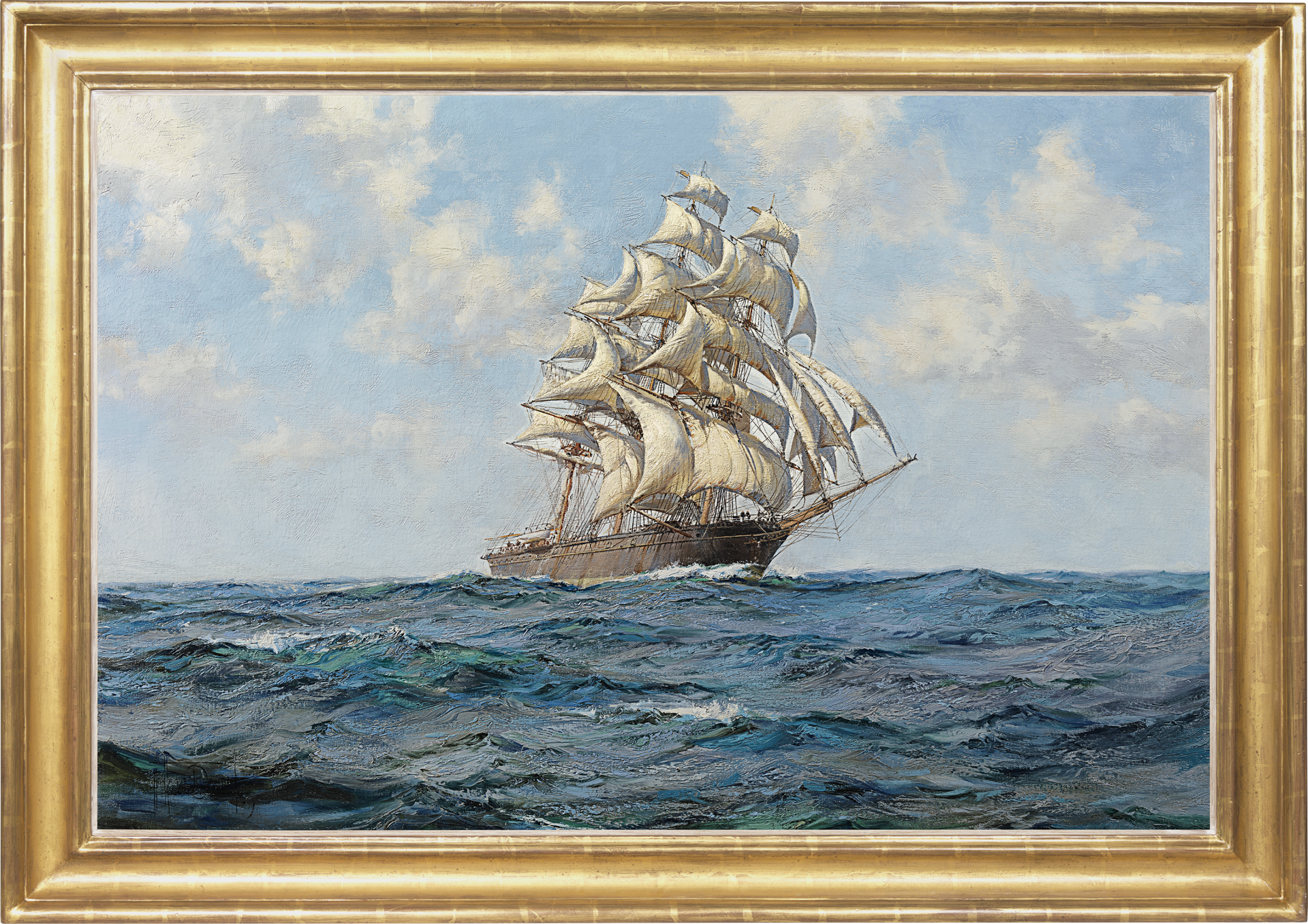
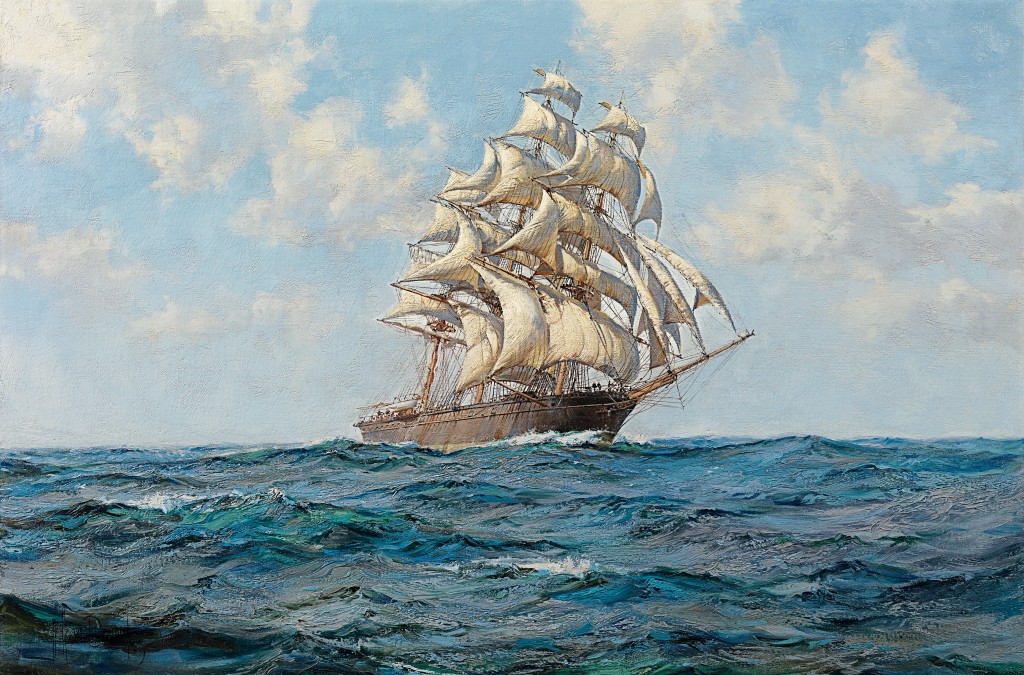
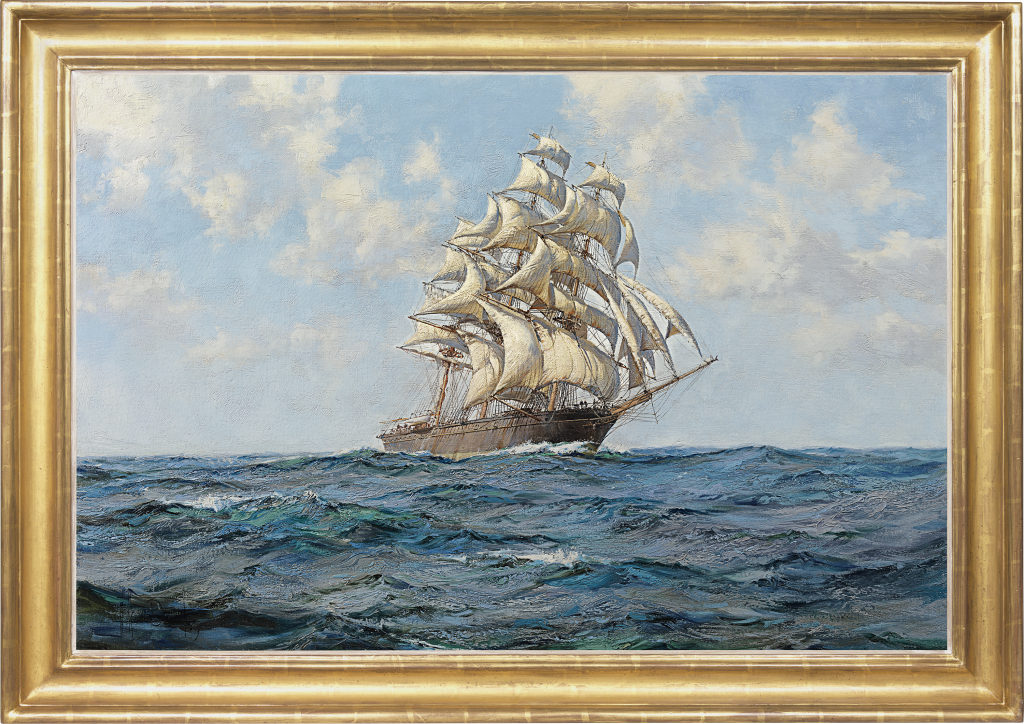
Blue seas - the Maitland
Signed lower left:
MONTAGUE DAWSON
Oil on canvas: 28 x 42 in / 71.1 x 106.7 cm
Frame size:
Painted circa 1959
Provenance:
Frost & Reed Ltd., London, inv. no.26229, purchased from the artist on 7th August 1959;
from which purchased on 18th August 1959 for £700 by a private collector, USA
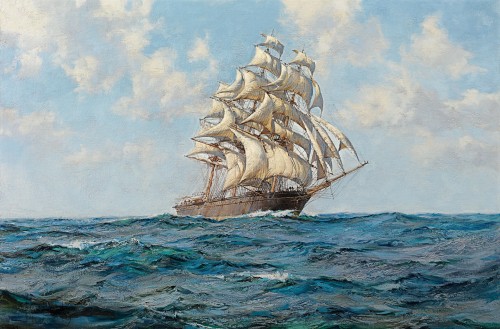
Montague Dawson captures the romance of the Victorian age of sail with this portrait of the tea clipper Maitland, scudding along with all sail set. Her towering sail plan is emphasised by Dawson’s adoption of a low viewpoint. Fine weather shows to advantage the beauty of the turquoise and royal blue waves and the pale blue, cloud-flecked sky.
Like the legendary clippers Ariel, Taiping and Thermopylae, Maitland was built at the height of the tea trade, when owners vied with each other to bring the new season’s tea to London as speedily as possible. Maitland was ordered by John Kelso of North Shields and built in William Pile’s yard at Sunderland. Launched on 2nd December 1865, she was registered at 799 tons and measured 183 feet in length with a 35 foot beam. Of composite construction, her planks were laid upon iron frames and her considerable beam provided good stability for her large and lofty sail plan. Maitland was highly unusual in that she had moonsails above standing skysail yards, adding to the elegant impression which she gave in a favourable wind.
Captain Coulson, Maitland’s first master, claimed a cracking speed of seventeen knots on her maiden passage. In 1869 she was credited with a speed of fifteen knots, but these figures were the exception rather than the rule. However, Maitland made Hong Kong eighty-seven days out of Sunderland on her first outward run, resulting in a prime tea cargo from the shippers at Foochow. She returned home in a speedy 104 days, fast but not remarkable.
Maitland survived the striking of the Ariadne Rock when leaving Woosung late in 1868. Repaired at Shanghai, she was back in service the following year, during which she claimed a record run of 22 ½ hours from Sunderland to the Downs while outward bound. Maitland came back home in a creditable 102 days against Thermopylae’s ninety-one days from Foochow to London.
In the Tea Race of 1870, in which twenty-seven ships participated, Maitland came joint fifteenth with Oberon and Taiping, taking 111 days; the leaders, Leander and Lahloe, took 98 days.
Like many of these handsome tea clippers, Maitland was short-lived. She was wrecked on a coral reef in the Huon Islands, north of New Caledonia, on 25th May 1874, while on a passage from Brisbane to China.
MONTAGUE DAWSON, RSMA, FRSA
Chiswick 1895 - 1973 Midhurst, Sussex
Montague Dawson was the son of a keen yachtsman and the grandson of the marine painter Henry Dawson (1811-1878). Much of his childhood was spent on Southampton Water where he was able to indulge his interest in the study of ships. For a brief period around 1910 Dawson worked for a commercial art studio in London, but with the outbreak of the First World War he joined the Royal Navy. Whilst serving with the Navy in Falmouth he met Charles Napier Hemy (1841-1917), who considerably influenced his work. Dawson was present at the final surrender of the German Grand Fleet and many of his illustrations depicting the event were published in the Sphere.
After the War, Dawson established himself as a professional marine artist, concentrating on historical subjects and portraits of deep-water sailing ships often in stiff breeze or on high seas. During the Second World War, he was employed as a war artist and again worked for the Sphere. Dawson exhibited regularly at the Royal Society of Marine Artists, of which he became a member, from 1946 to 1964, and occasionally at the Royal Academy between 1917 and 1936. By the 1930s he was considered one of the greatest living marine artists, whose patrons included two American Presidents, Dwight D Eisenhower and Lyndon B Johnson, as well as the British Royal Family.
The work of Dawson is represented in the National Maritime Museum, Greenwich and the Royal Naval Museum, Portsmouth.