SIR ALFRED MUNNINGS
Mendham 1878 - 1959 Dedham
Ref: CD 191
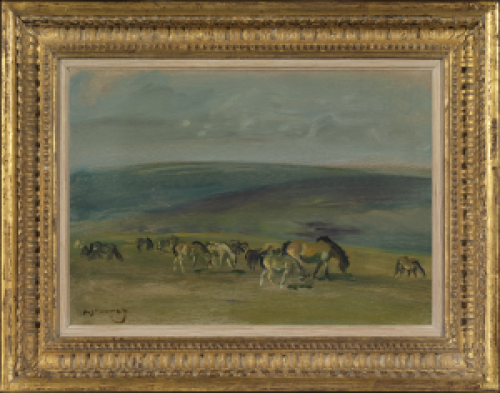
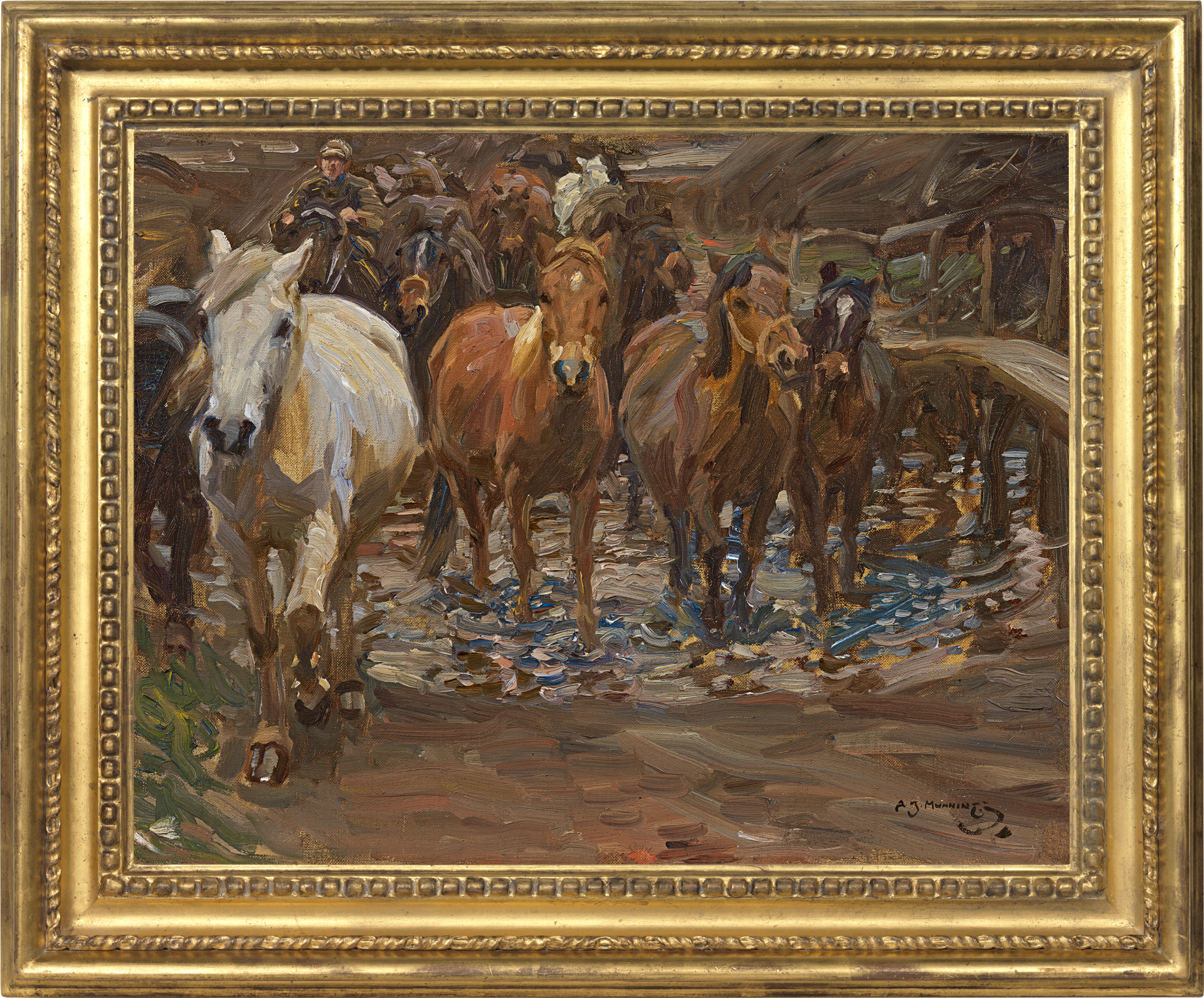
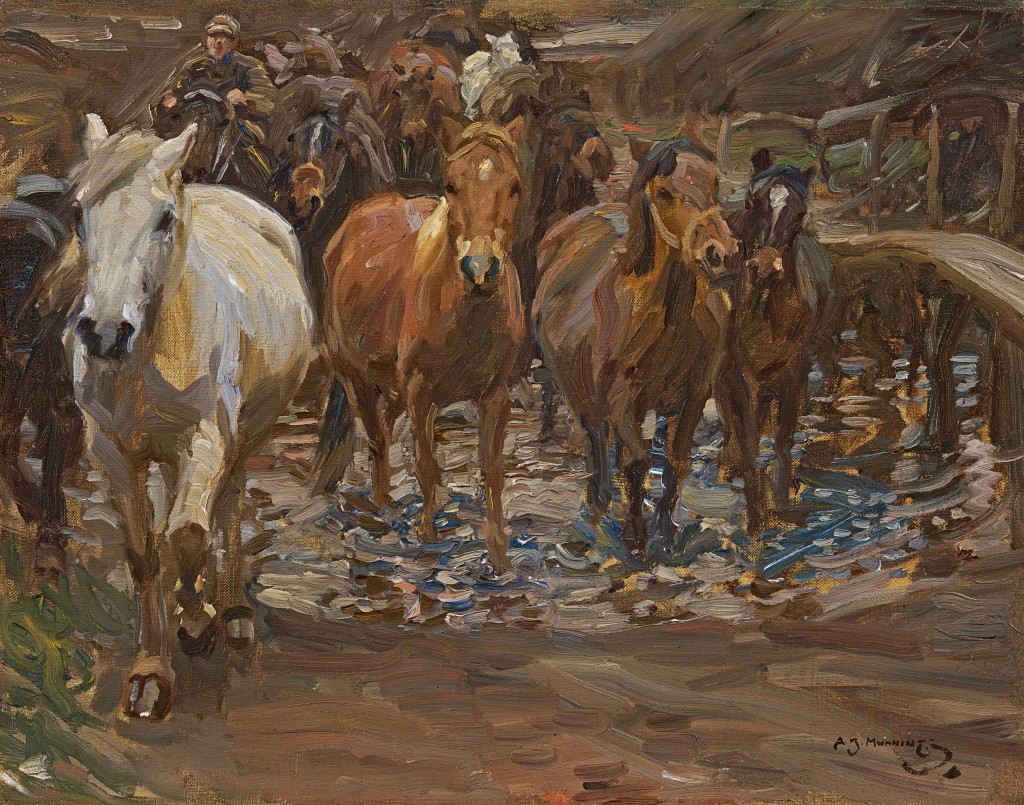
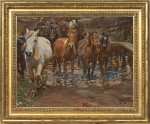
Ponies crossing a stream
Signed lower right: A.J. Munnings
Oil on canvas: 14 x 18 in / 35.6 x 45.7 cm
Frame size: 18 7/8 x 22 ¾ in / 47.9 x 57.8 cm
In an English style gilded hollow frame
Painted circa 1910
Provenance:
Pettus House, Elm Hill, Norwich (label on the reverse)
Private collector, UK, acquired as a gift circa 1950s;
by descent
Alfred Munnings explored the motif of ponies crossing a shallow stream in a number of works which culminated in The ford, his ambitious, five-foot Royal Academy exhibit of 1911, which to his disappointment was ‘skied’. The impetus for The ford series was a painting by Heinrich von Zügel which Munnings had seen on exhibition in Munich when on a trip with his early patron John Shaw Tomkins. He was especially impressed by Zügel’s picture of a peasant washing his cattle in the shallows of a stream, ‘a large, vigorous sketch done on the spot’[1]. Zügel’s painterly naturalism provided an intriguing counterbalance to the French Impressionism which influenced so many English painters in the first decade of the twentieth century.
The ford series was painted in late autumn 1910 at Munnings’s family home, Mendham Mill on the river Waveney, on the Norfolk-Suffolk border. Munnings set himself the challenge of painting a subject in subdued light and composing a group of horses in movement, head-on to the viewer, with all the attendant problems of foreshortening. As he recalled in the first volume of his autobiography, An Artist’s Life: ‘The grey-weather subject I prepared for was “The Ford” – grey water and dark reflections broken by lines of the current….Those models never ceased making motifs. Standing on rising ground, looking down on the lead ponies coming out of the water, I spaced the design – cutting out the sky….Ponies, water, reflections, filled the rest of the space. I still possess those five-foot studies. Looking at them now brings back the scene afresh. I hear myself shouting, “Hi! wake that dun horse; shove his head up!” or, to a boy with a pole, “Keep the water moving” ’[2].
The impetus of Ponies fording a stream is provided by the white horse on the left, which trots briskly forwards as if about to break the picture space. As so often in his works, Munnings makes a white horse the focus of his composition. Here he is Augereau, an animal which served the artist for several years and of whom he wrote that he was ‘the most picturesque of white ponies – an artist’s ideal’[3]. Bay and brown horses jostle together, delineated in lively, rapid brushwork, giving a sense of animal exuberance barely held in check by their human handlers. Munnings’s masterly control of tone evokes the grey, autumn day but also picks up the coloured shadows on the horses’ flanks and the gleams of colour in the churned-up river, with hints of midnight blue, pink and cream.
SIR ALFRED MUNNINGS, PRA, RWS
Mendham 1878 - 1959 Dedham
Born in Mendham, Suffolk, Alfred Munnings was the son of a miller. He was apprenticed to a firm of lithographers from 1893 to 1898 and studied at the Norwich School of Art and in Paris. There he was impressed with plein-air naturalism; this, together with his introduction to the racecourse in 1899, influenced the themes for which he became famous.
While in Mendham, Munnings painted many scenes of country life, particularly horse fairs. He went to Cornwall in 1911, and for many years was an important addition to the Newlyn School of artists. When the First World War broke out, Munnings enlisted, despite having the use of only one eye owing to an accident in 1899. He became an army horse trainer near Reading and later went to France as an official war artist, attached to the Canadian Cavalry Brigade.
The year 1919 was a major turning-point in all aspects of Munnings’s life; he painted his first racehorse, Pothlyn, the winner of the Grand National, and became an Associate of the Royal Academy. He met Violet McBride, whom he was to marry, and bought Castle House, Dedham, where the Munnings Memorial Trust maintains a permanent exhibition of his pictures. Munnings’s prolific career, spanning over sixty years, brought him honour, with election to the Presidency of the Royal Academy in 1944, a Knighthood in 1945, and a personal award from the Sovereign in 1947, when he was created Knight of the Royal Victorian Order.
[1] Sir Alfred Munnings, An Artist’s Life, London 1950, p.238.
[2] Munnings, op. cit., p.239.
[3] Munnings, ibid., p.199.