
CHARLES COLLINS
Dublin circa 1680 – 1744 London
Ref: CD 140
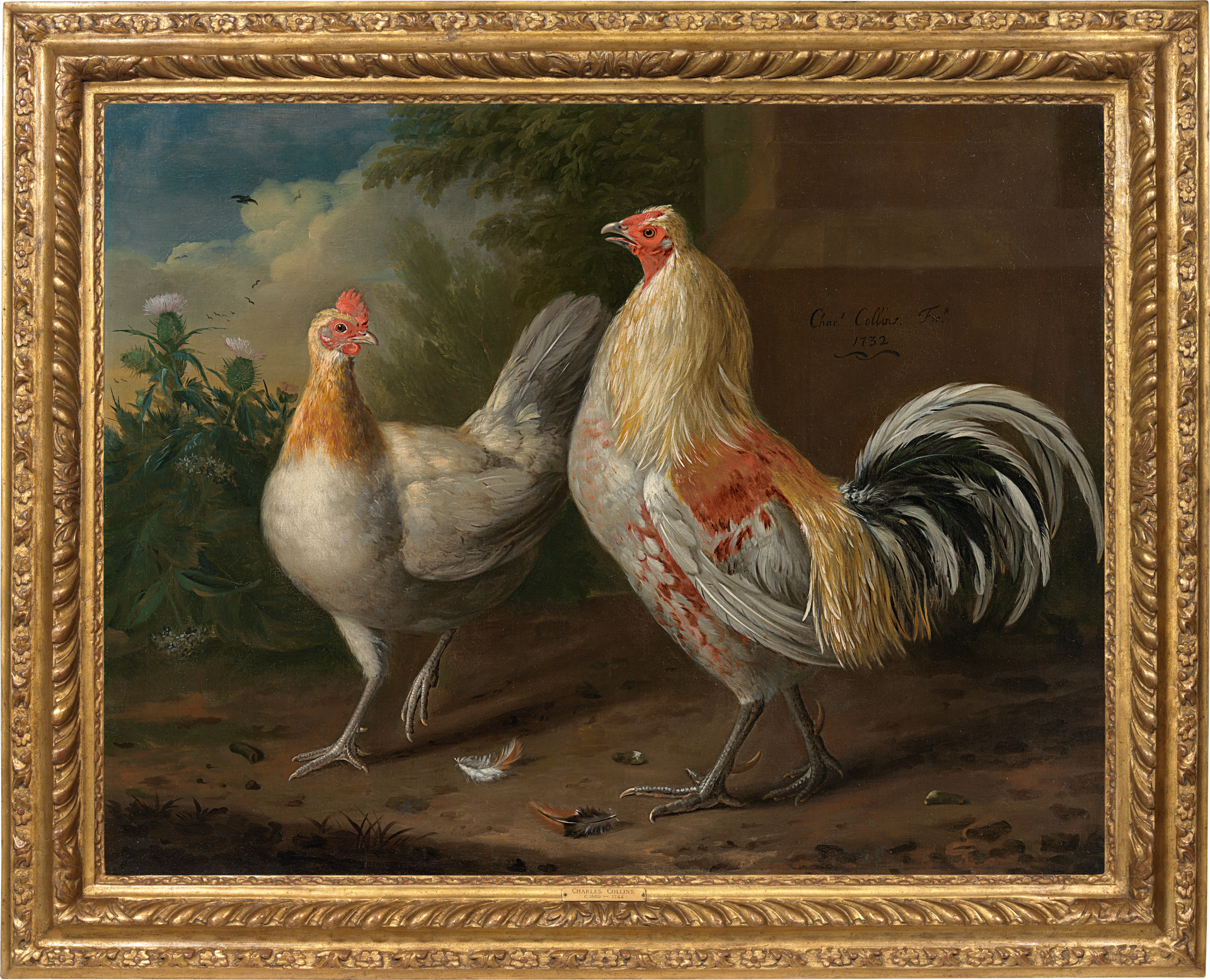
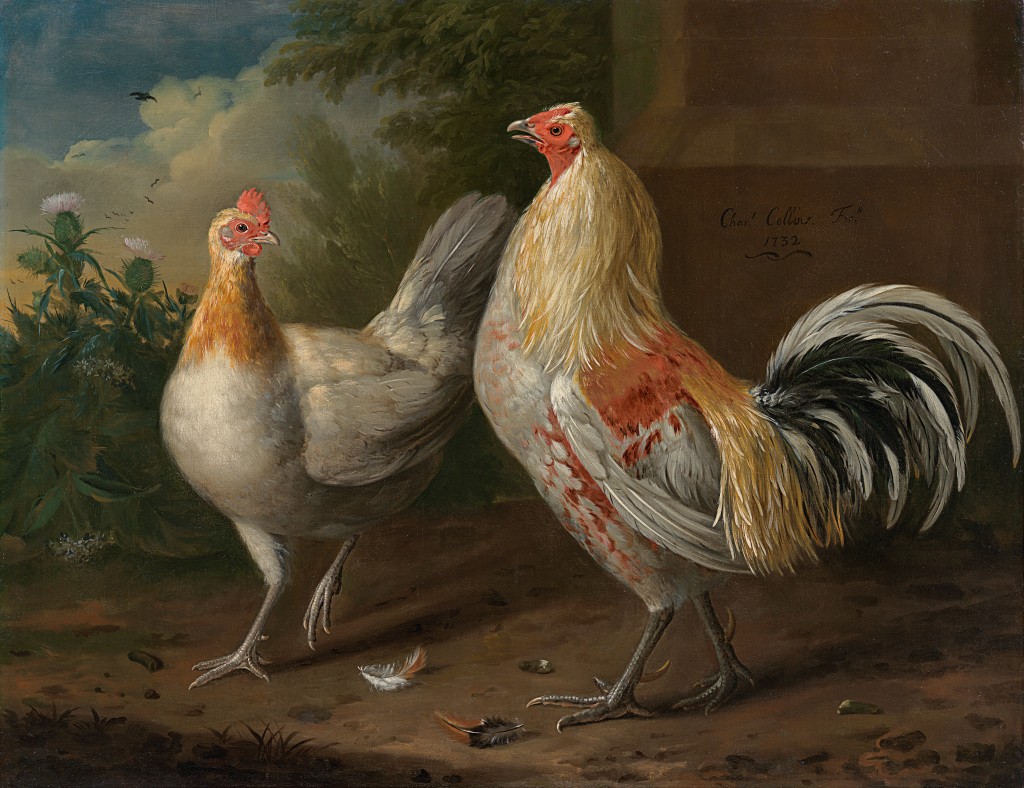
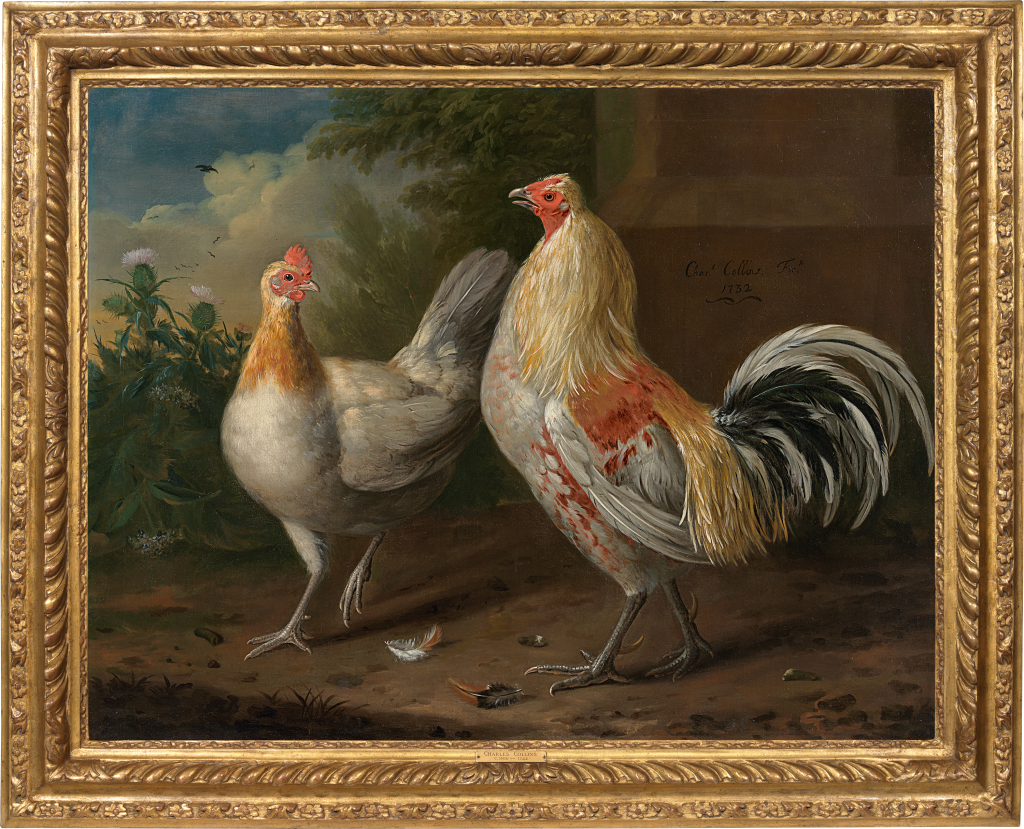
A sporting cockerel and a hen
Signed and dated upper right: Chr.s Collins Fecit / 1732
Oil on canvas: 27 ¾ x 36 in / 70.5 x 91.4 cm
Provenance:
Private collection, UK;
Bearnes, Hampton & Littlewood, Exeter, 29th June 1993, lot 750;
Richard Green Gallery, London;
private collection, USA
Exhibited:
London, Richard Green, Annual Exhibition of Sporting Paintings, 1993, no.2, illus. in colour
The Dublin-born artist Charles Collins followed in the tradition of bird painting made popular by seventeenth century Netherlandish artists such as Melchior de Hondecoeter (1636-1695) and the Hungarian Jacob Bogdani (1658-1724), who worked in Amsterdam in the mid-1680s before arriving in England in 1688. They were inspired by the ferment of interest in natural history in the seventeenth and eighteenth centuries, when there was a desire to depict, describe and classify birds and animals. Wealthy men put together collectors’ cabinets of naturalia and collected both live and taxidermied birds.
From 1737-9 Collins painted many birds from stuffed specimens owned by a Nottinghamshire Judge, Taylor White, who commissioned an extensive ‘Paper Museum’ of his collection, today held at McGill University, Montreal. He also made a number of works showing groups of British birds, carefully depicting both males and females. Some of these were engraved in 1736; nine of the oils are in the in collection of Anglesey Abbey, Cambridgeshire. The present Sporting cockerel and a hen, painted in 1732, predates these works but reflects Collins’s predilection for depicting birds in pairs. They would no doubt have been observed from life.
Collins tackles his subject with painterly bravura, lavishing attention on the light playing over the colourful feathers of the birds and capturing the feisty, commanding air of the cockerel. The cockerel’s comb and wattles have been removed, indicating that the bird was used for cockfighting. This was done to minimize a part of the bird especially vulnerable to injury. The ancient sport of cockfighting, banned in Britain from 1835, took advantage of the natural propensity of cockerels to fight for territory and to defend their hens. Heavy wagers were placed on which bird would be the winner and one successful in several fights would acquire a celebrity that might well demand a painted portrait. The birds in this work are the more imposing for being seen from a low viewpoint against a dramatic, wooded background. The finely-observed thistles at the left recall the ‘forest floor’ still lifes of the Dutch painter Otto Marseus van Schrieck (1619-1678).
CHARLES COLLINS
Dublin circa 1680 – 1744 London
Charles Collins specialized in bird and animal painting, reflecting the ferment of interest in natural history during the seventeenth and eighteenth century. Little is known of his early life, but he seems to have been born in Dublin and was described as an ‘Irish Master’ by the Dublin Evening Post in 1786. George Vertue noted that he ‘painted all sorts of fowl and game. He drew a piece with a hare and his own portrait in a hat’[1]. Collins was influenced by seventeenth century Netherlandish artists such as Melchior de Hondecoeter, Jan Weenix and Frans Snyders. His style is bold and painterly, with the birds given a vivid air of animation.
Collins worked both in oil and watercolour. A set of twelve oil paintings depicting carefully-observed groups of British birds in stylized Italianate landscapes formed the basis for the twelve engravings of Icones avium cum nominibus anglicis, published by Collins and John Lee in 1736 and engraved by Henry Fletcher and James Mynde. Nine of the original paintings are in the collection of Anglesey Abbey, Cambridgeshire, NT; the other three most recently sold at Christie’s on 11th June 2002, lot 44.
Collins made many studies from stuffed birds in the collection of the Judge and naturalist Taylor White of Wallingwells, Nottinghamshire. In 1737-9 he contributed 201 watercolours of birds, including a dodo, to White’s natural history ‘Paper Museum’ (McGill University, Montreal, Quebec). Thomas Pennant used Collins’s watercolour of a Buzzard (Cecil Higgins Art Gallery, Bedford) for an illustration in his British Zoology (1766). Collins also made still lifes, such as the Lobster on a Delft dish, 1738 (Tate Britain, London) and the Still life with game, 1741 (private collection). Charles Collins died in London in 1744.
The work of Charles Collins is represented in Anglesey Abbey, NT; the Courtauld Institute of Art, London; Tate Britain, London; the British Museum, London; the Cecil Higgins Art Gallery, Bedford; the National Gallery of Ireland, Dublin; McGill University, Montreal and the Minneapolis Institute of Arts.
[1] Anecdotes of Painting in England, vol. 2, p.122.