
CHARLES BROOKING
Deptford 1723-1759 London
Ref: CD 128
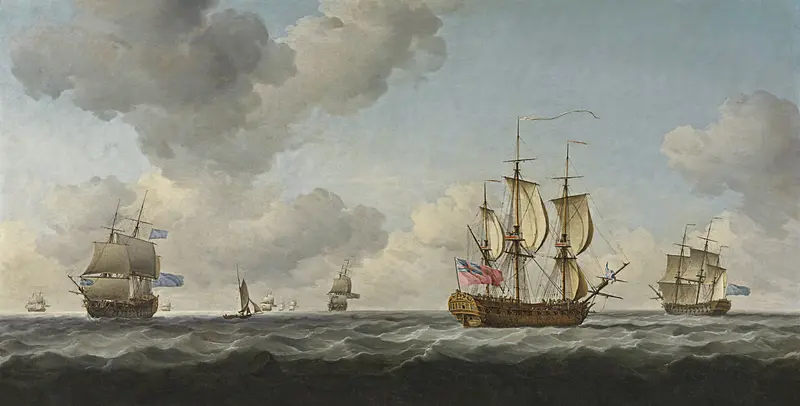
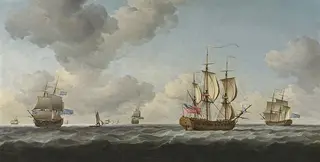
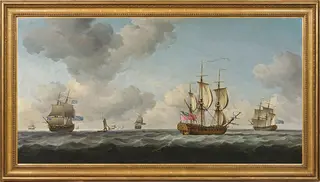
The Phoenix, 24 guns, encountering a squadron under a Rear-Admiral of the Blue in the Channel
Signed lower centre: C. Brooking
Oil on canvas: 28 5/8 x 55 ½ in / 72.7 x 141 cm
Frame size:
Painted circa 1745
Provenance:
Captain George L Cuming, Highfield Lodge, Jersey;
Frank T Sabin, by June 1956
Ivor Guest, 2nd Viscount Wimborne (1903-1967);
by descent
Literature:
David Joel, Charles Brooking 1723-1759 and the 18th Century British Marine Painters, Woodbridge 2000, p.158, no.254, illus.
Report by Brian Lavery
6th August 2025
The Composition
The vessel to the right of centre is clearly the main focus of the picture – apart from its position, it is the only one in sunshine, as shown by the whiter sails. The red ensign also tends to draw attention to it. The larger ship to the left is flying the flags of a rear-admiral of the blue, which makes identification easier. Apart from the small cutter on the left, all the other ships are flying the blue ensign which implies that they are part of the squadron under the rear-admiral, who would fly a blue flag from the mizzen mast.
Charles Brooking (1723-59)
Apart from the recognisable style, the artist can be identified by his signature on a buoy, which is characteristic.
In 1974 David Cordingly wrote,
What is remarkable about the original canvases is their sparkle and their astonishing sense of atmosphere. He shares with Constable the ability to fill a picture with a fresh breeze – a breeze which whips up waves, tightens ropes, puffs out sails and heels over ships and small boats. He has perfectly mastered the play of sunlight and shadow across the surface of the water, and his liquid green seas are alive with movement.
He was ‘…now generally regarded as the most gifted, and possibly the greatest, of all English marine artists.’ Only his early death prevented him achieving more prominence
The Setting
It is likely to be the English Channel. Many of Brooking’s paintings were set there, though it could also be the North Sea.
Similar sea conditions can be seen in other Brooking paintings, for example this one entitled ‘A naval squadron manoeuvering in a swell off Dover’.
There is possibly a dim view of a distant coastline in the background of the painting but it is difficult to be sure.
The wind, which is important in Brooking paintings, is coming from left to right in the picture. It is a fresh breeze.
Another pointer
Naval uniform for officers was introduced in 1748 at their request, but there is no sign of anyone wearing it on the quarterdeck of Vessel A, which suggests that it is set during the war of 1739-48.
The two figures on the right are presumably officers as they are not engaged in manual labour and seem to be in a position for supervising the movement of the ship. One of them is likely to be the captain, who would be on deck at a time when most of the crew were engaged in trimming sails etc
The Ships
Ten vessels can seen, all British warships except C which is a small cutter
Vessel A
This ship flies the red ensign so it is clearly not part of the squadron led by the rear-admiral. At first sight it looks like a frigate with a single deck of guns, a type which was introduced in the 1750s. Closer examination shows three ports below the full deck of guns.
This, and the 11 gunports above, would make it a 24-gun ship on the 1741 establishment, as shown in two models in the National Maritime Museum (SLR0461, SLR0476).
The smaller port, forward of the mast, was not used for guns but for loading stores. The other, much smaller ports are for oars.
Fifteen ships were built to this design, and six more to a revised version after 1745, but these were too late to enter service during that war. The 1741 establishment ships were:
Lowestoffe, entered service August 1942, sent to Mediterranean (Pr)
Aldborough, Feb 1742, to Orkney then America
Alderney, March 1743, to Lisbon
Phoenix, September 1743, Captain Brodrick
Sheerness, December 1743, commanded by the future admiral George Rodney. To Shetlands and then the English Channel under Sir John Norris. (Pr)
Wager, July 1744, North Sea then Newfoundland (Pr)
Shoreham, July 1644, commanded by Thomas Hanway, who could have had links with Brooking through his brother, one of the patrons of the Foundling Hospital. To Lisbon and Scotland under Byng (Pr)
Bridgewater, October 1744, in Channel and Scottish waters (Pr)
Glasgow, May 1745, coast of Scotland and Minorca
Triton, August 1745, anti-Jacobite (Pr) then America
Mercury, Feb 1746, with Boscawen’s squadron
Surprise, January 1746 (Pr)
Siren, November 1745, Anson’s fleet
Fox, May 1746, cruising
Rye, April 1746, Jamaica
Several of these ships (marked Pr) took privateers, which would presumably have been recorded in the painting if it represented any of these ships. Others served with fleets and convoys, which Ship A is clearly not doing, or served mainly in the Mediterranean or American waters.
The Phoenix
The Phoenix, commanded by Thomas Brodrick, was sent out ‘under secret orders’ in February 1743/4 (This is not recorded in Winfield’s British Warships 1714-1792 but is clear from the records). Britain was at war with Spain at that time, but not yet with France.
This is consistent with a ship sailing independently directly under Admiralty orders and therefore flying the red ensign. Such orders were quite rare and implied a good deal of trust in the officer concerned. Brodrick was probably selected because he was in a small, fast ship and was something of a hero. He had already carried out a reconnaissance of Brest and reported to the Cabinet on it. Brodrick’s service in the Phoenix is not mentioned in this extract from Charnock’s Biographia Navalis, but it is confirmed in logs and letters. His name was spelt in various ways.
Brodrick reported on his expedition to Cherbourg.
Therefore he would have been sailing eastwards from Plymouth towards Cherbourg on or shortly after 9 February 1743/4, probably with the prevailing wind behind him. After that he sailed eastward again, towards the Downs, where he met Admiral Norris’s fleet.
Log of the Phoenix
This shows the ship leaving Plymouth on the 3rd and arriving off Dover on the 18th. The course is East by North on the 17th and 18th and the wind is mostly west-south-west which would put it directly behind the ship as shown in the painting.
On 19 February they arrived at the Downs to meet Sir John Norris’s fleet, including Rear-Admiral William Martin of the Blue Squadron in the Sandwich.
Admiral Martin’s Squadron
William Martin was promoted to rear-admiral of the blue on 7 December 1743, the only one holding that rank at the time. After service in the Northumberland he was ordered to Portsmouth on 3 February 1743/4 (the same day as Brodrick’s orders) and hoisted his flag in the 90-gun Sandwich on the 6th. He sailed to join Admiral Norris’s fleet in the Downs, arriving on the 18th. Therefore he would have been sailing as part of a fleet under Norris, in the same direction as the Phoenix rather than tacking in the opposite direction, and probably not in sight, on the 17th and 18th. Therefore the picture, if that is indeed what it represents, has a fictional element, perhaps intended to show the freedom and nimbleness of a small ship compared with the lumbering ships of the line.
Details of Vessel A, the Presumed Phoenix
All the 24-gun ships of the 1741 establishment were built in private shipyards rather than Royal Dockyards. The Phoenix was ordered on 7 November 1742 from Thomas Graves of Limehouse, an established naval shipbuilder with a yard close to Deptford Dockyard from where the building could be supervised. There would be some information on her building in the Navy Board papers and it is possible that a contract for this or a similar ship might be found. It would give full details of the structure, but neither of these would add much to our understanding of the picture.
She was launched on 27 July 1743 and Brodrick was her first captain.
Detail from the ship’s plan
The type was made obsolete by the ‘true frigate’ design which began to enter service from 1757, in time to serve in the Seven Years War (1756-63). The lower deck guns were left out which allowed the ship to sink deeper in the water, lowering the centre of gravity and improving sailing qualities. Such a ship was depicted by Brooking in a drawing in the Mellon collection.
The Phoenix was converted to a hospital ship in 1757 and stationed at Tower Wharf, which might have given Brooking a chance to see her in her later state (but it would not account of the anomaly of the square tuck stern). She was disposed of in 1760.
The Plan
The original plan of the Phoenix shows internal detail. The lower deck gunports are marked A and B, the smaller entry port is marked C. D is the head of a pump, part of the internal detail.
Decoration
The stern decoration is similar in style to model SLR0476. The details varied from ship to ship, and carving was usually done under the auspices of the builder.
Not much can be seen of the figurehead, but it is probably the lion which was standard at the time.
Anomalies
The plans and models show vertical mountings for swivel guns.
There is no sign of these in the painting. However, there are several vague and otherwise unidentified shapes which might represent the guns themselves, lying at various angles.
Swivel guns on a frigate
The ship has a ‘square tuck’ stern, which was not usual in new ships after about 1735 and is not shown in the models or plan.
Both these features might suggest that the picture was done some time afterwards, partly from Brodrick’s memory.
The Crew
A ship of this type had a standard crew of 140 officers and men but they were often short-handed in wartime. A search of the Admiralty muster and pay books would reveal their names, but again it would not help much with our understanding of the picture. Many of the crew are assembled on the forecastle perhaps to work with the anchors or trim sails.
Other members of the crew can be seen on the quarterdeck, presumably reducing or trimming sail.
But it seems unlikely that sail is being reduced as there are no men aloft to furl them apart from a few in the tops, presumably lookouts.
The Other Ships
Vessel B
This is a three-decker ship of the line, probably a 90-gun second rate as a rear-admiral would not be allocated a 100-gun first rate. The forward gunports on the lower deck are closed, presumably to prevent the ingress of water in a lively sea. This makes it difficult to count the gunports, but the middle deck appears to have 13. This is consistent with all the 90-gun ships of the period – Sandwich launched 1712, Prince George (rebuilt 1723), Union (rebuilt 1726), Namur (rebuilt 1729), Neptune (rebuilt 1730), Marlborough (rebuilt 1732), Duke (rebuilt 1739) and St George (rebuilt 1740). Rebuilding at that time was virtually equivalent to a new ship.
It has an ‘open’ stern gallery which was quite common in the second quarter of the century.
It is not possible to identify the figurehead but it could be of the ‘double equestrian’ type with two horses’ heads.
Vessel C
This is similar to the boat shown in Serres’s Liber Nauticus of 1805. Its well known that Serres had worked with Brooking. Its function here is unknown but it is possible that it is a ship’s boat carrying a message from the admiral to Ship A.
Vessel D
Probably a 20-gun ship, low in the water and with a single deck of guns.
Vessel E, F, G, H
Too distant to be identified. All flying the blue ensign so part of the same squadron.
Vessel I
Apparently a two-decker ship of the line.
Vessel J
A two-decker ship of the line. The only one sailing on the port tack, presumably to go about at the first opportunity and follow the other ships. It is probably a 60-gun ship, a very common type in the 1740s.
Sails and Rigging
All the vessels except the cutter C have the standard ship rig of the time, with three masts, all square rigged and a triangular or quadrilateral mizzen sail aft. This is illustrated most clearly on Vessel J.
The topgallant sails are furled on all the ships, which would be normal in a fresh breeze. The mainsail or course is also tightly furled, which would be normal on a ship sailing before the wind as with A, so that it did not mask the foresail. It is also furled on all the other ships, which would be less necessary.
Ship B has the triangular mizzen sail, with part of it forward of the mast. On ship J the forward triangular part of the sail is cut off, which became standard in the 1740s. The mizzen sail is tightly furled on Vessel A as it would not be needed when sailing before the wind. The position of the ensign makes it difficult to be sure if it has the old-style sail, but most likely not.
The spritsail was hung from the yard attached to the bowsprit (seen furled on Vessel J) and was rarely used. There is no sign on any of the ships of other sails - jibs and staysails, which were just coming into use. They could have been useful when sailing close to the wind, but they are clearly not being used on Vessel C or Vessel J. They would not have been useful on Vessel A. It is impossible to tell with the others.
Conclusion
The established title ‘The Channel Fleet at Sea’ is only partly accurate. The ships flying the blue ensign are indeed probably a squadron of the Channel Fleet, but the main focus is in the ship with the red ensign which is clearly not part of that fleet.
The picture shows a light, relatively fast vessel on an independent mission, in contrast to lumbering ships of the line and their escorts constantly under the orders of an admiral. And the 24-gun ship is ‘running free’ with the wind behind her while the others make very slow progress. It seems likely that the picture is a celebration of the qualities of the Phoenix or a similar ship, and the status of her captain.
Brian Lavery is a maritime history expert who worked for sixteen years in museums, starting at Chatham Historic Dockyard and then at the National Maritime Museum, Greenwich, where he is currently a Curator Emeritus. He has published extensively on sailing ships of the seventeenth to nineteenth centuries, as well as nineteenth and twentieth century ships and navies. He was awarded the Desmond Wettern Maritime Media Award in 2007 and the Anderson Medal of the Society for Nautical Research in 2008.
CHARLES BROOKING
Deptford 1723-1759 London
Despite his short life, Charles Brooking was one of the most influential British marine painters of the eighteenth century. His best work was achieved in the final decade of his life. Brooking excelled at painting shipping in calm conditions, using luminous glazes to give a sense of light on sails moving gently in the lightest of breezes, subtle cloudscapes and the shifting hues and reflections of the sea. He was influenced by Willem van de Velde the Younger and Peter Monamy, but forged his own highly individual style which in turn influenced Dominic Serres the Elder (who may have been his pupil) and Francis Swaine.
Charles Brooking was born in Deptford in 1723, probably ‘bred in some department of the dockyard’; his father may have been the Charles Brooking who was a painter and decorator at Greenwich from 1729 to 1736. He is likely to have been self-taught. Two small marine paintings in a private American collection are signed C. Brooking aged 17 years. In 1752 he worked as a botanical draughtsman for John Ellis’s (?1710-1776) Natural History of the Corallines (1755). Brooking is said to have worked for a dastardly picture dealer in Leicester Square, who concealed his identity so that clients would not be able to commission him directly. However, his paintings portraying the exploits of the ‘Royal Family’ privateers were engraved and published in 1753, the same year as Morning, and in 1754 Taylor White, Treasurer of the Foundling Hospital, commissioned the great sea-piece Flagship before the wind under easy sail (still in situ at the Foundling Museum, London). Brooking, like the other artists who contributed to the Foundling Hospital’s decoration, was made a Governor for his pains.
Brooking depicted naval actions from the War of Jenkins’ Ear, 1739, although he never painted a fleet action. His paintings were informed by a thorough knowledge of the sea; he owned a small cutter, a plan for which survives in the Chapman Collection of the Sjohistorikas Museum, Stockholm. Brooking’s output was limited by the consumption which slowly killed him. He died aged only thirty-six in London in 1759, leaving his family destitute. His widow and children were allocated 10 gns from the profits of the Society of Artists’ exhibition of 1761.
The work of Charles Brooking is represented in the National Maritime Museum, Greenwich; Tate Britain, London; the Foundling Museum, London; the Royal Naval Club, Portsmouth; the National Gallery, Dublin; Glasgow Museum and Art Gallery; Yale Center for British Art, New Haven, CT and Bowdoin College Museum of Art, Brunswick, Maine.