PIETER CASTEELS III
Antwerp 1684 – 1749 Richmond
Ref: CC 233
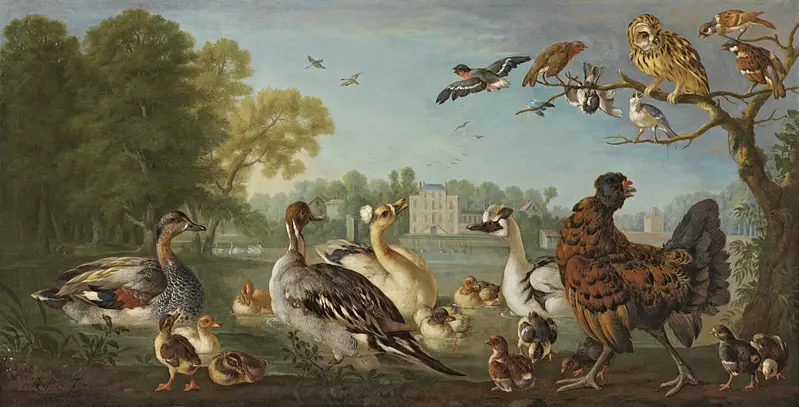
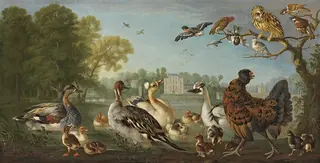
A bird piece with Alexander Pope's Villa at Twickenham
Signed and dated lower left: PCasteels . F - / 1729 (PC in ligature)
Oil on canvas: 27 5/8 x 53 7/8 in / 70.2 x 136.8 cm
Frame size: 35 ½ x 62 in / 90.2 x 157.5 cm
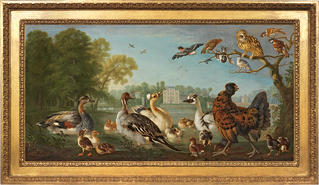
In an English William Kent style carved and gilded frame
Provenance:
Commissioned by Alexander Pope (1688-1744) for his Villa in Twickenham, circa 1729[1];
by inheritance to Martha Blount (1690-1763), London and Mapledurham House, Oxfordshire;
by descent to her nephew Michael Blount (1719-1792), Mapledurham House
Possibly in the collection of David Garrick (1717-1779), Twickenham[2]
Collection of Mrs Goodrich, London, circa 1895;
by descent to her great-grandchild, UK
Literature:
Maynard Mack, The Garden and the City: Retirement and Politics in the Later Poetry of Pope, 1731-1743, Toronto 1969, Appendix B, p.252 (as A Duck Piece, hanging in the Great Parlour)
On loan to Mottisfont Abbey, Hampshire, National Trust, 2002-2024
This painting was commissioned by the poet Alexander Pope (1688-1744) c.1739 and took pride of place in the Great Parlour of his Villa at Twickenham. From its shape, it was probably an overmantel. Antwerp-born Pieter Casteels III was a celebrated bird and flower painter who came to England in 1708 with his brother-in-law, the landscape painter Peter Tillemans[3]. Casteels flourished in the Anglo-Netherlandish cultural milieu of early Georgian England, his clients including the 10th Earl of Derby.
Alexander Pope settled at Twickenham, on the Thames west of London, in 1719. Frail, complex, acid-tongued and tender, he was a ‘celebrity poet’ by the time that he was in his twenties, famous for The Rape of the Lock (1712) and his verse translation of Homer’s Iliad (1715). However, as a Roman Catholic, Pope was an outsider in Protestant Hanoverian England, unable, like his co-religionists, to attend university, stand for Parliament, serve in the Army, or even live within ten miles of Westminster. His response was to live in leafy retirement on the banks of the Thames, existing for virtue, friendship and art. He could not resist, however, plunging into literary and political spats. Works such as the Epistle to Dr Arbuthnot (1735) and the Dunciads (1728-43) are excoriating satires on Whig hegemony – personified by the hated Prime Minister Robert Walpole – and cultural decay, which still dazzle with wit three centuries after the issues at stake have long been forgotten.
Casteels places his birds on the opposite side of the Thames from Pope’s Villa, which appears in the centre distance of the composition. The foreground frieze of fowl includes, left to right, a female mallard, a pintail, a fancy duck, a smew and a cockerel, with their various offspring. Above, a tawny owl sits on a branch, surrounded by a bullfinch (which flies off in fright, minus three tail feathers), a robin, bluetits and male and female sparrows[4]. The birds on the tree reference the theme of the Concert of birds which was popular in seventeenth century Flanders, for example Frans Snyders’s painting of 1629-30 which is today in the Museo del Prado, Madrid. (Casteels painted a Concert of birds with a mansion in the background in another work of 1729)[5]. The Prado painting depicts a wise owl holding a music manuscript from which all the other birds sing in harmony. The motif has its origin in thirteenth century Franciscan beliefs associated with the reverence of the Virgin Mary as Our Lady of the Birds.
Although Pope was not a particularly devout Catholic, there may be an echo of this iconography in his commission to Casteels. The Grotto which he built beneath his villa did, after all, include stones carved with the Crown of Thorns and the Five Wounds of Christ, imagery which would not have featured in contemporary Protestantism[6]. The notion of birds singing in harmony has obvious parallels – noted as well by Classical poets – with the craft of poetry. However, not all is peace in Pope’s avian world. The painting also references The Owl and the Birds by the fifth century BC fabulist Aesop, where the owl tells the other birds to beware of various seeds which will grow into plants that will harm them. The birds mock her, but when the inevitable comes to pass, revere her for her wisdom. Among the seeds is that of mistletoe, which is made into sticky birdlime and smeared on twigs to trap birds. This has happened to the bullfinch in Casteels’s painting, which flies off in terror, leaving behind three feathers. The commission alludes to the disharmony of literature and politics in Pope’s day, intruding into the Eden which he had created at Twickenham. Like Aesop’s owl, which ponders the folly of her race but gives advice no longer, Pope withdraws from the conflict into his rural retreat.
Pope made major alterations to the villa which he leased in 1719, designing, with the help of James Gibbs, a three-storey dwelling with slightly lowered and recessed wings. It was inspired by Palladian villas of the Veneto and the English Classicism of Inigo Jones. Clearly visible in Casteels’s painting is the entrance to the Grotto in the basement storey, with stairs leading up to the piano nobile. In front of the house was the Hampton Court to London road and then a further greensward running down to the river, which belonged to the poet. The Grotto (the only part of Pope’s Villa which survives today) ran under the house, leading at the back to a garden which was a delicious balance of order and wildness: ‘a little bit of ground of five acres, enclosed with three lanes…Pope had twisted and twirled and rhymed and harmonized this, till it appeared two or three sweet little lawns opening and opening beyond one another, and the whole surrounded with thick impenetrable woods’[7]. The Grotto, where Pope liked to work, was studded with shells, crystals, hidden mirrors and light sources, and threaded with secret springs, so that the sound of water and the glitter of minerals must have worked powerfully on the imagination of the poet and the many friends which he invited to visit his home.
When Pope died in 1744, his villa became a shrine for his admirers. Sadly, it was altered and vulgarised by the next owner, Sir William Stanhope, who added the two broad, polygonal wings which can be seen in Samuel Scott’s painting of c.1760 (Orleans House Gallery, Twickenham)[8]. Casteels’s painting is one of comparatively few that shows the villa in its original state. Pope’s Villa was demolished in 1807 by Baroness Howe, who was said to be ‘tired of [the] intrusions on her privacy’[9] occasioned by being the owner of the house of an English poetic icon. The spirit of Pope and his enviable Thames-side retreat however lives on in the painting that he commissioned for one of the chief rooms of his Villa, the Great Parlour, which led to the balconied portico facing the river. As a contemporary poet, James Thomson (1700-1748) described in a different context, Pope enjoyed
‘An elegant Sufficiency; Content,
Retirement, rural Quiet, Friendship, Books,
Progressive Virtue, and approving HEAV’N’[10]
Note on the provenance
After Pope’s death, the contents of his Villa were inherited by Martha Blount (1690-1763). For decades Pope maintained an amitié amoureuse with Martha and her sister Teresa, Catholic members of the minor gentry, like Pope himself. Initially Teresa, blonde and confident, was the favoured one. Later, Pope transferred his affection to the dark-haired, intelligent but shy Martha. She was the muse for many of his poems. Comparative lack of fortune consigned the Blunt sisters to spinsterhood. Pope’s ill-health, crooked frame and tiny stature ensured that romance – and he wrote wonderfully about love – remained in the realm of his imagination only. A pastel portrait of Martha was one of his treasured possessions in the ‘Chinese Room Fronting the Thames’ at the Villa[11].
On Martha’s death in 1763, her possessions, including the Casteels, were inherited by her nephew Michael Blount of Mapledurham House, Oxfordshire. He arranged for a sale of her goods. The painting is next recorded in the possession of Mrs Goodrich around 1895, in whose family it has descended.
PIETER (PETER) CASTEELS III
Antwerp 1684 - 1749 Richmond, Surrey
Pieter Casteels specialised in painting decorative arrangements of birds and flowers; following the death of Jacob Bogdani in 1724, he became the leading painter of this genre. Casteels was born in Antwerp in 1684, the son of the painter Pieter Casteels, with whom he trained. The younger Pieter came to England in 1708 accompanied by his brother-in-law, the landscape painter Peter Tillemans. Apart from a brief return to Antwerp in 1713 to enrol as a master of the painters’ guild, Casteels remained in England for the rest of his life. He became a member of Sir Godfrey Kneller’s Great Queen Street Academy in 1711 and a member of the Rose and Crown Club.
Casteels’s flowerpieces and bird subjects commanded a large clientele and were often conceived as part of a decorative scheme to be used as overdoors or overmantels. The decorative function of these works dictated their proportions and Casteels’s compositions often have a low viewpoint, designed to be seen from below. He also painted small history paintings with architectural settings. Casteels moreover had a flourishing business as an art dealer, importing paintings from Europe for clients including James Stanley, 10th Earl of Derby.
In 1726 Casteels etched a set of twelve prints of birds after his own designs, which sold successfully. In 1730 he made a series of flower paintings in collaboration with the engraver Henry Fletcher and the Kensington nurseryman Robert Furber. The Twelve Months of Flowers depicted plants that could be bought in Furber’s nursery; 457 copies of the set of prints after Casteels’s paintings were sold at 2gns each, and the trio followed the venture with Twelve Months of Fruit (1733).
Casteels retired from painting in May 1735 and spent the rest of his life as a designer of calico patterns, first at Martin Abbey, near Tooting, and later at Richmond, Surrey. He died in Richmond on 16th May 1749.
The work of Pieter Casteels is represented in Leeds City Art Gallery; the Fitzwilliam Museum, Cambridge; the Bowes Museum, Barnard Castle, Co. Durham; the Von der Heydt Museum, Wuppertal and the Yale Center for British Art, New Haven, CT.
[1] Probably listed as A Duck Peice in Ditto [Gold Frame] in the ‘Inventory of Pope’s Goods Taken after his Death’, 30th May 1744, as hanging in the Great Parlour of Pope’s Villa. The original MS was at Mapledurham. See Mack, op. cit., p.252.
[2] An Arnold & Co. (Fine Art Restorers London) label previously attached to the reverse of the painting cites Garrick’s Lodge or Stables, although this may be a misidentification of the house in the right background, which is actually Lady Ferrers’s Summer House.
[3] Casteels may have been inspired by Tillemans’s The prospect of the River Thames at Twickenham, c.1724-30 (Orleans House Gallery, Twickenham), which shows the same stretch of river with Pope’s Villa prominently depicted.
[4] I am grateful to David Dallas for his identification of the birds and his suggestion about the birdlime.
[5] Oil on canvas: 23 ¾ x 43 in / 60.3 x 109.2 cm. Christie’s New York, 4th October 2007, lot 64.
[6] See Mack, ibid., p.63.
[7] Horace Walpole to Horace Mann, 20th June 1760, quoted in Mack, ibid., p.26.
[8] Illustrated in Mack, ibid., p.18.
[9] Mack p.17, note 16.
[10] Spring, 1161-62, 1164.
[11] Mack, p.246.