JACOB BOGDANI
Eperjes 1658 - 1724 London
Ref: CD 167
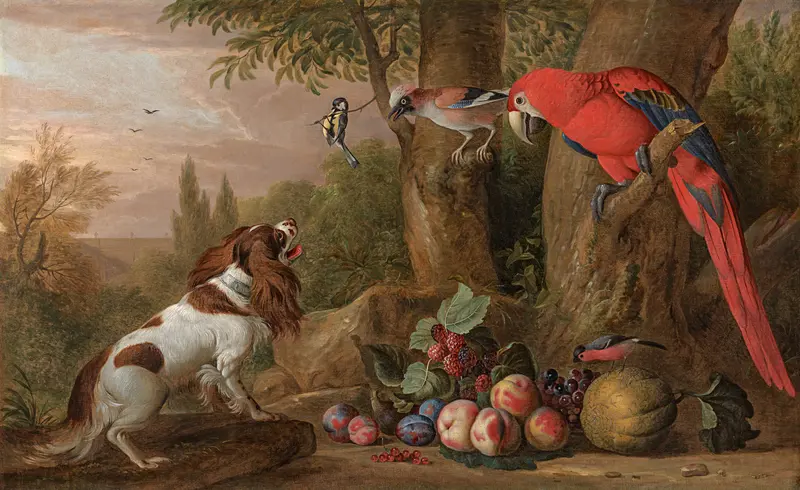
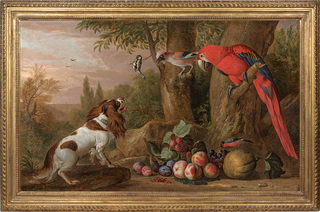
A King Charles spaniel with a scarlet macaw, jay and blue tit, with fruit in a park landscape
Signed lower left: J. Bogdani
Oil on canvas: 32 1/8 x 52 ½ in / 81.6 x 133.4 cm
Frame size: 39 x 59 in / 99.1 x 149.9 cm
Painted circa 1710
Provenance:
Private collector, UK, acquired in the late 1970s
Exhibited:
London, Richard Green, Jacob Bogdani c.1660-1724, no.11, illus. in colour (lent by a private collector, UK)
Born in Eperjes, northern Hungary (the present-day Presov, Slovakia), Jacob Bogdani brought an element of Mitteleuropean baroque grandeur to English painting. He spent two years, 1684-86, in Amsterdam, arriving in London by 1688, the year that put ‘Dutch William’ on the English throne. Bogdani established himself as a painter of flowers and fruit, but in the first decade of the eighteenth century began to produce bird paintings, perhaps inspired by the magnificent Windsor aviary belonging to Admiral George Churchill (1654-1710), the Duke of Marlborough’s brother. Churchill was one of his most important patrons; he also worked for William III and Mary II, and Queen Anne.
This work, which was probably intended as an overmantel, showcases Bogdani’s skill at painting still life, birds and animals, set within an atmospheric landscape. The mansion in the background is perhaps inspired by the long, baroque façade of William III’s state apartments at Hampton Court, designed by Christopher Wren from 1689. The elements of the composition reflect the aspirations of the Stuart élite. King Charles spaniels, named after Charles II (reg. 1660-85), retained their aristocratic popularity long after his reign. Aviaries of exotic birds, such as the magnificent scarlet macaw (Ara ararauna) to the right of this painting, reflected a courtier’s status. Originally brought back by Dutch sailors in the seventeenth century from South America, macaws were prized for their brilliant plumage and, if kept as pets, for their sociable nature and ability to mimic human language. This macaw is based on one studied in Admiral Churchill’s aviary, for it is shown in exactly the same position in Birds and deer in a landscape, c.1708-10 (Royal Collection Trust), one of eight paintings that Bogdani created for Churchill’s aviary and which were bought by Queen Anne from Churchill’s executors[1].
The luscious still life of fruit likewise gives a subtle indication of wealth and discernment. The seventeenth and early eighteenth centuries saw an increasing interest in, and expertise in, horticulture, with exotic fruit such as pineapples becoming luxury additions to the diet of the rich. Whereas the black mulberries in this work had been acclimatized in England since Roman times, melons (originally from India and Africa) are tender and at this period could only be grown in hotbeds, a mixture of straw and manure which gives off heat as it decomposes. They were scarce and expensive to produce. Peaches were sensitive to the English climate and were generally grown espaliered against south-facing brick walls of kitchen gardens: sometimes the wall was double, with a central cavity which could be heated with brushwood to keep off the frost. With its brilliant colouring and exquisite attention to detail, Bogdani’s painting evokes the luxury and confidence of late Stuart England.
JACOB BOGDANI
Eperjes 1658 - 1724 London
Jacob Bogdani was born in Eperjes in the County of Sáros, northern Hungary (the present day Presov, Slovakia), the son of Lewis and Susanna Bogdani, who were probably minor gentry. The threat from the Turks, who besieged Vienna in 1683, and the difficulties faced by the Protestant Bogdani living in a corner of the Catholic Austro-Hungarian empire, sent the young man westward. He worked in Amsterdam from 1684 to 1686, sharing a house with the Hamburg still life painter Ernst Stuven (c.1657-1712). He had settled in London by 1st June 1688 and became known as ‘The Hungarian’. Bogdani lived in the Covent Garden area for the rest of his life, marrying Elizabeth Hemmings in 1693.
For a decade or more after settling in England, Bogdani specialised in still lifes of fruit and flowers. In 1694 he supplied flowerpieces (now lost) for Queen Mary’s Looking Glass Closet in her beloved Water Gallery at Hampton Court, complementing the exquisite carved flowers and fruit provided by Grinling Gibbons. Charles Hatton commented in 1697: ‘I was this afternoon to see ye few best plants yet remaining ye noble collection of plants at Hampton very well painted by one Bugdan, a Hungarian and excellent painter of fruits and flowers’. Among the works were ‘very fine tulipps, painted from tulipps growing in my Lord Dovers garden [at Cheveley near Newmarket]’. In 1698 the 1st Duke of Devonshire bought flowerpieces from Bogdani for the decoration of his new country house, Chatsworth.
Around 1691 Bogdani explained his working methods: ‘He paint[s] in the Spring flowers & in the Somer flowers & Fruits when they are out Lobsters and oyster pieces. In the Winter pieces of Fowell & plate’. The production of bird pieces gradually became a greater part of his oeuvre. A number were owned by Admiral George Churchill, younger brother of the Duke of Marlborough and Ranger of the Great and Little Park at Windsor, who built a celebrated aviary near his house. Churchill’s exotic birds were undoubtedly a great inspiration to Bogdani, who must have made detailed studies, in oils or perhaps in watercolour, upon which he based his deft assemblages of birds.
Queen Anne acquired several of George Churchill’s bird paintings by Bogdani after the Admiral’s death in 1710; they remain in the Royal Collection. Her brother-in-law William III bought works by Bogdani for his palace at Dieren in Holland; William’s favourite Arnold van Keppel, Earl of Albemarle, had twenty-two Bogdanis at his Huis de Voorst near Zutphen. Bogdani’s patrons also included Edward Harley, 2nd Earl of Oxford and Sir Robert Walpole. Bogdani prospered in England, amassing property at Finchley, Spalding in Lincolnshire and Hitchen in Hertfordshire, becoming Lord of the Manor of Hitchen.
Bogdani’s daughter Elizabeth married the Transylvanian still life and bird painter Tobias Stranover (1684-1756), who worked in Bogdani’s studio. Bogdani’s son William was also trained by him as an artist, although he later took a post with the Board of Ordnance and became a Fellow of the Royal Society and the Society of Antiquaries and a member of the Spalding Gentlemen’s Society. Jacob Bogdani died at his house in Great Queen Street, Lincoln’s Inn Fields, in 1724. By a quirk of fate, some of his fortune eventually trickled down to the great landscape painter John Constable, as Bogdani’s grandson William Maurice Bogdani married Deborah Rhudde, kinswoman of Constable’s formidable grandfather-in-law, Dr Durand Rhudde, Rector of East Bergholt.
The work of Jacob Bogdani is represented in the British Royal Collection; the Victoria & Albert Museum, London; the Fitzwilliam Museum, Cambridge; Chatsworth House, Derbyshire; Nottingham Castle Museum; the National Gallery of Hungary, Budapest and the Yale Center for British Art, New Haven, CT.
[1] Oil on canvas: 79 ¼ x 112 ½ in / 201.3 x 285.6 cm, inv. RCIN 406686.