


SIR WILLIAM RUSSELL FLINT RA PRWS
Edinburgh 1880 - 1969 London
Ref: CD 172
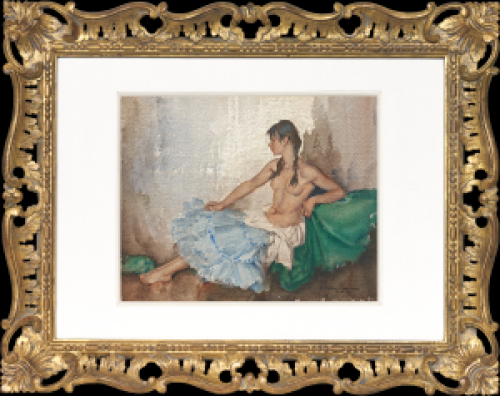
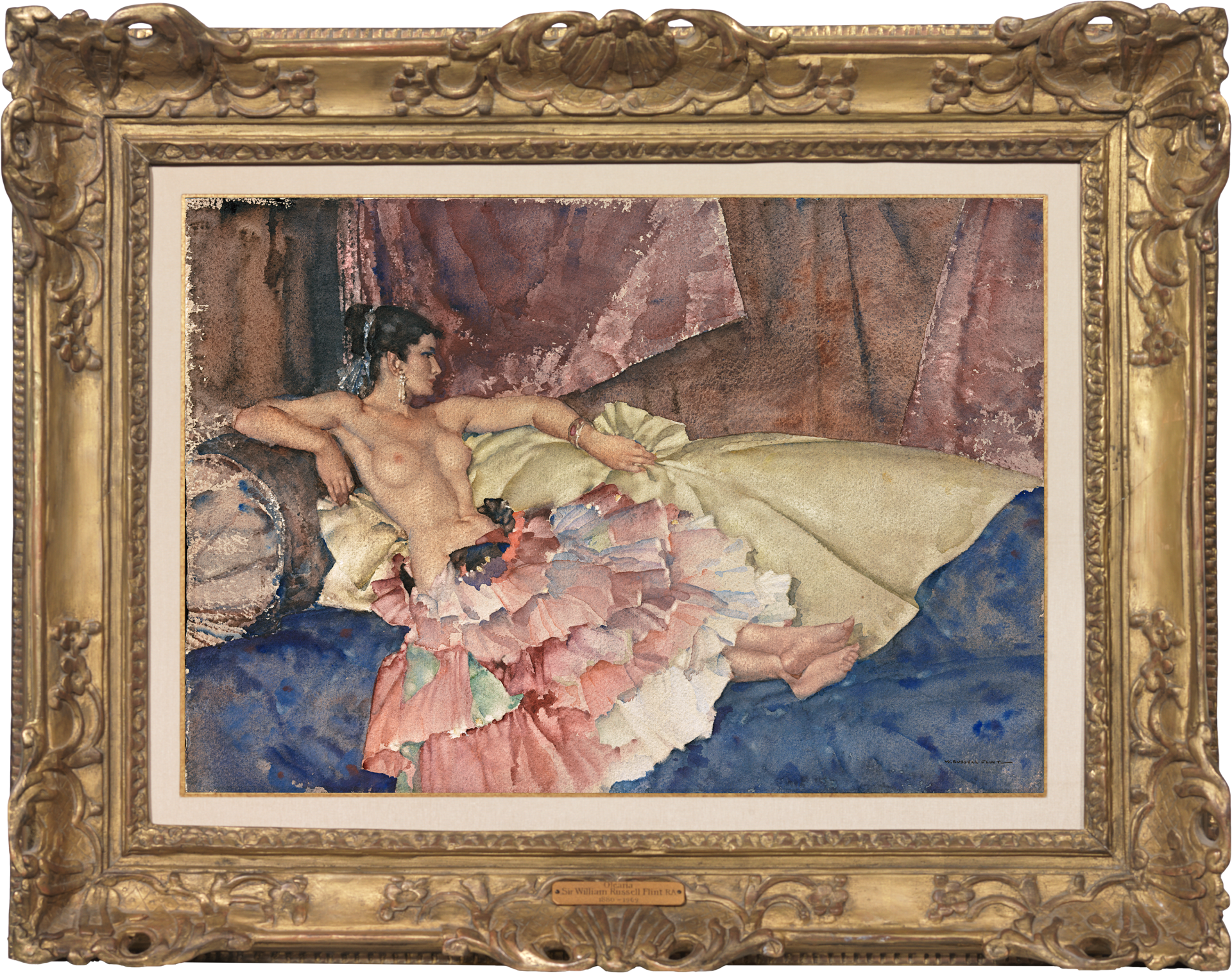
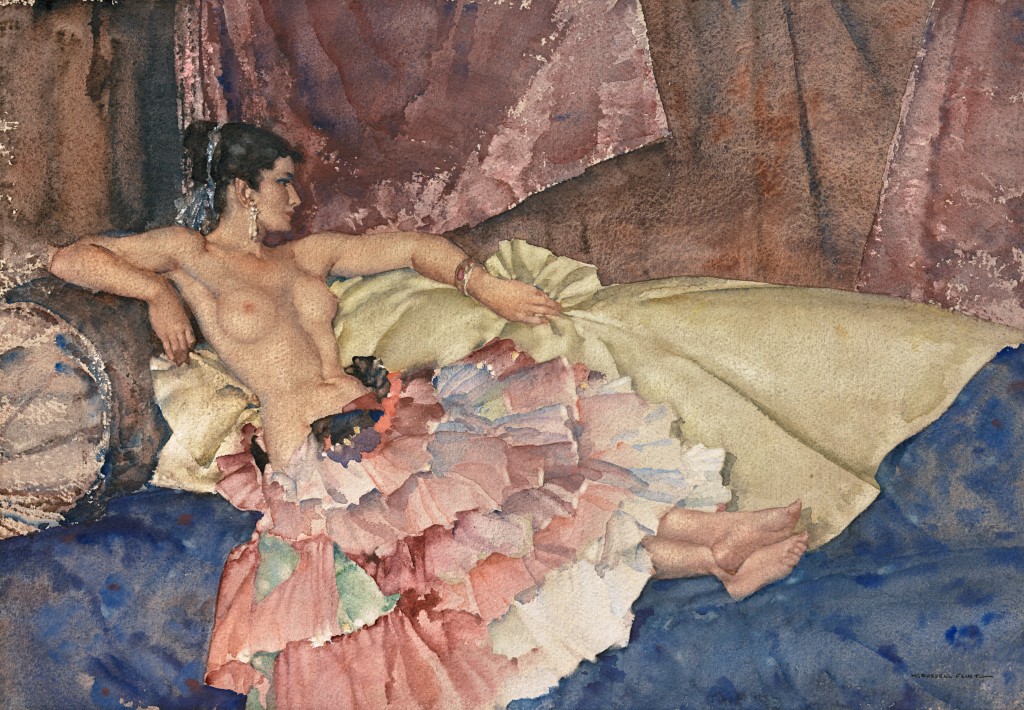
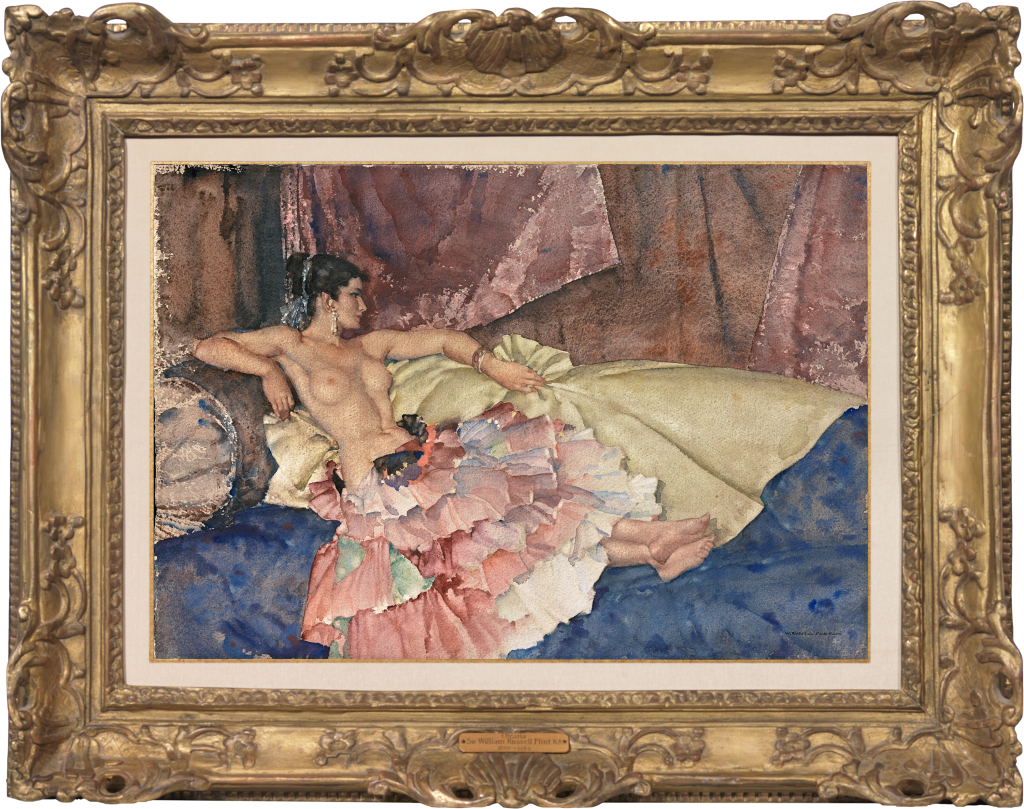
Olearia
Signed lower right: W. Russell Flint; signed and inscribed with the title on card attached to the reverse: Olearia / W Russell Flint
Watercolour: 13 ¾ x 19 ¾ in / 34.9 x 50.2 cm
Frame size: 21 ½ x 27 ½ in / 54.6 x 69.8 cm
In an antique 18th century carved and gilded frame
Painted circa 1959
Provenance:
Fine Art Society, London
Sotheby’s London, 8th November 1989, lot 213;
Richard Green, London;
private collector, Europe;
Sotheby’s London, 18th September 2019, lot 56;
private collector, UK
Exhibited:
London, Richard Green, An Exhibition of the Work of Sir William Russell Flint RA 1880-1969, January 1990, no.28, illus. in colour
Literature:
Published as a limited-edition print entitled Model for Elegance. See Keith Gardner, Sir William Russell Flint RA PPRWS 1880-1969, A Catalogue Raisonné of the Unsigned Limited Edition Works of Sir William Russell Flint together with a Review of Fine Books and Other Collectable Ephemera, Michael Stewart Associates, Bristol 1994, p.60
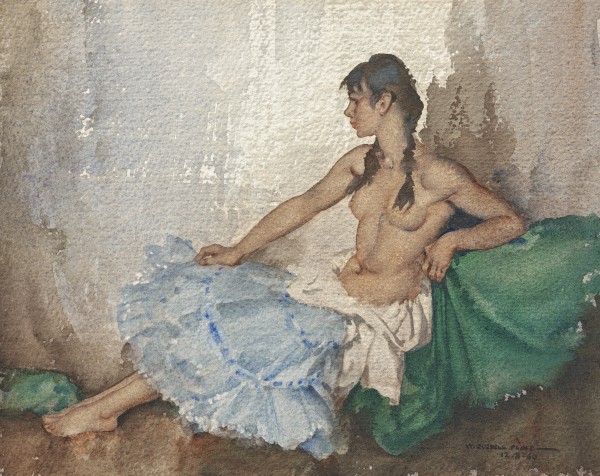
This radiant watercolour of Russell Flint’s celebrated model, Cecilia Green, recalls the style and drama of the artist’s depiction of Spanish dancers, in works such as Gitana dancers resting, Albaicin, Granada (Newport Museum and Art Gallery), one of his most sought after subjects from the 1930s. The same skirt in ruffled fabric cascading in layers of subtle, iridescent hues which reflect the resting dancer’s surroundings, also appears in Iberian flounces, 1955, reproduced on the cover of Pictures from the Artist’s Studio, the retrospective exhibition catalogue of Flint’s work held at the Royal Academy of Arts, 1962. The shape and movement of the voluminous garment is also represented in his Danza Montaña, 1959, a study of Tani Morena, and The Dance of the Thousand Flounces, circa 1952.
Sparkling jewels at her wrist, her ears and about her hair, catch the light like the white highlights of the skirt within the richly coloured studio interior, evoking a visit Flint made to the flamenco dancer, Carmen Amaya’s dressing room. Ralph Lewis recounts that ‘her flounced dresses were strewn casually about the room among other oddments. Her glittering trinkets cascaded across the dressing table.’[1] Flint visited Spain between the wars in 1921 and 1931, and was fascinated by the vitality of Spanish culture, in particular its dancers whom he painted at Albaicin, Granada and Valencia. He also enjoyed sketching Spanish dancers from the wings of the theatre when they visited London.
[1] Ralph Lewis and Keith Gardner, Sir William Russell Flint RA PPRWS, 1880-1969, David & Charles, London 1988, p.25.