

CHARLES-FRANÇOIS GRENIER DE LACROIX called LACROIX DE MARSEILLE
Marseille circa 1700 - 1782 Berlin
Ref: CD 218
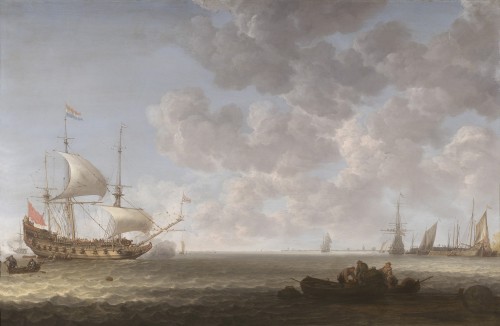
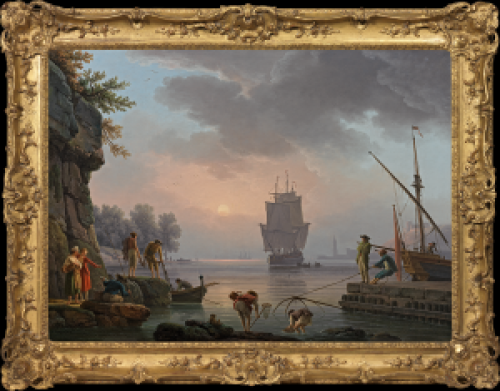
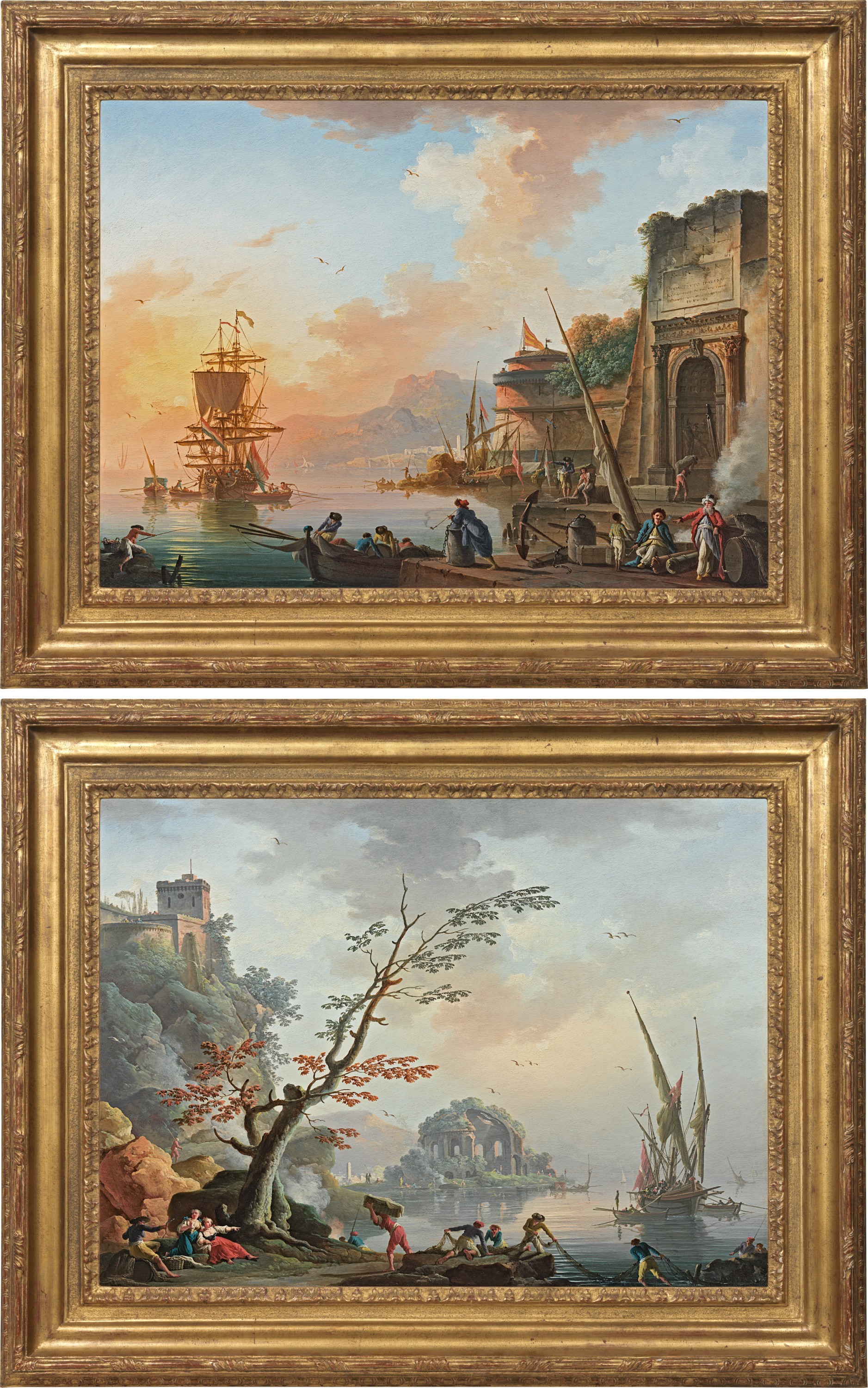
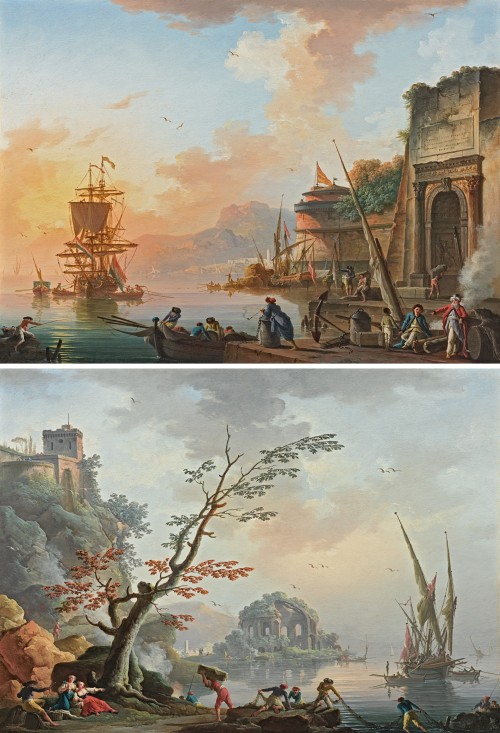
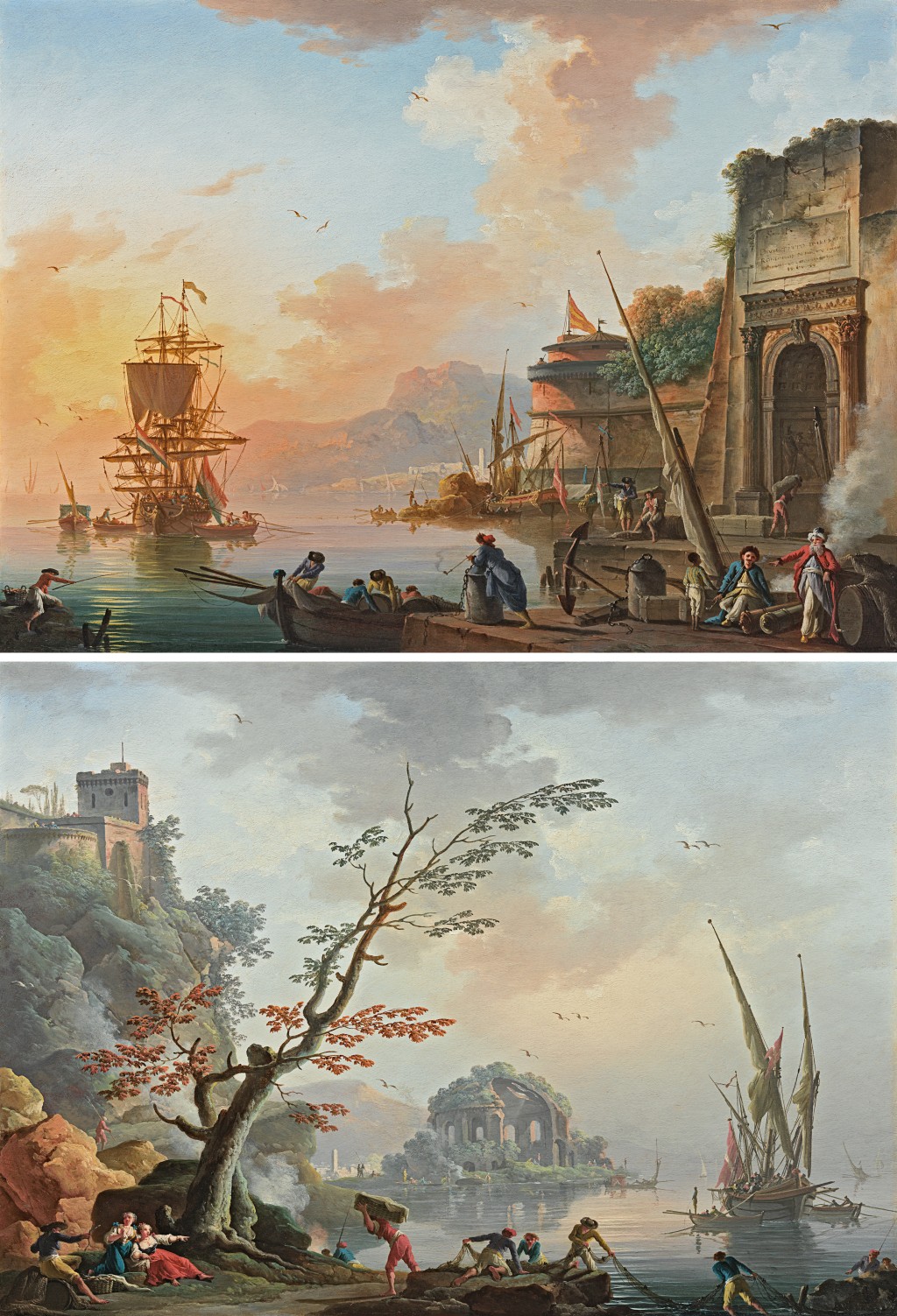
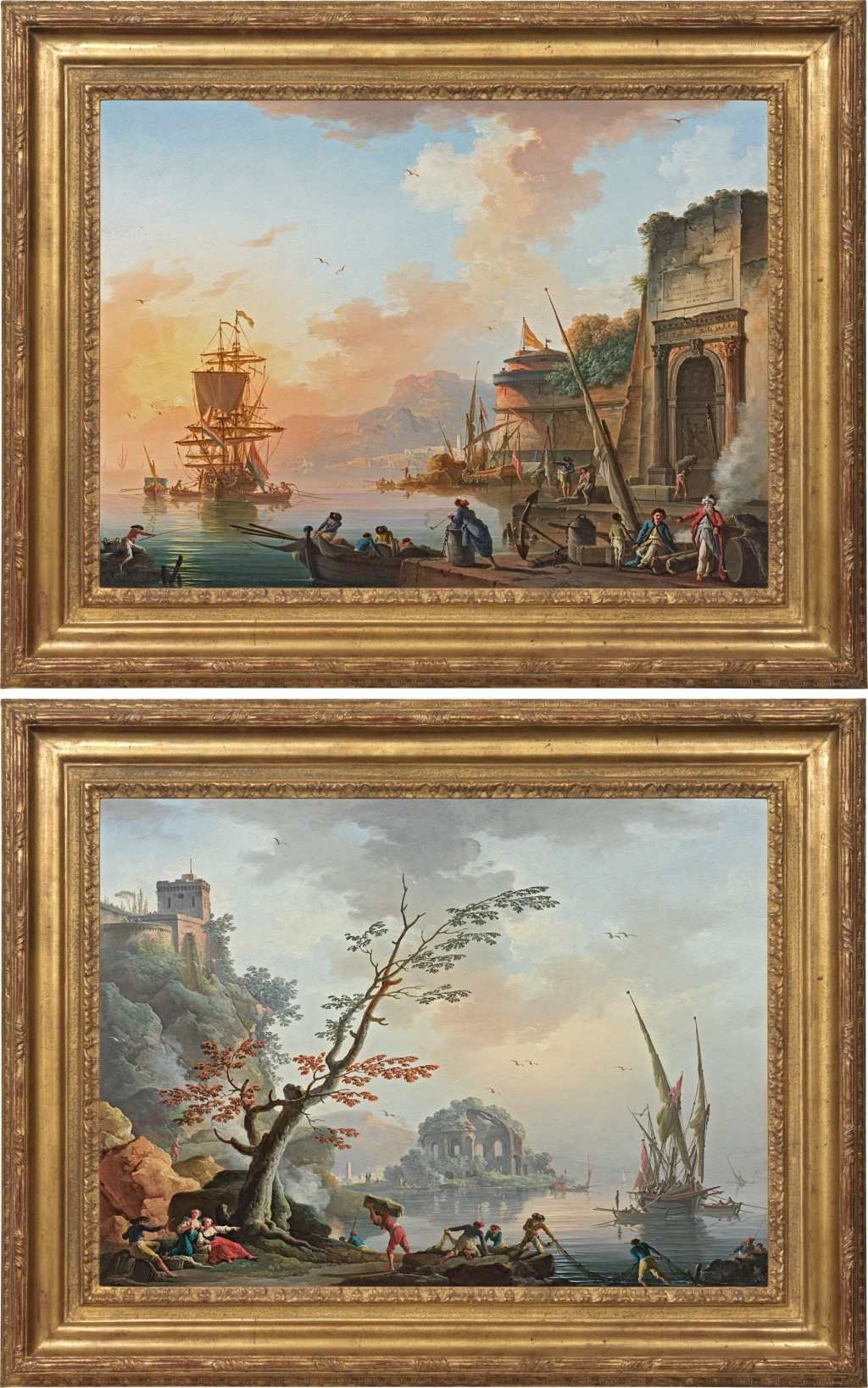
Mediterranean coastal landscape at sunset with a capriccio of the Arch of Titus and a Dutch man-of-war at anchor
Mediterranean coastal landscape at sunrise with a capriccio of the Temple of Minerva Medica
A pair, the former signed and dated lower right: Joseph /Vernet /1753
Oil on panel: 20 1/8 x 27 ½ in / 51.1 x 69.8 cm
Frame size: 28 x 35 in / 71.1 x 88.9 cm
In Louis XIV style carved and gilded pastel frames
Provenance:
Galerie de Haspe, Paris, 1953
Beaussant, Lefèvre, Paris, 14th December 2001, lot 70 (as Lacroix de Marseille);
Richard Green Gallery, London, 2001 (as Lacroix de Marseille);
Sven A Behrendt Collection, Europe, 2002
This pair of paintings throws fascinating light on the relationship between Charles-François Grenier de Lacroix, called Lacroix de Marseille, and Claude-Joseph Vernet, in whose Roman studio he worked. The Mediterranean coastal landscape at sunset with a capriccio of the Arch of Titus is signed Joseph /Vernet /1753 on the barrel at foreground right, indicating that Vernet was quite happy to put his name to the productions of his talented associate. The two artists’ styles were extraordinarily close in the 1750s, until Vernet returned to Paris in 1753. Pressure of work in Vernet’s last years in Rome seems to have made him turn over commissions to Lacroix. A series of landscapes of The four times of day commissioned by Sir Matthew Fetherstonhaugh of Uppark, Sussex (in situ) were copied (and signed) by Lacroix, ‘so exact…in every detail of brushwork that were it not for the signature it would be impossible to distinguish them from the master’s works’[1].
Until recent cleaning revealed the puzzle of the Vernet signature, these paintings have always been attributed to Lacroix de Marseille. The bright, clear colours, crisp outlines of the clouds and the slender, decorative tree in the Minerva Medica painting are characteristic of him. The motifs of the Arch of Titus and the Temple of Minerva Medica occur also in A coastal landscape with fishermen unloading boats, a capriccio of the Arch of Titus (private collection), signed and dated f De LaCroi f.t.Ro. 1758[2].
As they walked around Rome, both Vernet and Lacroix would have had plentiful reminders of the Classical civilization that began to be excavated in the Renaissance. These treasures continued being rediscovered in their own day. Archaeology had become increasingly sophisticated, spurring the Milordi who came to Rome on the Grand Tour to collect painted souvenirs of ancient buildings. Vernet and Lacroix catered for this market, often placing famous monuments in capriccio compositions of Mediterranean coastline, as with this pair.
In the first painting, Lacroix combines a round bastion, such as could be seen in the fortifications at Naples, with a ruined arch based on the central section of the Arch of Titus. Situated at the end of the Roman Forum near the Colosseum, the Arch of Titus was constructed circa 81 AD by the Emperor Domitian. It commemorated the official deification of his deceased brother Emperor Titus, Titus’s victory over the Jews in 70 AD and the destruction of the Temple in Jerusalem. Lacroix transforms the arch into the entrance to a fort, but keeps the inscription on the real Arch of Titus: S. P. Q. R. / DIVO TITTO RIPIRATO / ROMANUS. To the left, riding at anchor in the calm bay and drying her sails, is a Dutch man-of-war, while a lateen-rigged fishing boat shelters under the bastion. The figures in the foreground, arranged in a graceful line, reflect the diverse nations one might see in the southern Italian ports, among them local fishermen and Armenian and Turkish merchants, chosen for their picturesque dress.
The second work makes a central feature of the so-called Temple of Minerva Medica, which today can still be seen in a forlorn state as the trains draw out from Roma Termini. Although named after a statue of the goddess of wisdom, Minerva, which was found nearby (Vatican Museums), it is in fact a nymphaeum dating from the second half of the third century AD, enclosing a sacred spring. The complexity of the building and its delightful, round form led many artists, including the British painter Richard Wilson (1714-1782), to draw and paint it. The delicate, twisting tree which arches over the foreground is typical of Lacroix’s style.
CHARLES-FRANÇOIS GRENIER DE LACROIX called
LACROIX DE MARSEILLE
Marseille circa 1700/20 – circa 1782 Berlin
Charles François Grenier de Lacroix, known as Lacroix de Marseille, established his reputation as a painter of Italianate seascapes and landscapes. He specialised in capricci embellished with figures and distinguished by a taste for fantastic architecture. Despite his success during his lifetime, comparatively little is known about him. He used a number of different signatures, signing himself Grenier de La Croix on a Port scene dated 1750 (Toledo Museum of Art, OH) and using Delacroix on an Eruption of Vesuvius of 1767.
Born in Marseille, Lacroix’s first known paintings were two pendant seascapes signed and dated 1743, entitled Italian port at sunrise and Italian port at sunset. By 1750 he was in Rome, where he encountered the Marquis de Vandières, who was travelling with Germain Soufflot and Charles-Nicolas Cochin. Lacroix worked in the Roman studio of Joseph Vernet (1714-1789), who became the most important influence on his work. His copies after Vernet, for example the Four times of day at Uppark, Sussex (in situ; NT), signed by Lacroix and dated 1751, are ‘so exact…in every detail of brushwork that were it not for the signature it would be impossible to distinguish them from the master’s works’[3].
Lacroix visited Naples in 1757, painting Vesuvius and the surrounding countryside. Lacroix painted seascapes, seaports, storms and sunsets, often, like Vernet, in contrasting pairs showing different times of day or weather conditions. His capricci, particularly his depiction of figures, also reflect the influence of Italian artists such as Francesco Zuccarelli (1702-1788) and Marco Ricci (1676-1729/30). Lacroix was in Paris by the end of the 1770s and exhibited at the Salon du Colisée in 1776. He participated in the Salon de la Correspondance in Paris in 1780 and 1782 and, according to Pahin de la Blancherie, died in Berlin in 1782. During the eighteenth century his paintings were very popular; many were engraved by Le Veau and Le Mire.
The work of Lacroix de Marseille is represented in the Toledo Museum of Art, Ohio; the Dijon Museum of Art and the National Museum, Stockholm.
[1] St John Gore in Washington DC, National Gallery of Art, The Treasure Houses of Britain, 1985, no.200, p.280.
[2] Christie’s London, 5th July 2011, lot 15.
[3] St John Gore in Washington DC, National Gallery of Art, The Treasure Houses of Britain, 1985, no.200, p.280.