

CLAUDE-JOSEPH VERNET
Avignon 1714 - 1789 Paris
Ref: CD 141
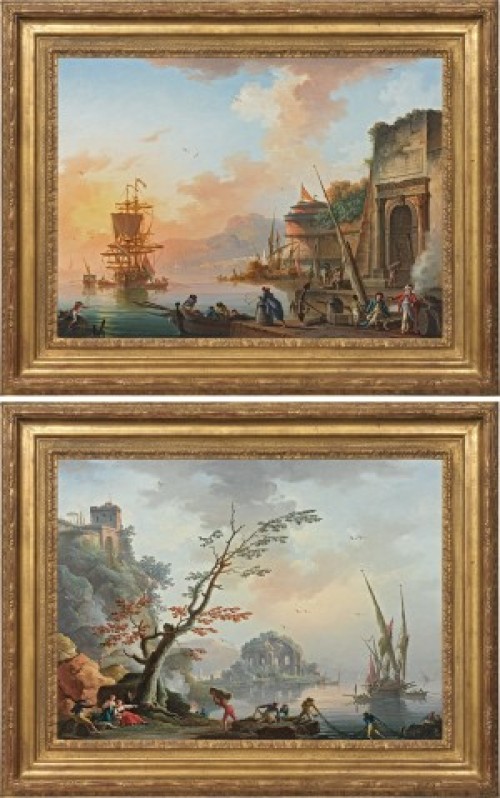
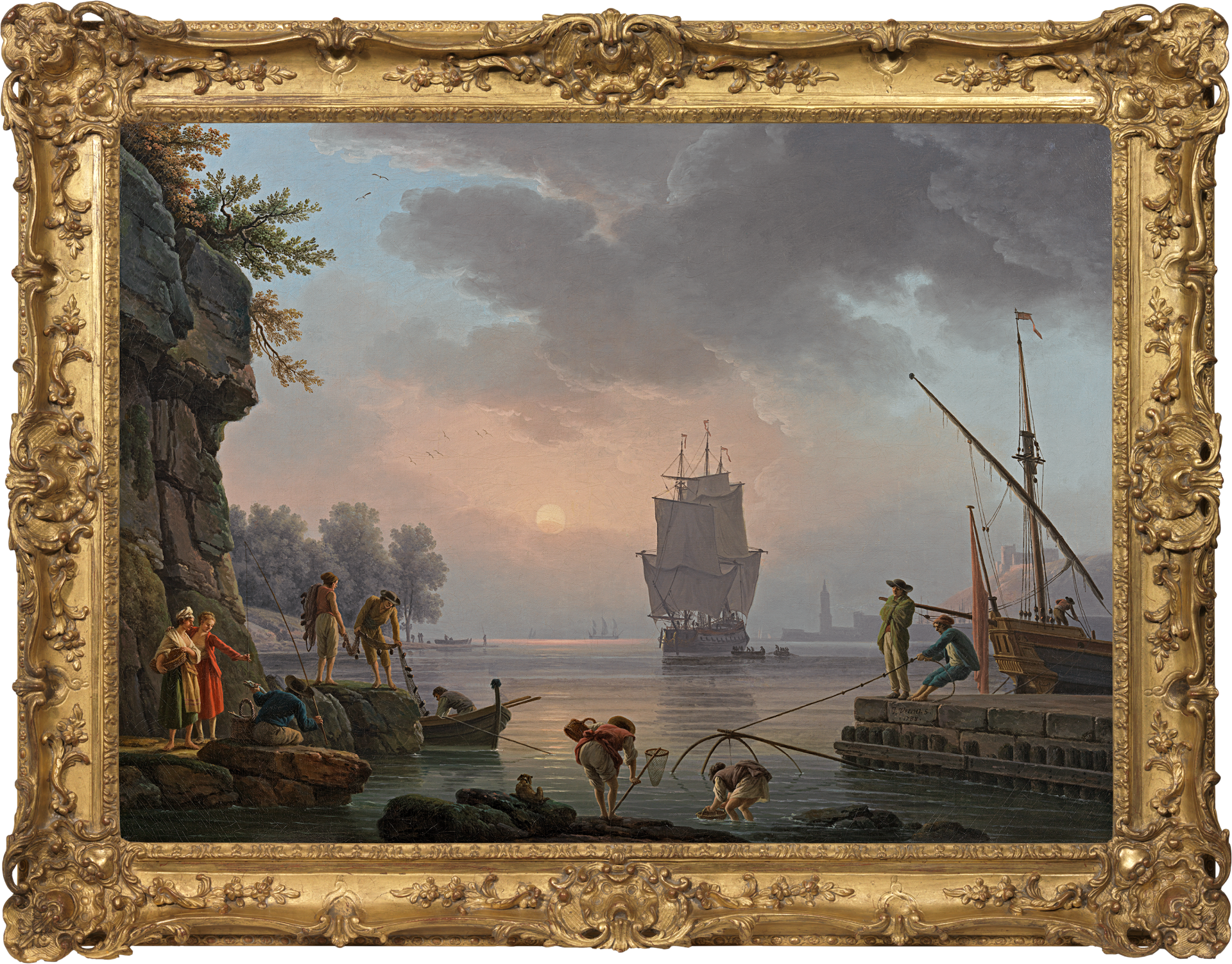
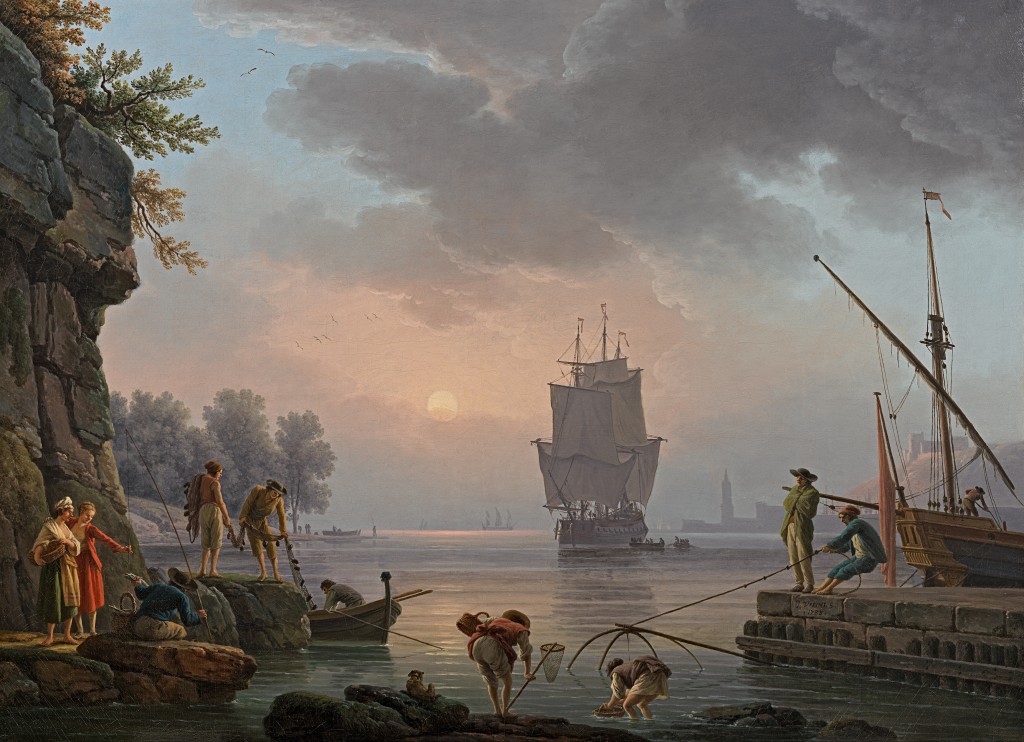
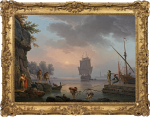
Marine par temps calme: brouillard
Signed and dated lower right: J. Vernet .f. / . 1788
Oil on canvas: 27 ½ x 38 1/8 in / 69.8 x 96.8 cm
Frame size: 35 ½ x 46 in / 90.2 x 116.8 cm
Provenance:
Probably commissioned by M. Barbeau in 1787, with a pendant, Rivière
Jean-Baptiste-Pierre Le Brun (1748-1813), Paris;
his sale, on the premises of Citoyen Lebrun, 96 Rue de Cléry, Paris, 11th January 1793, lot 12 (with the pendant, Rivière)
Comte Gabriel d’Arjuzon (1761-1851);
his estate sale, Me Siegneur, 14 Rue Rumfort, Paris, 2nd-4th March 1852, lot 24 (with the pendant Rivière as lot 25)
John Wombwell;
his sale, Me Chevallier, Hôtel Drouot, Paris, 24th May 1886, lot 45
Anonymous sale, Me Bondu, Hôtel Drouot, Paris, 16th June 1965, lot not specified
Galerie Cailleux, Paris;
where acquired in 1968 by a private collector, Europe;
by descent in an aristocratic private collection, Europe
Literature:
Probably ‘Livre de Raison de Joseph Vernet’ covering the period 1764-74 and 1788, MS 2322, folio 122, 1788 (Bibliothèques Avignon): Pr Mr Barbeau deux tableaux de trois pieds de large sur deux pieds deux pouces de haut[1]
Probably Louis Lagrange, Joseph Vernet et la peinture du XVIIIe siècle avec le texte des Livres de Raison, Paris 1864, p.358, no.316 in the Livres de Raison
Florence Ingersoll-Smouse, Joseph Vernet, Paris 1926, vol. II, p.43, no.1177
Emilie Beck-Saiello, “Car c’est moy que je peins”. Strategies familiales et professionelles de Joseph Vernet à travers l’étude critique de son livre de raison et de sa correspondence, Trocy-en-Multien 2025, vol. II, p.464
Claude-Joseph Vernet was born in Avignon in the South of France and spent almost twenty years in Italy, from 1734 to 1753, before returning to his homeland. His idealised views, which found favour with Louis XV and an international clientele, are informed by his intense observation of Mediterranean architecture, nature and light.
This painting is extraordinary for its poetic evocation of dawn breaking through the mist. In common with many of Vernet’s later works, the composition exudes serenity, in keeping with the French neoclassical taste for elegant restraint. Without being slavishly topographical, it brings together many elements that would have struck a chord with gentlemen who had made the Grand Tour of southern Europe: venerable architecture, picturesque local life and, in the central man-of-war, political rivalries that ensured the fleets of many nations would patrol the waters of the Mediterranean. Vernet’s father-in-law was an Irish Captain in the Papal Navy and the artist’s skill in painting ships would lead to the greatest commission of his career, a command to paint the Ports of France (1755-65) for Louis XV.
The man-of-war is silhouetted against the pale apricot sunrise, her drying sails hanging slack in the calm air, her pennants barely lifted by the faintest of breeze. Further warships can be glimpsed in the offing, above the band of sunlight on the horizon. In the far right distance a fort, reminiscent of Castel Sant’Elmo in Naples, is gilded by the first rays. In the foreground, Vernet presents a group of fishermen busy with the night’s catch. He shows different aspects of this economic enterprise, from the comparatively large lateen-rigged boat at the right, to the man fishing from the shore with a net held on an arched frame, to the character at foreground left, shore-fishing with a rod. Apparently artlessly disposed, these figures are in fact arranged in a serpentine line with the grace of ballet dancers, anchored in the composition for maximum effect. Vernet’s brilliance as a draughtsman and painter is evident in the care lavished on the two local women bargaining for a fish on a rock to the left. Irradiated by the sun, they are more vividly coloured than any of the menfolk, one dressed in red, the other in white, blue and yellow. Vernet evokes a dream of Mediterranean life in which humans live in harmony with nature, their every need fulfilled by the bountiful landscape around them.
Note on the provenance
This painting was commissioned by a Monsieur Barbeau in 1787, together with a pendant, Rivière, which stayed with it until the latter half of the nineteenth century. The pair was recorded in Vernet’s Livre de Raison for 1788 as Pr Mr Barbeau deux tableaux de trois pieds de large sur deux pieds deux pouces de haut.
By 1793 Marine par temps de calme: brouillard was in the possession of the artist and art dealer Jean-Baptiste-Pierre Le Brun (1748-1813), great-great nephew of Louis XIV’s history painter Charles Le Brun (1619-1690) and scoundrelly husband of the portrait painter Elisabeth Vigée Le Brun. Before 1852 it was in the collection of the politician and administrator Comte Gabriel d’Arjuzon (1761-1851), who served as Grand Chamberlain to the Emperor Napoleon’s brother Louis Bonaparte, King of Holland.
CLAUDE-JOSEPH VERNET
Avignon 1714 - 1789 Paris
Claude-Joseph Vernet was one of the most eminent and influential French landscape painters of the eighteenth century. Born at Avignon, son of the painter Antoine Vernet, Claude-Joseph showed great talent at an early age. Patronised by the Marquise de Simiane, the Marquis de Caumont and the Comte de Quinson, he went to Italy in 1734. In Rome, Vernet probably worked initially in the studio of the French marine painter Adrien Manglard. By 1738 he had established a reputation as a painter of landscapes, seaports and coast scenes, reminiscent of seventeenth century masters such as Gaspard Dughet. In 1745 he married Virginia Cecilia Parker, daughter of Mark Parker, an Irish Captain in the Papal Navy.
Vernet was particularly concerned with rendering the transience of nature and the effects of light and weather. His paintings won critical acclaim for his ability to capture the changing beauties of nature. His subtle interest in changing landscape is seen in the way he conceived works in pairs and sets, contrasting times of day, weather, sea and shore scenes.
Vernet became a member of the Académie Royale and returned to France in 1753. That year he was commissioned by Louis XV to paint his famous series of the Ports of France, a celebration of the country's principal seaports, in which he combined the exacting demands of topography with a poetic monumentality. Vernet completed only fifteen of the proposed twenty or more ports, exhibited at the Salon between 1755 and 1765. However, both in scale and quantity, this was one of the greatest official commissions of the century. Vernet finally settled in Paris in 1765, working for a large international clientele. He travelled to Switzerland with his patron Jean Girardot de Marigny in 1778, and died in Paris on the brink of the Revolution in 1789.
The work of Claude-Joseph Vernet is represented in the Musée du Louvre, Paris; the Château de Versailles; the National Gallery, London; the Hermitage, St Petersburg; the Prado, Madrid and the Philadelphia Museum of Art.
[1] In eighteenth century measurement, the pied was roughly equivalent to an English foot and the pouce to an inch. The measurements in the Livre de Raison are given as width before height.