JEAN-BAPTISTE GREUZE
Tournus 1725 – 1805 Paris
Ref: CD 106
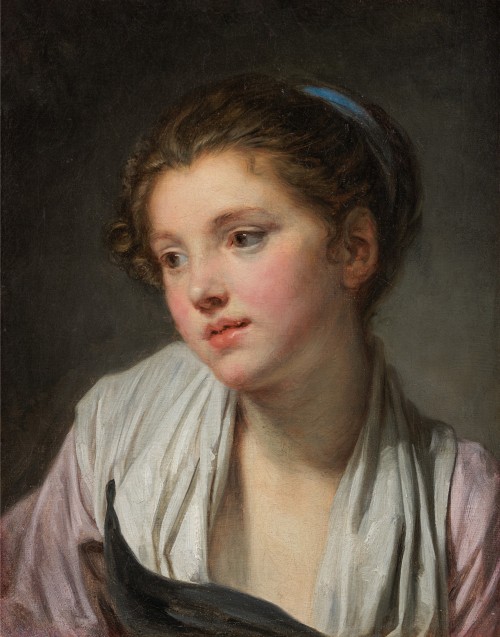
Portrait de jeune fille
Oil on canvas: 16 x 12 7/8 in / 40.6 x 32.7 cm
Frame size: 23 x 20 in / 58.4 x 50.8 cm
Painted circa 1770
Provenance:
Probably acquired directly from the artist by the Swiss banker Jean-Frédéric Perregaux (1744-1808), Paris;
probably inherited by his daughter Anne-Marie-Hortense Viesse de Marmont, Maréchale Duchesse de Raguse (1779-1855), Paris and Viry-Châtillon;
her deceased sale, Hôtel Drouot, Paris, 14th-15th December 1857, lot 23[1]
Comte Spitalieri de Cessole, Nice;
by descent in a private collection, France
Jean-Baptiste Greuze sprang to fame with sentimental, moralizing paintings such as L’Accordée de village (Musée du Louvre, Paris), which caused a sensation at the Salon of 1761. Building on Charles Le Brun’s (1619-1690) exploration of human expression in Méthode pour apprendre à dessiner less passions (1698)[2], Greuze captured a range of responses to this village betrothal by subtle delineation of the heads of his figures, evoking shy innocence in the fiancée, tearfulness in her mother and robust indifference in the sibling feeding the chickens. He was responding to an era of sensibility, an eighteenth century precursor of the modern mantra ‘Be Kind’, which valued feeling over rationality, charity to those lower on the social scale and the bourgeois virtues of domestic bliss.
Greuze was admired for his ability to capture expression in the single ‘heads’ that formed a considerable part of his output in the latter half of his career. The history painter Jean-Joseph Taillasson commented in his 1805 obituary of Greuze: ‘What earned him the most important part of his glory, what won him the highest place in the opinion of artists and refined connoisseurs, were the beautiful heads spread throughout all the cabinets of Europe and which are there admired as masterpieces’[3]. Most sought-after were Greuze’s bust-length paintings of young women with wistful, ambiguous expressions, such as The dreamer (private collection)[4]. The viewer is invited to guess the thoughts beyond the languorous eyes.
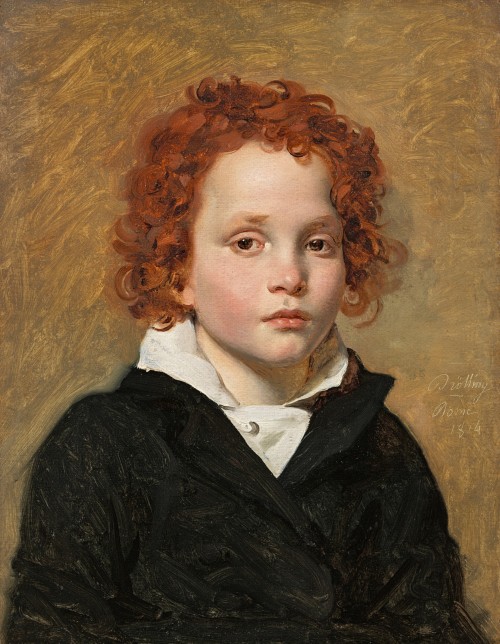
Painted circa 1770, Portrait de jeune fille is sympathetic and tender, devoid of the cloying sentimentality and chalky tones of Greuze’s late female heads. It has most in common with the straightforward, naturalistic child studies of the 1760s, such as Une tête de petit garçon, 1763 (The Metropolitan Museum of Art, New York). The young girl’s modestly averted gaze turns her thoughts inwards, placing her beyond a direct relationship with the viewer. Greuze’s soft brushwork and warm palette throws over her the gentle radiance of youth. Her skin and lips have a rosy blush; curls cluster at her temples. The girl is simply dressed in a lilac robe and white kerchief with a stiff, dark apron bodice, such as a child or servant might wear. Similar aprons can be seen on the bourgeois mother and child in Jean-Baptiste-Siméon Chardin’s La bénédicité (Saying grace), 1744 (Hermitage, St Petersburg). Touches of colour, such as the sky-blue ribbon in the girl’s hair, contrast with the plain, grey background, which shades from deep to lighter grey as the light falls from the left. Although the Jeune fille is to some extent a generic Greuze ‘type’, he based some of his observations on his beloved daughters Anne-Geneviève (1762-1842) and Louise-Gabrielle, who modelled for many of his works.
Such intense studies of a bust-length single figure have precedents in seventeenth century Dutch art, in the tronies which study anonymous sitters without narrative content. They can be young or old, gnarled or pretty. Jan Vermeer’s Girl with a pearl earring, c.1665 (Mauritshuis, The Hague) has sometimes been seen as a tronie, although she turns to engage with the viewer in a way avoided by Greuze’s Portrait de jeune fille. Instead, Greuze’s sensitive painting marvels at the fleeting bloom of youth and an interior life of which we can only guess.
Note on the provenance
In the nineteenth century this painting was recorded in the collection of Anne-Marie-Hortense Viesse de Marmont (née Perregaux), Maréchale Duchesse de Raguse (1779-1855). It was lot 23 in her estate sale at Hôtel Drouot, Paris, 14th-15th December 1857. According to the preface to the catalogue of this sale, the Duchesse inherited her eighteenth century French School paintings from her father, the Swiss banker Jean-Frédéric Perregaux (1744-1808), who had bought them directly from the artists. The first Regent of the Banque de France, Perregaux owned major works by Boilly, Greuze, Robert, Vernet and Vigée Le Brun, among others. His Hubert Robert landscape The Ponte Salario, c.1775, is in the National Gallery of Art, Washington DC. Perregaux’s daughter inherited a considerable fortune, a share in his bank and part of his art collection, which probably included Greuze’s Portrait de jeune fille.
In 1798 Anne-Marie married the aristocrat Auguste-Frédéric-Louis Viesse de Marmont, later Maréchal Duc de Raguse (1774-1852). Marmont fought with distinction through the Revolutionary and Napoleonic Wars, becoming aide-de-camp to Napoleon. He was military and civil governor of Dalmatia, created Duc de Raguse in 1808. After the battle of Wagram the following year, Napoleon raised Marmont to the rank of Maréchal. In 1814, seeing that France could not win the war, Marmont surrendered to the Allies and thenceforth was loyal to the Bourbons, going into exile with Charles X after the 1830 Revolution and dying in Vienna in 1852, the last of the Napoleonic Marshals.
The Marmonts’ marriage was unhappy and produced no children. They divorced in 1817, the Maréchal bewailing the fact that he had ‘married so young with such a bad woman’. Anne-Marie, however, seems to have lived contentedly enough, with her personal fortune and her excellent collection of paintings.
Greuze’s Portrait de jeune fille was later in the collection of Comte Spitalieri de Cessole, from a distinguished family in Nice.
Jean-Baptiste Isabey, Portrait of Anne-Marie-Hortense Viesse de Marmont, Maréchale Duchesse de Raguse, 1818. Watercolour on card. The Edward B Greene Collection, Cleveland Museum of Art.
JEAN-BAPTISTE GREUZE
Tournus 1725 – 1805 Paris
Jean-Baptiste Greuze was born at Tournus between Dijon and Lyon on 21st August 1725, the sixth of nine children of a roofer, Jean-Louis Greuze (1697-1769), and his wife Claudine Roch. He was later to describe his father as an architect and property developer. Likewise, he was baptised Jean Greuze, but adopted the more genteel-sounding Jean-Baptiste in the mid-1750s.
Precociously talented (he is said to have fooled his father at the age of eight that a drawing he had made was a print), Greuze may have had some artistic training in his home town. In the late 1740s he went to Lyon to study with the portrait painter Charles Grandon (c.1691-1762). He probably travelled with Grandon to Paris around 1750, when the latter went to join his son-in-law, the composer André Grétry. Greuze studied at the Académie Royale with Charles-Joseph Natoire and painted small pictures to make a living: one of these may be The triumph of Galatea (Musée Granet, Aix-en-Provence), which is in the style of François Boucher. Greuze was supported at the Académie by its Director Louis de Silvestre and the sculptor Jean-Baptiste Pigalle. He was made an associate member (agréé) on 28th June 1755 after presenting some of his pictures, including the Family Bible reading (Hottinguer Collection, Paris) and painting a brilliant portrait of Silvestre in public. Greuze exhibited at the Salon for the first time in 1755, where his Family Bible reading was bought by La Live de Jully.
In September 1755 Greuze set off for Italy with the historian and collector Louis Gougenot, Abbé de Chezal-Benôit. Bankrolled by Gougenot, the pair visited Turin, Genoa, Parma, Modena, Bologna, Florence and Naples before arriving in Rome in January 1756, where Greuze decided to stay. The Marquis de Marigny, Louis XV’s Surintendant des Bâtiments, commissioned two paintings for his sister Madame de Pompadour and gave orders that Greuze should be lodged in the Palazzo Mancini, home of the Académie de France in Rome. Typically, Greuze dawdled over these prestigious commissions, not finishing Simplicity (1759; Kimbell Art Museum, Fort Worth, TX) and A young shepherd holding a flower (1761; Petit Palais, Paris) until long after his return to Paris. Instead he flung his energies into ‘Four Pictures in Italian Costume’ which he rushed back to exhibit at the Salon of 1757: Broken eggs (Metropolitan Museum of Art, New York); Neapolitan gesture (Art Museum, Worcester, MA); Indolence (Wadsworth Atheneum, Hertford, CT) and The fowler (National Museum, Warsaw). These paintings were influenced by the moralising themes and detailed execution of seventeenth-century Dutch and Flemish masters such as Dou and Teniers. While in Rome Greuze also produced portraits, including that of the Comte de Stainville (later Duc de Choiseul), French Ambassador to the Holy See, and indulged in a dalliance with a member of the noble Pignatelli family. Fragonard, who was in Rome at the time, described Greuze in these years as ‘an amorous cherub’.
Greuze exhibited more than a dozen works at the Salon of 1757. He was first mentioned by Denis Diderot in his Salon of 1759, hailed as an exponent of a new seriousness and morality in painting. The friendship with Diderot endured ten years; more lasting was Greuze’s friendship with the German engraver Jean-Georges Wille, who makes many references to Greuze in his Journal and who became the subject of one of his finest portraits (1763; Musée Jacquemart-André, Paris). Also in that year, 1759, Greuze married Anne-Gabrielle Babuti (1732-after 1812), the beautiful, wealthy daughter of a Parisian bookseller. They had three daughters, Marie-Anne-Claudine, who died young; Anne-Geneviève (1762-1842), who became Greuze’s pupil, and Louise-Gabrielle. Mme Greuze proved grasping and flagrantly unfaithful; Greuze divorced her, at huge financial cost, in 1792.
Greuze gained great success in 1761 with the sentimental and morally uplifting Marriage contract (L’Accordée de village) (Louvre, Paris), commissioned by Marigny. In 1767 he was pressured to present the reception piece due to the Académie twelve years’ previously, when he became an associate. Greuze spent two years reinventing himself as a history painter with the aim of enhancing his status with the Académie. His reception piece, Septimius Severus reproaching Caracalla, 1769 (Louvre), the superb fruit of his study of classical sculpture and the work of Poussin, was poorly received. He was elected a full member of the Académie, but to his fury was still classed as a genre painter. Greuze shunned the Académie Salons, exhibited elsewhere, and made a fortune through sales of prints after his work. Royalty and noblemen flocked to his studio in the Louvre, including Gustave III of Sweden in 1771 and Joseph II of Austria in 1777.
Greuze’s late work mixed realistic observation with the grand manner of history painting. In The father’s curse and The punished son, 1777 (Louvre), operatic emotion conjoins with extraordinary beauty of painterly execution. In 1793, as the Revolution began, Greuze joined the Commune Générale des Arts, led by Jacques-Louis David. With the dissolution of the Académie Royale and its snobberies, he returned to exhibit at the Salons of 1800, 1801 and 1804. Greuze died in his studio in the Louvre on 21st March 1805, attended by his faithful daughter Anne-Geneviève, whom he fondly called his Antigone.
[1] ‘Elle a un ruban bleu dans les cheveux, et un mouchoir blanc sur les épaules; l’expression de la physiognomie est douce et naïve. Greuze a peint cette figure avec amour dans une manière qui n’est ni trop fondue ni trop heurtée, avec des empâtements modérés et délicats’.
[2] See Yuriko Jackall, Jean-Baptiste Greuze et ses têtes d’expression: La fortune d’un genre, Condé-en-Normandie 2022, chapter II, ‘Les identités académiques de Greuze’, pp.91-143.
[3] ‘Notice sur Creuze [sic]’, Journal des débats et loix [sic] du pouvoir législatif et des actes du gouvernement, 6 germinal an 13 [27th March 1805]: ‘Mais ce qui lui a mérité la plus belle partie de sa gloire: ce qui lui assigne une très haute place dans l’opinion des artistes et des connoisseurs délicats, ce sont les belles têtes répandues dans tous les cabinets de l’Europe, et qui sont admirées comme des chefs-d’oeuvre’. Quoted in Yuriko Jackall, ‘Off with Greuze’s heads: a case of identity theft’, Journal 18, issue 8, Self/Portrait, autumn 2019.
[4] Hartford, CT, Wadsworth Atheneum, Jean-Baptiste Greuze 1725-1805, 1977, exh. cat. by Edgar Munhall, pp.154-5, no.73, illus.