BALTHASAR VAN DER AST
Middelburg 1593/94 - 1657 Delft
Ref: CD 224
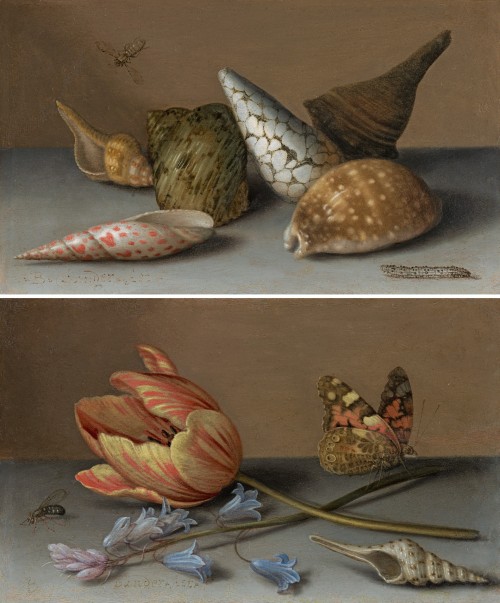
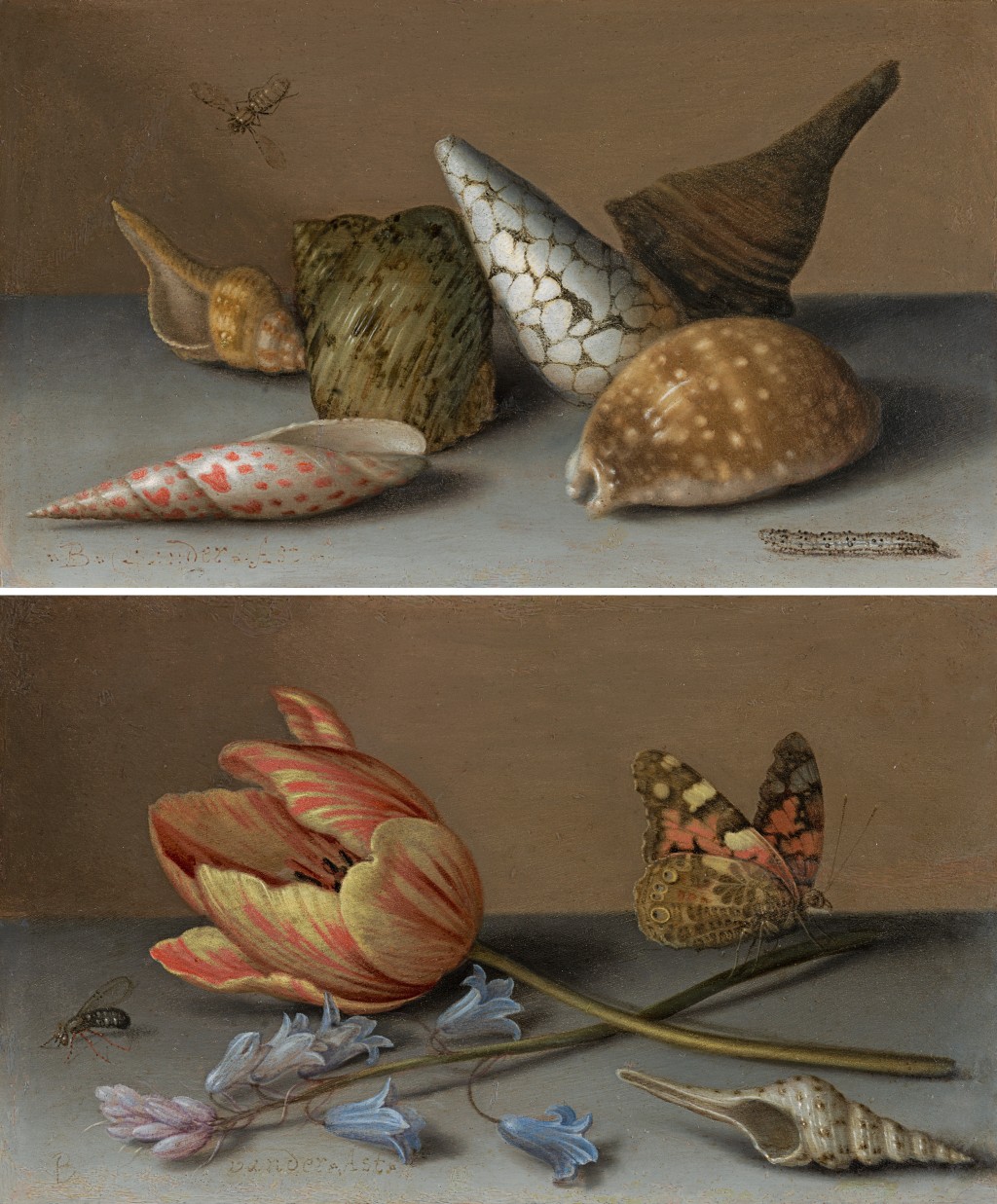
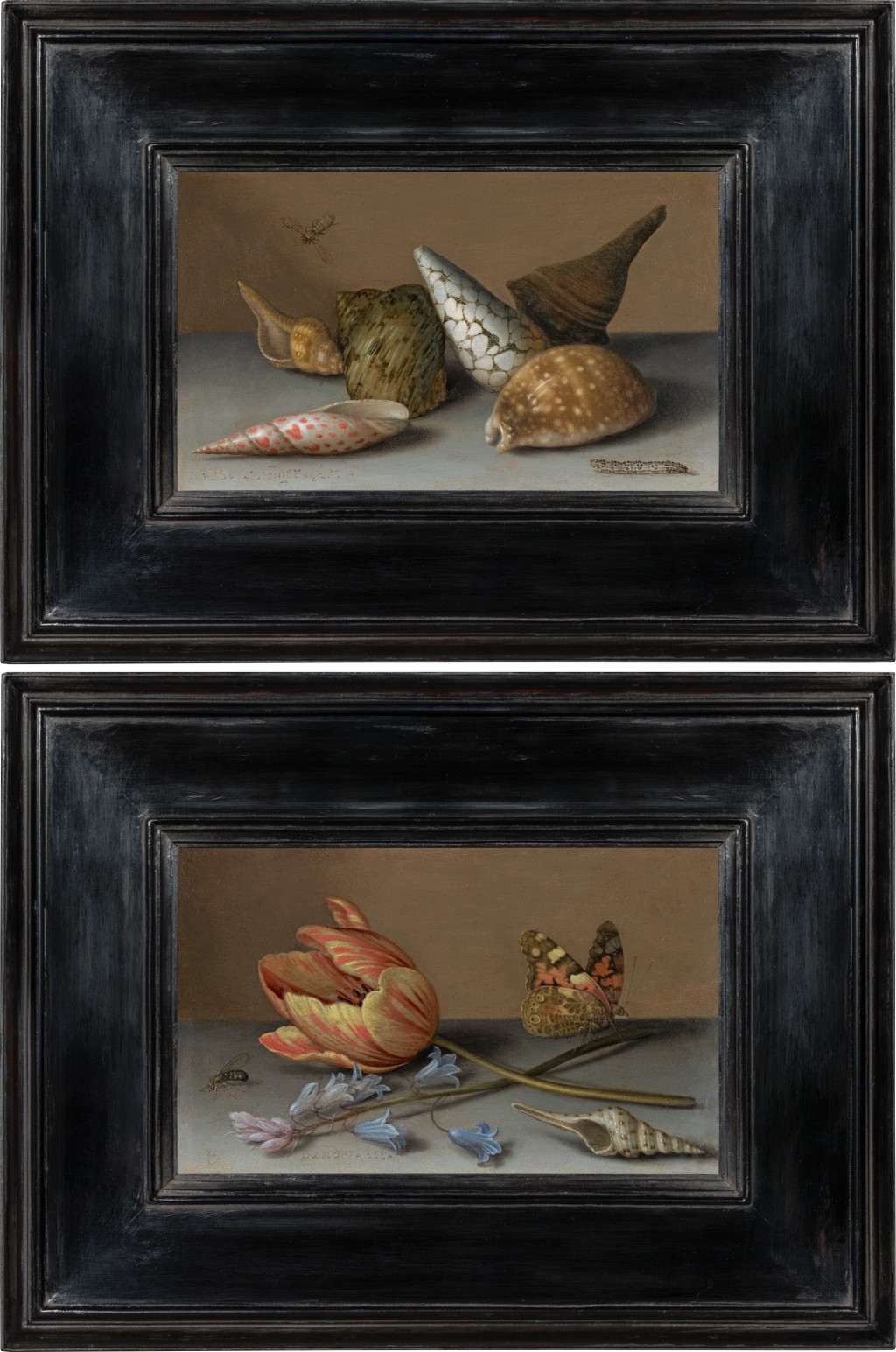
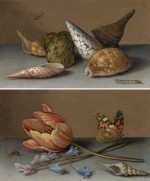
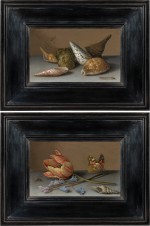
A still life of shells, with a wasp and a caterpillar on a stone ledge
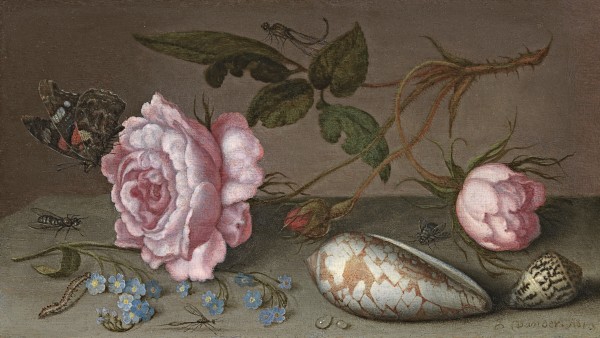
A still life of a tulip, bluebells and a shell on a stone ledge with a fly and a Painted Lady butterfly (Vanessa cardui)
The former signed lower left: .B. vander. Ast;
the latter signed lower left: B…vander. Ast.
Oil on copper: 4 ½ x 7 1/8 in / 11.4 x 18.1 cm
Painted in the 1630s
Provenance:
Comte Briard, Les Pavillons d’Ernée, 12th February 1884
Hendrik Piek-Ditmar (1879–1950), The Hague;
by inheritance to his wife, Wilhelmina Hendrika Piek-van Ditmar (1881–1968), The Hague, until 1952
Galerie Charpentier, Paris, 9th May 1952, lot 80 and 81, pl.XV (FFr. 350,000);
Madame S Collection, 1952
Sotheby’s London, 2nd July 1986, lot 161;
where acquired by David Koester, Zurich;
from whom acquired by Hans and Marion König, Germany, 1987
Exhibited:
Maastricht, Pictura, March 1987
Aachen, Suermondt-Ludwig-Museum/Gotha, Herzogliches Museum, Stiftung Schloss Friedenstein, Schöner als die Wirklichkeit. Die Stilleben des Balthasar van der Ast (1593/94–1657), 10th March-5th June 2016, exh. cat. by Sarvenaz Ayooghi, Sylvia Böhmer and Timo Trümper, pp.178-80, nos. 29a-b (cat. entry by Martina Dlugaiczyk), illus. in colour
Literature:
LJ Bol, The Bosschaert Dynasty, Painters of Flowers and Fruit, Leigh-on-Sea 1960, pp.76, 80, no.53 and 80
LM Helmus, Schilderkunst tot 1850, Utrecht 1999, p.216, note 7
Balthasar van der Ast was taught by his brother-in-law Ambrosius Bosschaert the Elder (1573-1621), the pioneering Middelburg flower painter of the first decades of the seventeenth century. Van der Ast developed the tradition of his mentor, like Bosschaert producing paintings of flowers in vases on ledges, often with a few shells and insects scattered around. Works such as the present pair, in which a choice number of blooms and a few shells are placed on a ledge with flying insects, are an innovation of van der Ast. The personality of each flower and shell is brought out by their being placed against neutral backgrounds, with just enough overlapping to bind the composition together.
Van der Ast derives from Bosschaert the sense of sculptural solidity of his objects and exquisite attention to each individual petal or curl of shell, but gives his painting a softness and atmosphere, influenced by the Utrecht painter Roelandt Savery (1576-1639), that moves away from the more linear approach of Bosschaert and his own early work. The delicate quality of these still lifes is enhanced by their being painted on copper, a more expensive support than panel which provides an exceptionally smooth surface for the finest of brushwork.
The Still life of shells has, to the modern eye, a pleasingly austere, almost abstract quality. Van der Ast places his six shells so that they just overlap, putting them into a relationship with one another. Together, they symbolise the riches of the ocean and the daring voyages of Dutch sailors who were travelling to the ends of the known world for trade, scientific enquiry and colonial conquest. Middelburg, where van der Ast was born, had access to the Scheldt estuary and was the second most important centre, after Amsterdam, for the Dutch East India Company (VOC). It was also a centre for scientific enquiry, famed for lens crafting. Such currents fuelled the fascination with collecting rare naturalia, such as the shells depicted here.
Van der Ast chooses his shells for their variations in size, shape, colour and texture. They include, at the rear far left, a whelk (Babylonia sp.) and next to it the matte spiral of a turban shell (Turbo sp.) from the Indian Ocean. Next to the turban is a striking example of an Indo-Pacific marble cone (Conus marmoreus Linne.). In front of the cone shell is a cowrie (Cypraea sp.), its smooth, glossy shell reflecting gentle highlights. At foreground left is an elegant auger (Terebra sp.), a species found in the seas of Africa, the Americas and the Indo-Pacific. Above the shells hovers a wasp and below them a caterpillar. Van der Ast thus introduces creatures which live on the earth, in the air and in the sea (the molluscs which inhabited the shells).
The Still life of a tulip, bluebells and a shell echoes the composition of the shell still life with the blue-grey of the stone ledge which occupies half of the composition, below a plain background of light brown. In this work the colour is provided by a magnificent, red-striped tulip in the glory of its pristine maturity, its stem crossed with a delicate bluebell. A turrid shell is in the foreground right. A fly crawls to the left, while a Painted Lady (Vanessa cardui) butterfly perches on the stem of the bluebell.
When van der Ast made this painting in the 1630s, the fever for tulip collecting was at its height, with single bulbs changing hands for as much as the cost of a house in Amsterdam. The market crashed in 1637, although Dutch expertise with tulips continued. The lure of the tulip lay in the exquisite, flame-like markings that spontaneously appeared on solid-coloured blooms. No-one could predict which bulbs would develop into these miraculous, lucrative variations. What was not understood at the time was that the flame patterns were caused by a virus which prevented the red pigment anthocyanin from being formed evenly, revealing the yellow base colour[1]. (The flame patterns on modern tulips are the result of breeding, not disease).
The soft, intricate outlines of the flowers in this work contrast with the smoother, compact shells in the second composition. As a pair, these paintings depict the precious variety of nature, spanning the animal and plant kingdoms. Van der Ast may also have intended a spiritual reading of his still lifes in an age when religion was dominant. The stems of the tulip and bluebell form a cross. The caterpillar in the Shell still life is echoed by the Painted Lady butterfly in the Tulip painting. The transformation of a caterpillar into a butterfly was often seen in seventeenth century Netherlandish painting as a metaphor for Christian life, as the souls of the righteous leave the body at death and rise to heaven.
Pairs of still lifes are comparatively rare in van der Ast’s oeuvre. A larger pair on panel, Basket of fruits and Basket of flowers, c.1622, is in the National Gallery of Art, Washington DC[2]. The present pair, like the National Gallery of Art paintings, may once have formed part of a Kunstkammer similar to the one shown in Joseph Arnold’s miniature The Kunstkammer of the Dimpfels, ironmongers and merchants from Regensburg, 1668 (Ulm Museum). Designed to reflect the family’s wealth and intellectual sophistication, it brings together globes, miniature cannons, shells, porcelain and paintings large and small, including a pair of still lifes contrasting flowers and fruit. Van der Ast’s exquisite still lifes on copper of Flowers and Shells capture with the magic of his artistry the fleeting treasures of nature and preserve them for us to enjoy four hundred years later.
BALTHASAR VAN DER AST
Middelburg 1593/94 – 1657 Delft
Balthasar van der Ast was born in Middelburg in 1593 or 1594, the son of Hans van der Ast (d.1609), a wealthy merchant in woollen clothing. He was trained from c.1610 in the studio of his twenty-year-older brother-in-law and guardian Ambrosius Bosschaert the Elder (1573-1621). He appears to have taken over the position of the leading painter of still lifes of flowers and fruit in the North Netherlands soon after Bosschaert’s death in 1621. During the 1620s and 1630s, van der Ast’s domicile Utrecht was the main Dutch centre of flower painting; besides van der Ast, among others, Roelant Savery, Johannes Baers, Jacob Marrel and Bosschaert’s sons worked there. In 1632 van der Ast himself moved to Delft where he joined the painters’ guild of St Luke and married Margrieta Jans van Buijeren the following year. He died there in 1657.
[1] Anna Pavord, The Tulip, London 2000, p.9.
[2] Inv. no.1992.51.1. 7 1/8 x 9 in / 18.1 x 22.8 cm.