MELCHIOR DE HONDECOETER
Utrecht 1636 - 1695 Amsterdam
Ref: CD 221
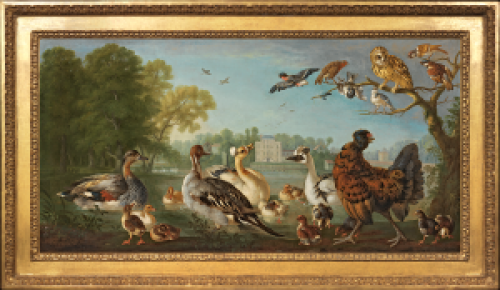
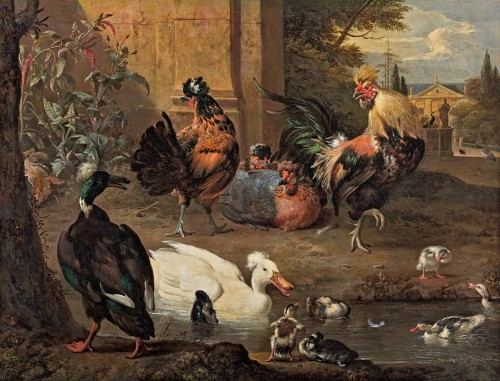
A cockerel, hens and ducks in a park landscape, with a mansion and peacocks beyond
Signed upper centre: MD Hondekoeter
Oil on canvas: 39 5/8 x 51 ½ in / 100.6 x 130.8 cm
Frame size: 41 x 61 in / 104.1 x 154.9 cm
In an English Louis XIII style carved and gilded frame
Painted circa 1680-85
Provenance:
Newhouse Galleries, New York;
from which acquired by a private collector, USA;
by descent to their grandchild
Melchior de Hondecoeter was one of the most renowned bird painters of the seventeenth century, an age when this genre reached its apogee. Known as the ‘Raphael of bird painters’ in the nineteenth century, his fame rivalled that of his uncle and teacher Jan Baptist Weenix (1618/19-1659), another specialist in bird and game pieces. After spending his early career in The Hague, Hondecoeter moved to Amsterdam in 1664, where he spent the rest of his life. Amsterdam was the commercial powerhouse of the northern Netherlands. Hondecoeter gained many commissions for the town houses and country estates of wealthy Amsterdam burghers, often working in a large format on the scale of life, or greater.
Hondecoeter sometimes painted exotic fowl such as pelicans, which could be observed in fashionable menageries. However, this composition focusses on domestic ducks and hens, albeit special breeds with beautiful plumage. The strutting cockerel at the right is full of life and brilliantly observed with the play of light over his multicoloured feathers. In the background is an Italianate mansion with a statue and a peacock and peahen, all status symbols in the seventeenth century Netherlands which looked to Italy as the sine qua non of sophistication.
Hondecoeter seems to have composed his paintings by reference to oil sketches taken from life, rather than the drawings relied upon in other studios. Several of the delightful ducklings in the foreground are derived, sometimes in mirror image, from an oil sketch of seven chicks on one canvas in the Rijksmuseum, Amsterdam[1].
MELCHIOR DE HONDECOETER
Utrecht 1636 - 1695 Amsterdam
Melchior de Hondecoeter, known in the nineteenth century as the ‘Raphael of bird painters’ is one of the most renowned seventeenth century Dutch masters in this field. He was born into a family of artists and studied with his father Gijsbert Gillisz. de Hondecouter (1603/4-1653) and his uncle Jan Baptist Weenix (1618/19-1659).
Hondecoeter worked in The Hague from August 1658, in the house of the art collector Philemon Lissant. The following year he joined The Hague guild. In 1663 he married a girl from Amsterdam and by September 1664 had moved to his new wife’s home city, where he obtained citizenship in 1668. Melchior de Hondecoeter painted a variety of domestic and exotic birds distinguished by their brightly coloured and carefully observed plumage. These birds were often set in farmyards, courtyards or elegant parks and enhanced by the introduction of architectural features or distant landscape views. His compositions were sometimes enlivened by cocks fighting and attacks from birds of prey. Two highly unusual allegorical works, traditionally entitled Emblematic representations of King William’s wars (Holkham Hall, Norfolk) depict birds battling monsters and, in the lower half, naval battles and the destruction of war.
Hondecoeter appeared to study his birds from the life chiefly in oil sketches rather than by making drawings. One of these modelli, Study of ducklings, was sold at Lempertz, Cologne on 20th May 1995, lot 864. During his lifetime, Hondecoeter’s works were greatly sought after. He painted large, decorative murals for the town and country houses of rich Amsterdam burghers. Outstanding among these are the murals which adorned Driemond, a large country house near Weesp that belonged to the merchant Adolph Visser (parts are now in the Alte Pinakothek, Munich).
The work of Melchior de Hondecoeter is represented in the Rijksmuseum; the Historisch Museum, Amsterdam; the Alte Pinakothek, Munich; the Metropolitan Museum of Art, New York; the Hermitage, St Petersburg and the National Gallery, London. Numerous paintings in country houses in England and abroad are still in situ.
[1] Painted circa 1665-68. Oil on canvas: 12 ½ x 15 in / 32 x 38 cm. Inv. no.SK-A-5023.