MICHEL-MARTIN DRÖLLING
1786 – Paris - 1851
Ref: CD 225
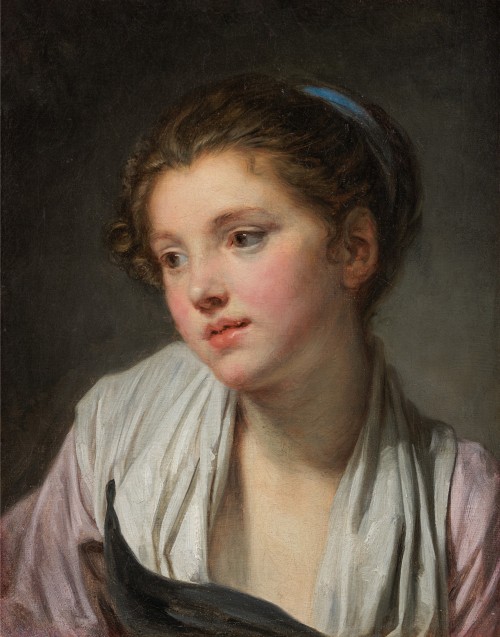
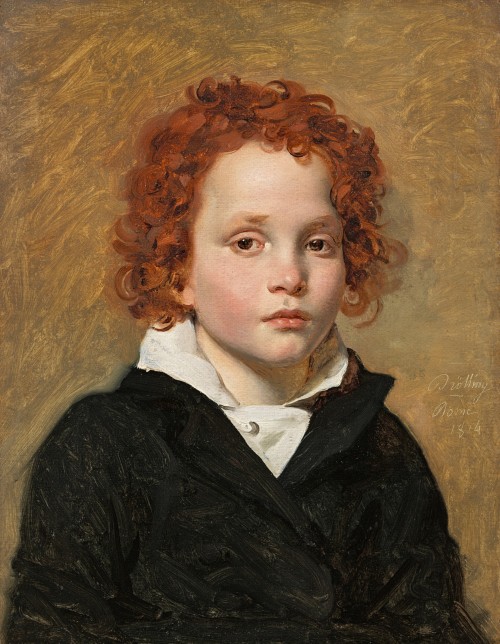
Portrait of a young boy with red hair
Signed and dated lower right: Drolling / Rome / 1814
Oil on canvas: 19 x 14 ½ in / 48.3 x 36.8 cm
Frame size:
In a
Provenance:
Auguste-Jean-Baptiste Vinchon (1786-1855);
by descent
Etude Odent, Tours, 11th October 1998, lot 44 (FFr.720,000)
Simon Dickinson, Geneva and London, 1999;
from whom acquired by a private collector, France
This charming, spontaneous portrait, executed in a single morning in the golden light of a Roman studio, was made when Michel-Martin Drölling was halfway through his sojourn as a pensionnaire of the Villa Medici, having won the prestigious Prix de Rome in 1811. This was a full scholarship of three to five years inaugurated in the mid-seventeenth century by Louis XIV. From 1803 the prize winners lived and worked in the magnificent villa at the top of the Spanish Steps which housed the French Academy in Rome.
The son of the German-born, Paris-domiciled artist Martin Drölling (1752-1817), Michel Martin had previously been the pupil of Jacques-Louis David (1748-1825), whose towering career spanned the ancien régime, the bloody years of the Terror (which he enthusiastically endorsed) and the Napoleonic era. Drölling’s career was more tranquil, encompassing the Neoclassical history painting of his master and the religious revival of the Bourbon Restoration.
Drölling was a superb portraitist, particularly of children, approaching them with a sincerity and simplicity which is deeply moving. This is apparent in his 1816 Portrait of Caroline Hayard, daughter of the chemist and artists’ colourman Charles Hayard, which has recently been acquired by the Louvre; Hayard’s shop was a focus for French-speaking artists passing through Rome. We do not know the identity of the striking red-haired boy in the present portrait, but he is surely an acquaintance, not a Roman urchin. The child’s gaze is steady and cool. Despite the speed at which it was painted, the face with its tumble of dark-red curls is carefully observed, light playing over the boy’s flawless skin with its slight blush of red on the cheeks. The head is contrasted by the white collar and dark coat, which are more broadly painted, and by a neutral, scumbled background.
Drölling sent this painting to Paris along with an important Classical history subject, Philoctète à l’Ile de Lemnos (whereabouts unknown) and a study of a woman in the dress of a Neapolitan peasant. He wrote to his father in Paris on 7th September 1814: ‘j’ai profite de l’envoie pour y joindre 2 têtes d’études: une femme en habit de paysanne du royaume de Naples et l’autre un petit garçon qui a les cheveux rouges. Cette dernière a été faite en une matinée. Informe-toi bien du jour où tout cela arrivera afin de retirer les deux têtes en question car je ne veux pas qu’elles soient exposées, elles n’en valent pas la peine’[1]. Despite Drölling’s downplaying of the Young boy with red hair as a study, not worthy to be sent for exhibition, it has far more fascination for us today than his rather stiff, Neoclassical history paintings.
Note on the provenance
The first owner of this delightful work was Auguste-Jean-Baptiste Vinchon (1786-1855), an artist who won the Premier Prix de Rome in 1814, the year that this painting was made, and sojourned at the Villa Medici from 1816 to 1818. In his later career Vinchon moved in the same academic artistic circles as Drölling, becoming known as one of the juste milieu painters who steered a course between strict Neoclassicism and the Romanticism of painters such as Delacroix. Vinchon and Drölling both worked on the decoration for the new Parisian church of Notre-Dame-de-Lorette, Drölling contributing Christ among the Doctors and Vinchon The Presentation of the Virgin (1823-36, both in situ). It is not known when Vinchon acquired Portrait of a young boy with red hair, but it descended in his family until sold at Etude Odent, Tours, 11th October 1998, lot 44. Also in this sale from the family were portraits and studies from Vinchon’s Roman stay, as well as a copy of the Portrait of a young boy with red hair attributed to Vinchon. Drölling’s tender depiction of the child was clearly an inspiration to his fellow painter, as well as a treasured souvenir of carefree days of youthful learning in the radiant light of the Eternal City.
MICHEL MARTIN DRÖLLING
1786 – Paris – 1851
Michel Martin Drölling was the son of the German genre and portrait painter Martin Drölling (1752-1817), who had moved to Paris to study at the Académie Royale and who later painted designs for Sèvres. Michel Martin studied with his father and in 1806 entered the studio of the famed neoclassical history painter Jacques-Louis David (1748-1825). Strongly influenced by David, Drölling obtained the Prix de Rome in 1810 with The anger of Achilles (Ecole National Supérieure des Beaux-Arts, Paris). He studied at the Villa Medici in that city from spring 1811 to June 1816. Back in Paris, Drölling exhibited The death of Abel at the Salon in 1817. He decorated two ceilings in the Musée Charles X in the Louvre and gained two commissions from the Musée d’Histoire in Versailles, The Tours States-General, 1836 and the Alexandria Convention, 1837.
Drölling’s genre paintings show a porcelain smoothness and attention to detail and light influenced by the seventeenth century Dutch paintings which had also impressed his father. His portraits likewise show a classical calm, subtle observation of personality and exquisite light effects. He often set his sitters in landscapes, for example the Portrait of Jacques-Antoine Manuel, 1822 (Musée des Beaux-Arts de Brest). The neoclassical lines of his portrait drawings, such as the Portrait of Mademoiselle Julie Duvidal de Montferrier (Louvre, Paris), have much in common with the work of Jean-Auguste-Dominique Ingres (1780-1867), a slightly older pupil of David and Villa Medici pensionnaire. Drölling emulated David in history paintings like The Separation of Hecuba and Polyxenas, 1824 (Musée Crozatier, Le Puy). From 1823 to 1836 he worked on the decoration of the new neoclassical church of Notre-Dame-de-Lorette, Paris, producing Christ among the Doctors (in situ). Drölling had many pupils, including Paul Baudry, Jules Breton and Jean-Jacques Henner. He died in Paris in 1851.
[1] Carole Blumenfeld, ‘Les conseils avisés d’un peintre à son fils: la correspondence entre Martin Drölling (1752-1817) et Michel-Martin Drölling (1786-1851), Bulletin de la Société de l’Histoire de l’Art Français, 2009-10, pp.318-319.