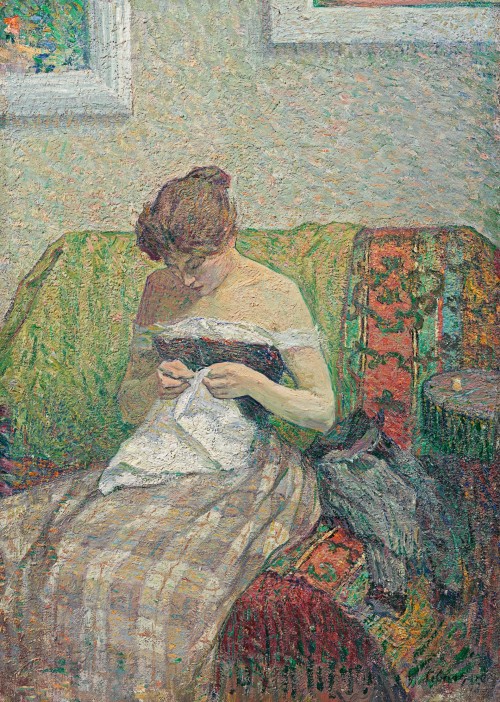
HENRI LEBASQUE
Champigné 1865 - 1937 Le Cannet
Ref: CD 212
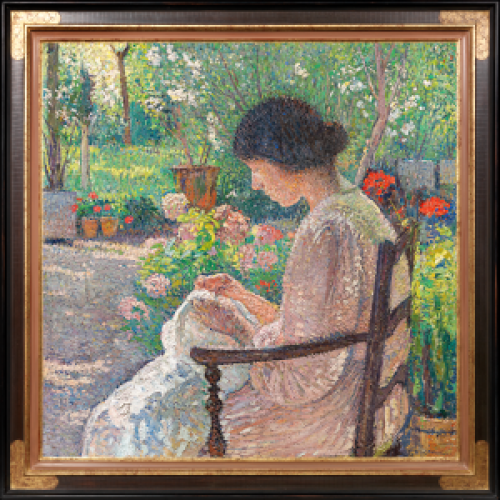
Femme cousant
Signed and dated lower right: H Lebasque 93
Oil on canvas: 18 x 13 in / 45.7 x 33 cm
Frame size: 25 x 20 in / 63.5 x 50.8 cm
Provenance:
Monsieur Olivier Sainsère (1852-1923)
Arthur Tooth & Sons, London, inv. no.6981 and S8982, by 1965
Christie’s Houston, 6th April 1970, lot 51
Schweitzer Galleries, New York
Hammer Galleries, New York
Private collection, London
Exhibited:
Paris, 10th Exposition des Indépendents, 1894, no.455
London, Arthur Tooth & Sons, The Rim of Impressionism, 16th March-3rd April 1965, no.14, illus.
London, Arthur Tooth & Sons, Pointillism, 7th-25th June 1966, no.10, illus.
Literature:
Paul Vitry, Henri Lebasque, Paris 1928, p.19, illus.
Denise Bazetoux, Henri Lebasque, Catalogue Raisonné, vol. I, Neuilly-sur-Marne 2008, p.191, no.664, illus.
Mme Christine Lenoir has confirmed the authenticity of this work
Femme cousant, made in 1893, is one of the outstanding works of Henri Lebasque’s early career, demonstrating his talent both as a draughtsman and as a colourist. Born in Champigné in the Loire valley, he came to Paris in 1885 and passed the stringent exams for admission to the Ecole des Beaux Arts, which taught a conservative, academic curriculum based on history painting. He studied in the atelier of the portraitist Léon Bonnat and came into contact with Edouard Vuillard (1868-1940) and Pierre Bonnard (67-47), founders of the group known as the Nabis (Prophets). Femme cousant reflects the Nabis’ interest in domestic, intimate subject matter and their love of pattern.
A young woman sits on a sofa, absorbed in her sewing. In the privacy of her own home, she has taken off her jacket and sits at her ease with her chemise shrugged off her bare shoulders, exposing a creamy expanse of flesh described by Lebasque in blended brushwork bounded by the finest of green and black lines. There is nothing flirtatious about the woman, who is seemingly unaware of any viewer, but the outlines of her body are imbued with a delicate sensuousness. The model is probably Catherine, known as Ella, whom Lebasque was to marry the following year. The couple had two daughters, Marthe and Hélène. A contented family life was to inspire many of Lebasque’s paintings thereafter.
The young woman sits serenely cocooned within a swirl of colours and patterns evoked by Lebasque with brilliantly varied brushwork, showing how far he had moved from the smooth manner of his academic training. The wall behind the sofa is composed from staccato, blended dots of pale green and pink, two bright, white-framed paintings forming highlights that chime with the young woman’s white chemise and her sewing. Her full, checked skirt is a dance of linear threads, while to the right a richly-coloured, exotic textile cascades over the sofa in crosshatched brushstrokes which summon up shadows. The obsession with pattern and texture can be compared to paintings by Vuillard such as Interior, the dressmaking room, 1893 (private collection, USA), although Lebasque is not interested in the flattening and abstraction of elements in the composition evident in Vuillard’s work[1]. He was also moving into the orbit of the Pointillist painters Paul Signac (1863-1935) and Maximilien Luce (1858-1941), without ever fully embracing the mechanistic aspects of Pointillism. Beautifully balanced, acutely observed and shimmering with colour, Femme cousant is Lebasque at his independent best.
Lebasque showed this painting at the Salon des Indépendents in 1894, his second year of exhibiting at that forum. Its first owner was the lawyer and politician Olivier Sainsère (1852-1923), a major collector and supporter of the arts. Sainsère sat on many art committees and owned a number of works by Lebasque. As a member of the Conseil Supérieure des Beaux-Arts, he was able to announce to Lebasque that his painting Le goûter sur l’herbe (Musée d’Angers) had been acquired by the French State at the Salon of 1903. Sainsère’s collection included works by Monet, Renoir, Seurat, Vuillard, Toulouse-Lautrec and Matisse. He was a major patron of Picasso.
HENRI LEBASQUE
Champigné 1865 - 1937 Le Cannet
Hailed by critics and artists alike as ‘the painter of the good life’, Henri Lebasque was acclaimed for his individuality, his delicate sense of light and his personal charm. Such were the qualities that prompted Beaunier to write: ‘Lebasque merits the renown of a lovely original artist, who knows his calling, uses it well, and never abuses it’ (Gazette des Beaux Arts, May 1908, p.366).
Born in Champigné in the Loire valley, the son of a wood merchant, Lebasque went to Paris in 1885 and studied at the Ecole des Beaux Arts. He then entered the atelier of the portraitist Léon Bonnat and began to exhibit at the annual art society exhibitions and the Paris Salons. He later assisted Ferdinand Humbert with the decorative murals of the Panthéon.
Lebasque’s vision was coloured by his contact with Edouard Vuillard (1868-1940) and Pierre Bonnard (1867-1947), founders of the Nabis group and Intimists who favoured the calm and quietude of domestic subject matter. From his acquaintance with Seurat and Signac, Lebasque learnt the significance of a colour theory which stressed the use of complementary colours in shading.
Lebasque was a founding member of the Salon d’Automne in 1903 with his friend Matisse. Two years later a group of artists exhibited there who included Rouault, Derain, Vuillard, Manguin and Matisse. They were dubbed ‘Les Fauves’ for their stylistic ‘savagery’. The critic Vauxcelles noted that Lebasque’s talent arrived ‘in the midst of the roaring of the unchained beasts’. Like Les Fauves, Lebasque adopted a similar flattening of the picture plane, but blended with a sophisticated, subtle fluidity. He painted domestic scenes with his family as models, still lifes, landscapes, portraits and nudes.
From 1900 to 1906 Lebasque lived at partly at Lagny on the Marne, but also visited Paris, London and Venice. He was enchanted by the light of the Midi on a trip to St Tropez in 1906 and spent many summers in the south of France. During the First World War, Lebasque was a war artist. He exhibited in America from 1916 and from 1918 was represented by Galeries Georges Petit. In 1924 Lebasque moved to Le Cannet on the French Riviera, where he shared a model with his friend and neighbour Bonnard. He died in Le Cannet on 6th August 1937.
The work of Henri Lebasque is represented in the Louvre, Paris; the Musée d’Orsay, Paris; the Musée d’Angers; the Fine Arts Museums of San Francisco, CA; the Fogg Art Museum, Harvard University, Cambridge, MA; the Nelson-Atkins Museum, Kansas City, MO; the National Museum of Western Art, Tokyo; the Statens Museum for Kunst, Copenhagen and the Thyssen-Bornemisza Museum, Madrid.
[1] Antoine Salomon and Guy Cogeval, Vuillard: The Inexhaustible Glance. Critical Catalogue of Paintings and Pastels, Milan 2003, vol. I, p.291, no.IV-116, illus. in colour.