OSIAS BEERT THE ELDER
Kortrijk c.1580 - 1624 Antwerp
Ref: CD 226
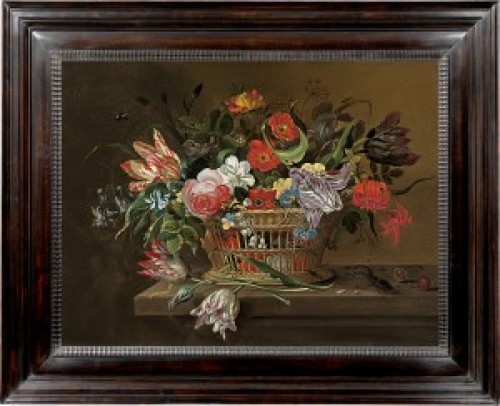
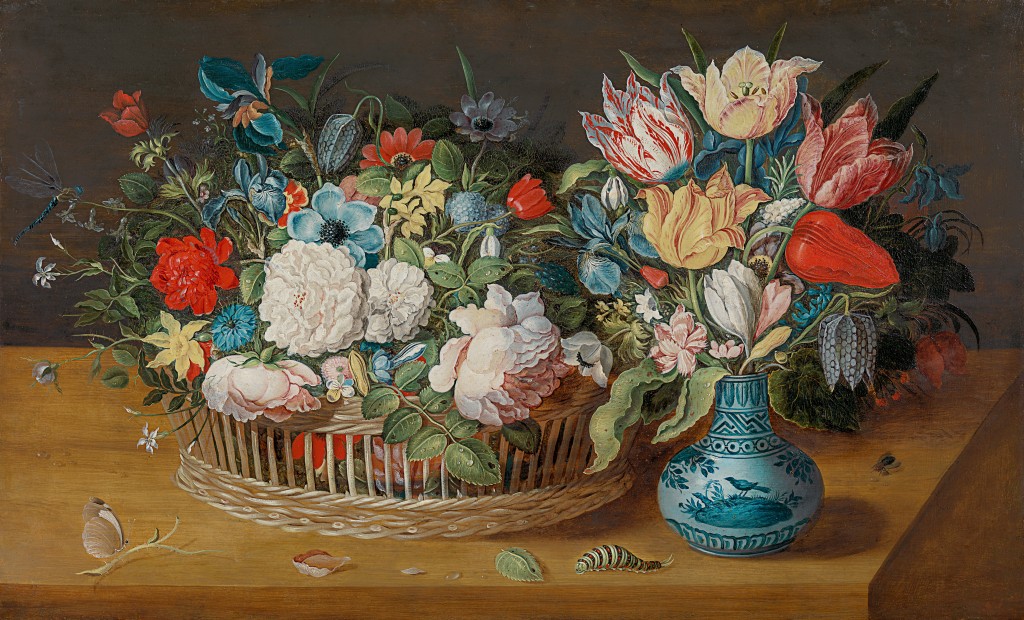
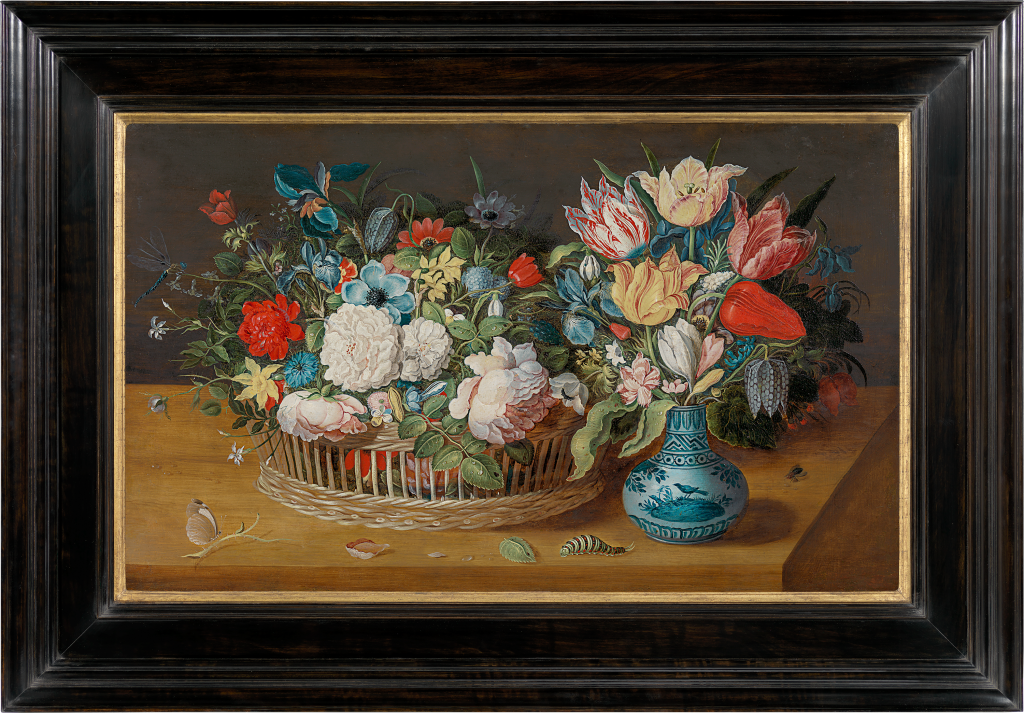
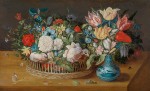
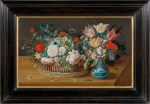
Still life of flowers in a reed basket and a Wanli porcelain vase on a ledge
Oil on panel: 15 ¼ x 25 ¼ in / 38.7 x 64.1 cm
Frame size:
Painted circa 1610-20
CD 226
OSIAS BEERT
Circa 1580 – Antwerp - 1623
Still life with flowers in a reed basket and a Wanli porcelain vase on a ledge
Oil on panel: 15 3/8 x 25 3/8 in / 39.1 x 64.5 cm
Frame size: 22 ½ x 33 in / 57.3 x 83.8 cm
Painted circa 1610-20
Provenance:
Aspelin Collection, Sweden
Bukowskis, Stockholm, 1920s
Gösta Stenman Gallery, Stockholm, 1934
Count Carl von Rosen Collection, Stockholm
Counsellor Wallin Collection, Stockholm
Bukowskis, Stockholm, 6th November 1975, lot 5;
Richard Green Gallery, London, 1975;
Alfred Studer, Liechtenstein, acquired from the above;
private collection, Switzerland;
Koller, Zurich, 23rd March 2016, lot 3031;
Richard Green Gallery, London, 2016;
private collection, Belgium
Exhibited:
Stockholm, Gösta Stenman Gallery, 1934
London, Richard Green Gallery, Annual Exhibition of Old Masters, 1976, p.14, no.5, illus. in colour
Literature and documentation:
Olof Granberg, Inventaire général des trésors d'art, peintures & sculptures, principalement de maîtres étrangers (non-Scandinaves) en Suède, vol. III, Stockholm 1913, no.97 (as by Balthasar Van der Ast)
Marie-Louise Hairs, Les peintres Flamands de fleurs au XVIIe siècle, Brussels 1985, no.115, pp.342-3, illus.
Sam Segal, Flowers and Nature, The Hague 1990, p.183, footnote 2
Klara Alen, Osias Beert. Pioneer of the Antwerp Laid Table and Flower Still Life, forthcoming
RKDimages database no.14703 (https://rkd.nl/explore/images/14703)
Sam Segal documentation (RKD The Hague), no.3202
Around 1600, the still life as an independent genre emerged in the Netherlands. Osias Beert was one of the remarkable figures during the development of the early flower still life, together with such painters as Jan Brueghel the Elder (1568-1625), Jacques de Gheyn (1565-1629), Roelandt Savery (1576-1639) and Ambrosius Bosschaert the Elder (1573-1621). Beert produced a rich variety of still-life paintings, varying from sumptuous laid tables with oysters, fruit and wine to brilliant flower bouquets[1].
Little is known about the life of Osias Beert. He must have been born in Kortrijk around 1580. Shortly after, in the spring of 1582, the family moved to Antwerp. Osias Beert entered the Antwerp Guild of Saint Luke in 1596 as an apprentice to Andries van Baesrode, an otherwise unknown painter. In 1602, Beert was admitted as a master. In 1606, he married Margareta Ykens in the Church of Our Lady. Between 1605 and 1618, Beert had six apprentices, among whom his nephew Frans Ykens (1601-ca. 1692). The artist died in Antwerp in 1623. Art historians have rediscovered Beert and his oeuvre only just in the twentieth century, but in his time, the artist must have held a good reputation. He collaborated with Rubens as a flower specialist for Pausias and Glycera[2].
The Still life with flowers in a reed basket and a Wanli porcelain vase on a ledge illustrates a new type of still life among the flower paintings and one of Beert’s specialisms: the complex of a combined flower still life. In these works, Beert combined flowers in two, three or even four containers within the same painting[3]. The present painting is one of the six combined flower pieces of Beert known so far. The artist always combined flowers in a reed or lacquerware basket, a glass or a vase of serpentine or Chinese porcelain.
This flower piece contains a remarkable diversity of flowers, insects and even a butterfly (cf. the identification list[4]). Like all early flower paintings, the flowers in this work consist of varieties from different seasons. In reality, these flowers could never have bloomed at the same time. Painters sometimes worked for months on different paintings at the same time, or took inspiration from sketches, drawings and prints.
In the Still life with flowers in a reed basket and a Wanli porcelain vase on a ledge, fairly large flowers fill the greater part of the picture. In the reed basket, pink and white roses draw attention. The flowers in the basket are abundant and many of them overlap. The bouquet in the Wan-Li vase is executed more archaically. The red and yellow tulip shows its pistils to the viewer. This tulip forms a main axle around which the other flowers are neatly organized in a symmetric manner.
This particular painting is an autograph work by Osias Beert and shows many of the
characteristics of the artist’s flower pieces, for example the flat white increases and the sinuous, impasto delineations of flowers in white or light pink. The well-preserved yellow colours are characteristic of Beert’s work and can be explained by his working method. Beert mixed lead white with other pigments to stabilize yellowish hues. Butterflies and other insects also reveal Beert’s personal hand. The corners of the butterflies are often rounded, and the caterpillars and dragonflies are frequently s-shaped and fairly plump. In addition, the almost identical objects that are repeated in several works, are also typical of Beert’s paintings. The beautiful Wan-Li vase found in this work, returns in another one of Beert’s paintings. Here, the bird rests on foliage and not on a small piece of earth[5].
Beert never dated his works. Only a few works offer references to date his work as they were painted on copper that contains a mark with the years 1607 to 1609 on the verso. More accurate dating of works not bearing such a mark – the vast part of Beert’s oeuvre – should always be done with caution. In the case of the present painting, the complexity of the composition, the overlap of the basket and the vase, the overlap in the flowers, the combination with the insects, the butterfly and the single rose pads on the ledge might indicate a later period in his career, between 1610 and 1620.
Symbolism is never explicitly present in Beert’s still-life paintings. The worm-eaten leaves and the fallen petals could imply a Vanitas. The caterpillar may refer to the life before death, while the butterfly may symbolise the liberated soul, which, after a virtuous life, may rise to heaven in the hereafter.
Work of Osias Beert can be found in many public collections, including the Rijksmuseum in Amsterdam, the Rockoxhuis in Antwerp, the Gemäldegalerie Alte Meister in Berlin, the Museum of Fine Arts in Brussels, the Wallraf-Richartz Museum in Köln, the Museo del Prado in Madrid, the Ashmolean Museum in Oxford, the Musée du Louvre in Paris, the Staatsgalerie in Stuttgart and the National Gallery of Art in Washington.
Dr Klara Alen
Dr Klara Alen is the Research Curator Historical Garden, Rubenshuis, Antwerp and co-author, with Dr Sam Segal, of Dutch and Flemish Flower Pieces. Paintings, Prints and Drawings up to the Nineteenth Century (Leiden 2020).
Spring Crocus Crocus vernus
Yellow Crocus Crocus stellaris
Liverwort Hepatica nobilis
Pansy Viola tricolor
Daisy Bellis perennis subplena
Peacock Anemone Anemone pavonina
Apothecary’s Rose Rosa gallica cv. Officinalis
Jasmine Jasminum officinale
White Rose Rosa x alba
Yellow Radial Narcissus Narcissus radiifloru flavus
Peacock Anemone Anemone pavonina
Love-in-a-Mist Nigella damascena
White Rose Rosa x alba subplena
Pansy Viola tricolor
Jonquil Narcissus Narcissus jonquilla
Poppy Anemone Anemone coronaria cinerea
French Marigold Tagetes patula
English Iris Iris latifolia
Siberian Iris Iris sibirica
Rose Campion Lychnis coronaria
Hyacinth Hyacinthus orientalis albus
Poppy Anemone Anemone coronaria
Elongated Crocus Crocus elongata
Marsh Speedwell Veronica scutellata
Snake’s Head Fritillary Fritillaria meleagris
Star Anemone Anemone hortensis
Peacock Anemone Anemone pavonina
Snowball Viburnum opulus roseum
Peacock Anemone Anemone pavonina
Grape Hyacinth Muscari botryoides
Snowdrop Galanthus nivalis
Pansy Viola tricolor
White Spring Crocus Crocus vernus subsp. albiflorus
Spring Crocus Crocus vernus roseus
Scottish Crocus Crocus biflorus
Liverwort Hepatica nobilis rosea
Carnation Dianthus caryophyllus duplex
Poppy Anemone Anemone coronaria alba
Liverwort Hepatica nobilis alba
Golden Narcissus Narcissus tazetta subsp. aureus
Blunt Tulip Tulipa mucronata f. obtuse
English Iris Iris latifolia
Snowdrop Galanthus nivalis
Tapered Tulip Tulipa armena bicolor
Fire Tulip Tulipa praecox bicolor
Spanish Iris Iris xiphium
Rosemary foliage Rosmarinus officinalis
Tapered Tulip Tulipa armena albescens
Columbine Aquilegia vulgaris
White Grape Hyacinth Muscari botryoides cv. Album
Peacock Anemone Anemone pavonina lilacina
Red Tulip Tulipa agenensis
Hyacinth Hyacinthus orientalis
Snake’s Head Fritillary Fritillaria meleagris
a Large White (butterfly) Pieris brassicae
b American Lady (caterpillar) Vanessa virginiensis
c Fen Hawker (dragonfly) Aeschna juncea
d Bluebottle fly Calliphora vomitoria
[1] See for example Osias Beert, Flowers in glass vase in a niche, panel, 29 x 20 ¼ in / 73.5 x 51.5 cm. Rockoxhuis, Antwerp. Osias Beert, Laid table with oysters, fruit and wine, panel, 20 ¾ x 29 in / 52.9 x 73.4 cm. National Gallery of Art, Washington, no. 1995.32.1.
[2] Peter Paul Rubens and Osias Beert, Pausias and Glycera, canvas, 80 x 76 ½ in / 203.2 x 194.3 cm. The John and Mable Ringling Museum of Art, Sarasota, FL, no.SN 219.
[3] See for example Osias Beert, Still life with flowers in four different containers, panel, 37 ¾ x 47 ¼ in / 96 x 120 cm. Private collection.
[4] I would like to thank Dr. Sam Segal for his kind help.
[5] Osias Beert, Flowers in a Wanli vase, panel, 13 ¾ x 9 ½ in / 35 x 24.5 cm. Private collection.