MICHELE MARIESCHI
1710 - Venice - 1743
Ref: CD 166
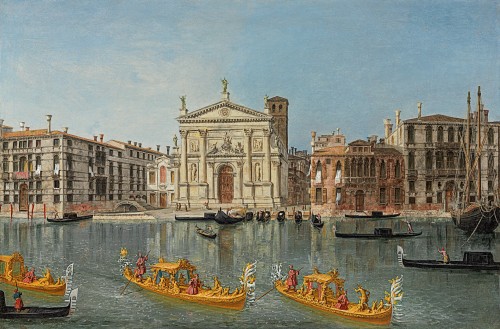
Venice: the Grand Canal with San Stae and the gilded gondolas of Luigi Pio di Savoia, Imperial Ambassador to Venice
Oil on canvas: 22 3/8 x 33 ½ in / 56.8 x 85.1 cm
Frame size: 28 x 39 in / 71.1 x 99.1 cm
Painted circa 1738-39
Provenance:
Probably commissioned in Venice in 1738 by Henry Howard, 4th Earl of Carlisle (1694-1758), Castle Howard, Yorkshire and supplied through the agency of the antiquarian Anton Maria Zanetti the Elder (1680-1767) by 3rd June 1740;
by descent at Castle Howard to the Hon. Geoffrey WA Howard (1877-1935);
Christie, Manson & Woods, London, Catalogue of Pictures by Old Masters from the Collection at Castle Howard, York, and Sold by Order of the Executors of the late Honourable Geoffrey WA Howard, 18th February 1944, lot 13 (A view on the Grand Canal, Venice, with gondolas and figures, erroneously attributed to Canaletto, with a pendant, View of the Piazza di San Marco; the pair sold for £189 to Koetser)[1];
Leonard Koetser, London;
from whom acquired on 7th November 1944 by Thomas Agnew & Sons, London, inv. no.11162;
from whom acquired on 21st November 1944 by Ivor Guest, 2nd Viscount Wimborne (1903-1967), Ashby St Legers Manor, Northamptonshire[2];
by descent to Ivor Guest, 4th Viscount Wimborne (b.1968)
Literature:
Manuscript list, undated, in the hand of Anton Maria Zanetti the Elder’s secretary, listing this painting as no.14: Veduta della Chiesa di S: Stae con altri Palazzi sopra il Canal Grande, et le tre gondole livree dell’Ambasciatore Cesareo (Castle Howard Archives)
Born in the parish of San Marcuola, one of the poorest parts of Venice, the eldest child of an engraver, Michele Marieschi appears to have been driven and ambitious, his perfectionism allegedly contributing to his early death in 1743. Marieschi spent the first part of his career as a stage designer and turned to view painting in the 1730s, encouraged by the success of Canaletto.
Marieschi found major Venetian patrons, notably the commander of the Republic’s army, Marshal Johann von der Schulenburg. His work was also collected by the English Milordi for whom Venice was an essential stop on their European Grand Tour. This painting has recently been rediscovered as one of a group of eighteen works by Marieschi supplied
around 1740 by the antiquarian Anton Maria Zanetti the Elder (1689-1767) to Henry Howard, 4th Earl of Carlisle (1694-1758) for Castle Howard, Yorkshire.
Marieschi’s lively sense of Venice as a great outdoor theatre is reflected in his shimmering brushwork, which invests the famous buildings of the Grand Canal with an air of magic. Dominating this view is the church of San Stae, with one of the richest baroque facades in the city. Dedicated to the early Christian martyr Sant’Eustacio (Stae in Venetian dialect), it was reconstructed in 1709 to a design by Domenico Rossi, a pupil of Longhena. San Stae was under the patronage of the Mocenigo family, whose palazzo lies behind the church.
To the left of San Stae is the Scuola dei Tiraoro e Battioro, headquarters of a modest guild of artisans who made gold thread and gold leaf. Further left, beyond the Rio della Pergola, is the imposing block of the late sixteenth century Palazzo Foscarini-Giovanelli. To the right of the church is the gothic Palazzo Priuli Bon, lacking the third storey which was added later, and finally Palazzo Giustinian, later Palazzo Contarini, which burned down in the mid-nineteenth century and was replaced by a garden.
Gliding across the foreground are three magnificent ceremonial gondolas belonging to Luigi Antonio Pio di Savoia (1674-1755), Imperial Ambassador to Venice. Their gilt allegorical figures and scarlet-liveried gondoliers contrast with the cool blue of the Grand Canal and the serene cerulean of the sky, bringing both glamour and a sense of movement to the composition. Ceremonial gondolas were a familiar feature of Venetian life, where politics was played out with the flamboyance and finesse of a drama. They made ideal subjects for the vedute painters seeking to catch the essence of the city for clients taking souvenirs back to chilly northern Europe. Canaletto, for example, painted Luigi Pio di Savoia’s Ambassadorial predecessor in The Entry of the Imperial Ambassador Giuseppe Bolagnos to the Doge’s Palace on 16th May 1729 (Crespi Collection, Milan).
Luigi Pio di Savoia was the second son of Gilberto Pio di Savoia, Prince of San Gregorio and Duke of Nocera, and the Spanish noblewoman Juana de Moura. After an early career as a soldier for the Habsburg Holy Roman Emperor, he was Chief Director of Court Music in Vienna from 1721 to 1732. Among his duties was overseeing productions for the Italian opera; in 1729 he persuaded the famous Italian poet and librettist Metastasio to come to Vienna. This passion for the theatre would have given Luigi Pio di Savoia a natural affinity with Marieschi, who started his life as a scene painter. According to Pietro Guarienti, Marieschi worked for a while as a set designer in Germany.
In 1732 Luigi Pio was appointed Imperial Ambassador to Vienna by Charles VI, an appropriate position for a Habsburg loyalist who was of Italian noble blood. He chose as his Embassy the gothic Palazzo Correr in Riva di Biasio, not far along the Grand Canal from the church of San Stae. In a letter of 6th December 1732 to the Emperor Charles VI, Luigi Pio described his official entry to Venice as Ambassador, starting at the island of San Secondo at the head of the Grand Canal and processing with his three golden gondolas to the Palazzo Correr, accompanied by Venetian Senators in their crimson robes[3]. Flaming torches greeted the party at the palazzo, as well as a band of forty-two musicians. ‘Machines’ flowed red and white wine and the evening ended with another baroque theatrical ‘machine’ delivering a firework display on the Grand Canal. Dario Succi suggests that the theatrical wizard Marieschi may have had a hand in the design of these complex machines[4].
As can be seen in Marieschi’s painting, Luigi Pio’s gondolas called forth the full genius of the Venetian carvers’ and gilders’ art[5]. Each was a floating political allegory reflecting the current concerns of the Holy Roman Empire, described in detail in Luigi Pio’s letter. The first had Europe on the prow and Valour holding down Asia. The Empire had long been concerned with the encroachment of the Ottoman Empire on her eastern borders; indeed, the Turks had almost reached Vienna in 1683. The felze (covered cabin) was decorated with figures of Justice, Counsel, War and Reward, while Grace was on the stern. The second gondola bore Peace, Concord and Temperance on the bow, with the Splendour of the Name on the stern. The third gondola had the Greek goddess of wisdom and warfare Pallas on the top, and cherubs with war instruments. Less elaborately decorated than the other two in Marieschi’s painting, it is distinguished by an intricate steel prow, or fero, with the characteristic prongs symbolising the six sestieri (districts) of Venice.
Also in attendance at the entrance ceremony was Luigi Pio’s everyday gondola, itself a luxurious affair with a felze of black velvet and mirrored interior. This gondola can be seen in the left foreground of Marieschi’s work. In Marieschi’s view, the carving on the three gondolas is somewhat simplified and none have passengers, but the double-headed eagle of the Holy Roman Emperor is prominent in their decoration. In the golden gondola on the left, the felze is shown closed, providing the privacy which enabled countless floating intrigues, both political and amorous.
As Dario Succi has commented, Luigi Pio’s golden gondolas appear in no less than twelve paintings by Marieschi dateable between 1736 and 1740[6], indicating a strong relationship between Ambassador and painter, although not all these works would have been commissioned by Luigi Pio himself. After the death of the Emperor Charles VI in 1740, Luigi Pio was demoted from Imperial to Royal Ambassador, as Charles VI’s heir, Maria Teresa, could, as a woman, only be considered Empress as the wife of her husband Charles of Lorraine (however much she really held the power). Maria Teresa held the crowns of Austria, Hungary and Bohemia in her own right. In 1743, the year of Marieschi’s untimely death, she appointed a new Ambassador to Venice and Luigi Pio retired to Padua.
Three of these views, including the present painting, depict the golden gondolas in front of San Stae. In every case, the gondolas are positioned differently. The second Grand Canal at San Stae was with Richard Green Gallery in 1985 and is now in a Parisian private collection[7]. A larger Grand Canal at San Stae depicts the church further away and three black gondolas in the foreground in front of the three golden ones[8].
Note on the provenance
Until recently, this painting has been unseen in public since 1944, when it was sold by Agnew’s to Ivor Guest, 2nd Viscount Wimborne (1903-1967). Recent research has reconfirmed that The Grand Canal with San Stae was one of the eighteen works by Marieschi acquired circa 1740 by Henry Howard, 4th Earl of Carlisle (1694-1758) through the agency of the Venetian antiquarian and engraver Anton Maria Zanetti the Elder (1680-1767). He was a friend of Marieschi and author of the celebrated cartoon of the artist now in the Fondazione Giorgio Cini, Venice[9]. The 4th Earl of Carlisle was one of the most important English patrons of Venetian vedute painters, amassing around forty works by Canaletto, Bellotto and Marieschi.
In 1738 Henry Howard inherited from his father, the 3rd Earl of Carlisle, Castle Howard in Yorkshire, designed by the soldier-dramatist-architect John Vanbrugh in 1699. The taste for Italian pictures was inaugurated by the 3rd Earl, who commissioned works by Antonio Pelligrini and Marco Ricci. His son undertook a Grand Tour to Italy as a young man, in 1714-15, and again in 1738-39, travelling for the health of his heir Charles, Lord Morpeth. The pair was in Venice by November 1738, travelling on to Rome and Florence before returning to England in November 1739.
Lord Carlisle was clearly fascinated by Venetian vedute, perhaps seeing in the aristocratic Republic of Venice a pattern for the Whig aristocracy to which he belonged. He had met Anton Maria Zanetti in Venice, where he had admired the artist and engraver’s collection of paintings and antique gems. Zanetti wrote to Carlisle on 3rd June 1740 about the paintings by Marieschi acquired through his agency and delivered to Castle Howard early that year: ‘J’ay plaisir que vous avez reçeu les Tableaux; et trouvez a votre gré: Je crois que vous les aurez placés dans votre Maison de Campagne, et que en regardant la ville de Venise vous vous souviendrez de moi: Si quelqu’un de vos amis en est charmé, comme je l’espere, et qu’il les trouve a un prix onet de 6 livres, et qu’il en ait plaisir d’en avoir, vous me fairez grande grace de m’en ordonner pour faire plaisir au Peintre qu’il les a fai, qui est le plus bon homme du monde, et qui en est aussy abil, que Cannaletto, au quel presentement on paye seulement le nom, et la renommée’[10].
Zanetti omits the name of the artist, no doubt to stop Carlisle contacting Marieschi directly and undercutting his prices. The Castle Howard Archives have an undated list of the eighteen paintings supplied, written in the clear hand of Zanetti’s secretary. The present work is no.14: Veduta della Chiesa di S: Stae con altri Palazzi sopra il Canal Grande, et le tre gondole livree dell’Ambasciatore Cesareo.
By 1928 The Grand Canal with San Stae was hanging in the Canaletto Room at Castle Howard with the other works by Marieschi and three Bellottos; they were all at the time attributed to Canaletto (fig. 1). A photograph from Country Life shows the present painting to the far right of the fireplace, second row down in a group of eight[11]. It is clearly distinguished from the larger Marieschi view of San Stae that was with Richard Green Gallery in 1985 by the presence of Ambassador Luigi Pio di Savoia’s ‘everyday’ black gondola visible in the photograph in the foreground left of the composition. It also retains the frame seen in the Country Life photograph.
Seven Marieschis (then attributed to Canaletto) were sold by the 9th Earl of Carlisle in the 1890s. In 1940 a fire ravaged more than twenty rooms at Castle Howard, including the Canaletto Room. The eleven remaining Marieschis were saved but were put up for sale - still described as being by Canaletto - at Christie’s on 18th February 1944 by the Executors of the Hon. Geoffrey Howard. The Grand Canal with San Stae was lot 13, listed as A view on the Grand Canal, Venice, with gondolas and figures, with a pendant, View of the Piazza di San Marco. The pair sold for £189 to Leonard Koetser[12].
Koetser sold the San Stae in November 1944 to Agnew’s, from whom it was acquired on 21st November 1944 by Ivor Guest, 2nd Viscount Wimborne (1903-1967) of Ashby St Legers Manor, Northamptonshire[13]. The Guest fortune derived from the Dowlais Ironworks, once the largest in Europe, founded by Lord Wimborne’s great-grandfather Sir John Guest (1785-1852). The painting has descended in the Guest family.
Fig. 1. A detail of the Canaletto Room at Castle Howard, Yorkshire, 1928, before the fire of 1940. Eight paintings by Marieschi hang on the left, with the present Grand Canal with San Stae outlined in green. Photo: Country Life Picture Library.
MICHELE MARIESCHI
1710 - Venice - 1743
Michele Marieschi was born in 1710 in the parish of San Marcuola, Cannaregio, one of the poorest areas of Venice, the eldest of eight children of an engraver who died when Michele was ten years old. Like Canaletto, he probably began his career as a theatrical scene painter. There is no firm evidence to corroborate Pietro Guarienti’s assertion that Marieschi worked in Germany. His first recorded activity, as an associate of Francesco Tasso, was the preparation in 1731 of the setting for the Carnival Thursday celebrations in the Piazzetta. In the mid-1730s he began to paint capricci influenced by Marco Ricci and Luca Carlevarijs, followed by Venetian views inspired by Canaletto’s success with the genre.
In 1735 Marieschi made two drawings for engravings of Tasso’s decorations for the funeral of Maria Clementina Sobieska, wife of the Old Pretender, at San Paterniano in Fano. The following year he became a member of the Collegio dei Pittori and was paid the handsome sum of fifty-five zecchini by Marshal Johann von der Schulenburg for a sparkling, dramatic View of the courtyard of the Doge’s Palace (private collection, Italy). In 1737 Schulenburg bought Marieschi’s The Grand Canal with the Rialto Bridge from the north and the arrival of the new Patriarch Antonio Correr, 7th February 1735 (Osterley Park, The National Trust); he remained an important patron until the artist’s death. In November 1737 Marieschi married Angela Fontana (d.1751), the daughter of a successful picture dealer, Domenico Fontana. One of his sponsors was the figure painter Gaspare Diziani, who had probably been his mentor in theatre painting and who contributed staffage to Marieschi’s Venetian views.
Marieschi was a highly inventive painter of capricci, which have an almost surreal air derived from his early life as a scene painter. He divided his Venetian views between fairly small canvases and much larger ones, such as those for Schulenburg. The Venetian scenes are characterised by flickering brushwork, strong shadows and deep, dynamic space which gives his work a very individual, almost ‘romantic’ quality. Because Marieschi’s mature career lasted a mere seven years, it is difficult to establish a chronology for his oeuvre. A series of eighteen paintings (now dispersed) commissioned by Henry Howard, 4th Earl of Carlisle, was made in 1739-40. The staffage in Marieschi’s works is often provided by specialist figure painters, including Gaspare Diziani, Giovanni Antonio Guardi, Francesco Simonini and Francesco Fontebasso.
In 1741 Marieschi himself etched a Self-portrait and twenty-one Venetian views of his own composition, which he published as Magnificentiores Selectioresque Urbis Venetiarum Prospectus. This was intended to compete with Antonio Visentini’s Prospectus Magni Canalis Venetiarum (1735), which had brought Canaletto’s compositions to a Europe-wide public. Marieschi’s career was cut short when he died in 1743 at the age of thirty-two, according to Guarienti because of his ‘excessive application to work and study’. His assistant Francesco Albotto (1721-1757) took over his studio and married his widow in 1744.
The work of Michele Marieschi is represented in National Gallery of Ireland, Dublin; the National Museum, Stockholm; the National Gallery, London, the Accademia, Venice; the Museo Correr, Venice; the Fitzwilliam Museum, Cambridge and the Philadelphia Museum of Art.
[1] Oil on canvas: 54.5 x 83.8 cm / 21 ½ x 33 in. Formerly with Il Gabinetto Salamon, Milan. See Dario Succi, Michele Marieschi Opera Completa, Azzano Decimo 2016, pp.161-2, no.7, illus. in colour.
[2] Information from the Agnew’s archive collection held at the Research Centre at the National Gallery, London.
[3] Quoted in Susan Tipton, ‘Diplomacy and Ceremonial in Ambassador Pictures by Carlevarijs and Canaletto’, RIHA Journal, no.8, 2010, accessed online. The original letter is in the Vienna HHSTA, State Departments, Venice, Reports, Box 21, Pio di Savoia 1732-1734.
[4] Dario Succi, Michele Marieschi Opera Completa, Azzano Decimo 2016, pp.58-59.
[5] For another example of an elaborate Ambassadorial gondola, see the print after Luca Carlevarijs, The highly ornamented second gondola of Ambassador Giovanni Battista Colloredo entering Venice, c.1720-30 (Metropolitan Museum of Art, New York).
[6] Succi, op. cit., p.56.
[7] Oil on canvas: 22 x 33 ¼ in / 56 x 84.5 cm. Provenance: Richard Green, 1985; Christie’s London, 6th December 2007, lot 43; private collection, Paris. See Succi, ibid., cat. no.99, pp.280-1; 284-8, illus. in colour. Dario Succi erroneously catalogues this painting as one of the series of Marieschis acquired by Henry Howard, 4th Earl of Carlisle, as the present work was then unknown to him.
[8] Oil on canvas: 32 7/8 x 44 7/8 in / 83.4 x 114 cm. Provenance: Comtesse Benedetti, Paris; her sale, Hôtel Drouot, 12th-13th June 1912, lot 11 (erroneously as by Canaletto); Mme de Saint Alary, Paris; Attilio Staffanoni, Bergamo; Pietro Accorsi, Turin; private collection, Paris, by 1971; Sotheby’s London, 8th July 2009, lot 38; private collection; Robilant & Vuena, London. See Succi, ibid., cat. no.100, pp.286; 288-90, illus. in colour.
[9] The argument for the attribution of the Castle Howard paintings to Marieschi was made by Dario Succi in Mirano, Barchessa di Villa Morosini, Bernardo Bellotto detto il Canaletto, 1999, pp.65-67. See also Succi, Michele Marieschi Opera Completa, op. cit., pp.28-51.
[10] Castle Howard Archives, Mss. J 12/12/18.
[11] H Avray Tipping, ‘Castle Howard-II. Yorkshire, the seat of the Hon. Geoffrey Howard’, Country Life, 11th June 1927, vol. 61, no.1586, p.955.
[12] The pendant: oil on canvas: 54.5 x 83.8 cm / 21 ½ x 33 in. Formerly with Il Gabinetto Salamon, Milan. See Dario Succi, Michele Marieschi Opera Completa, Azzano Decimo 2016, pp.161-2, no.7, illus. in colour.
[13] Information from the Agnew’s archive collection held at the Research Centre at the National Gallery, London.