


GIOVANNI BATTISTA CIMAROLI
Salò, near Brescia 1687 - 1771 Venice
Ref: CD 153
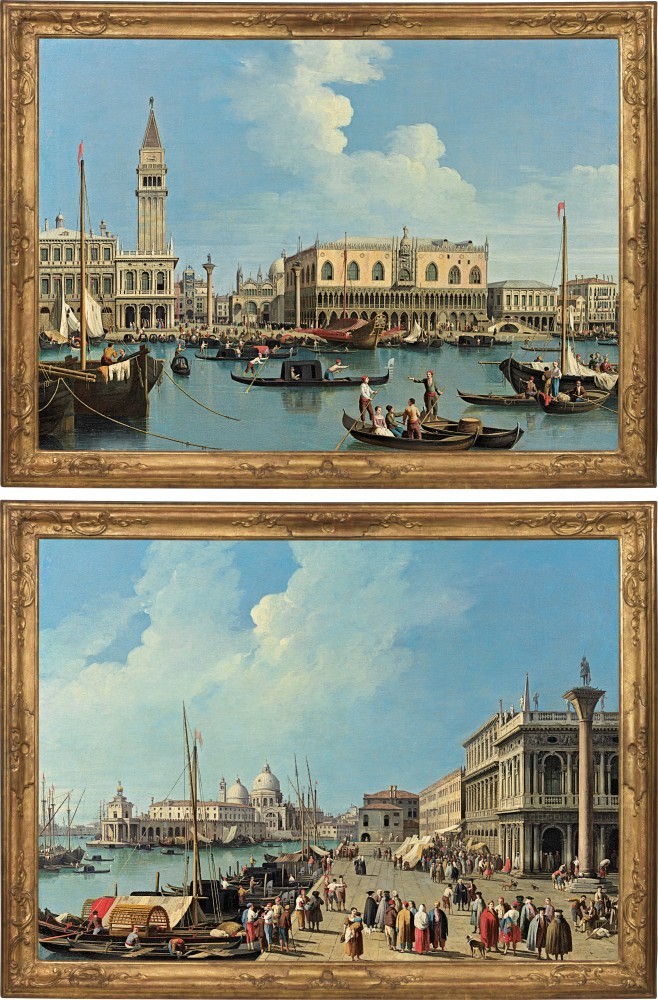
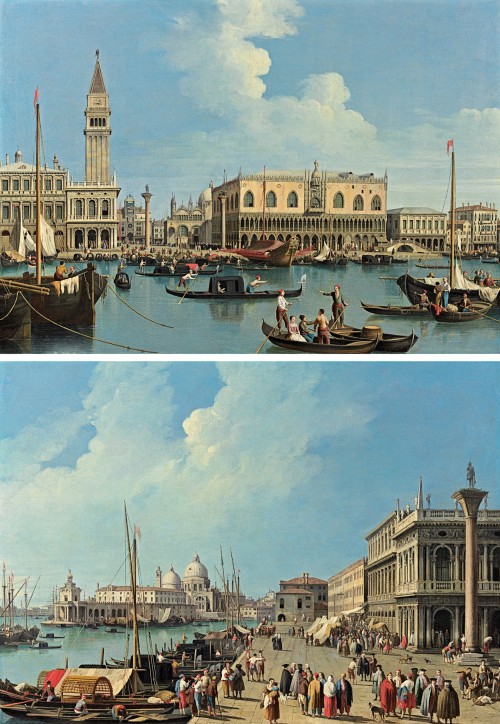
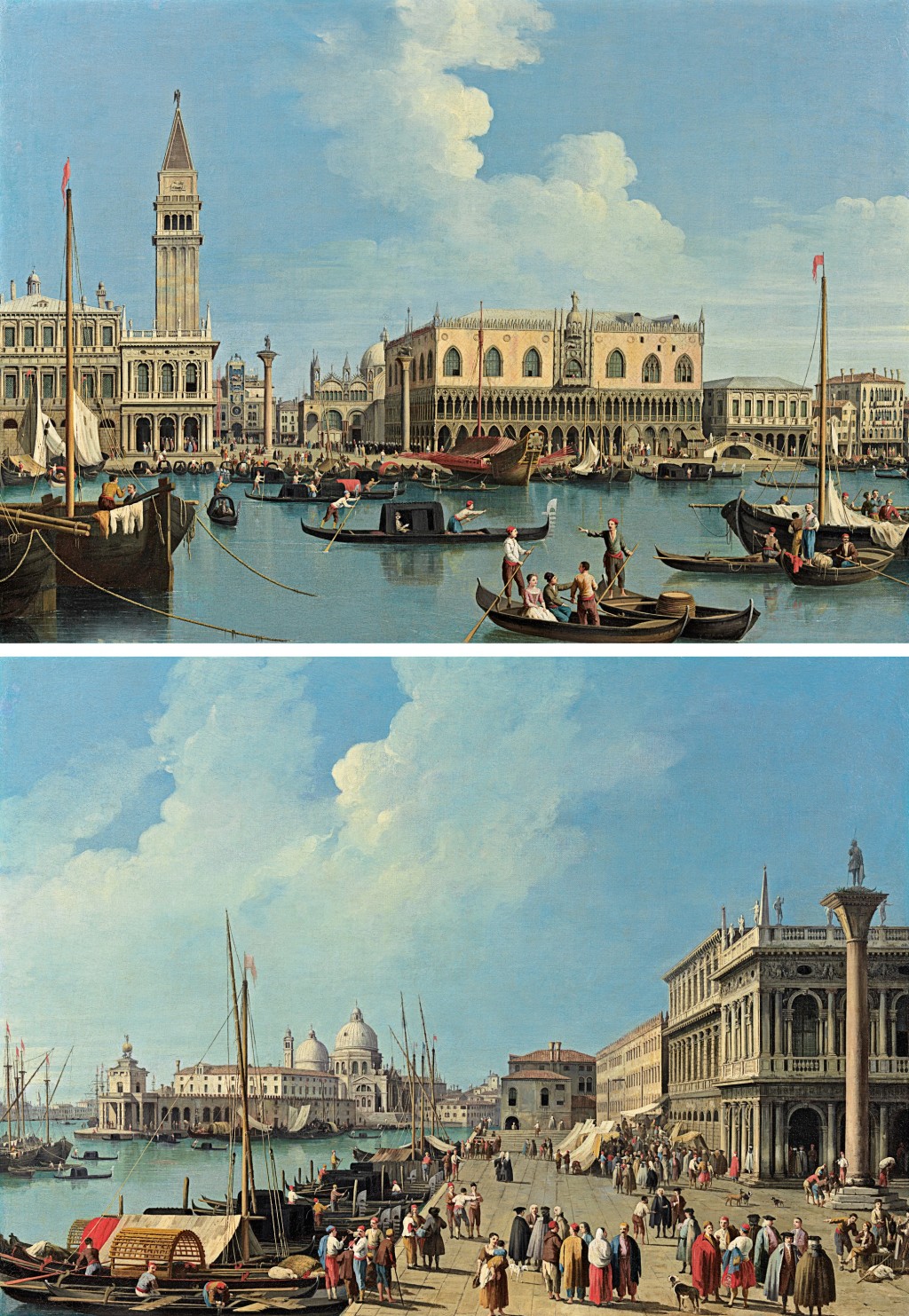
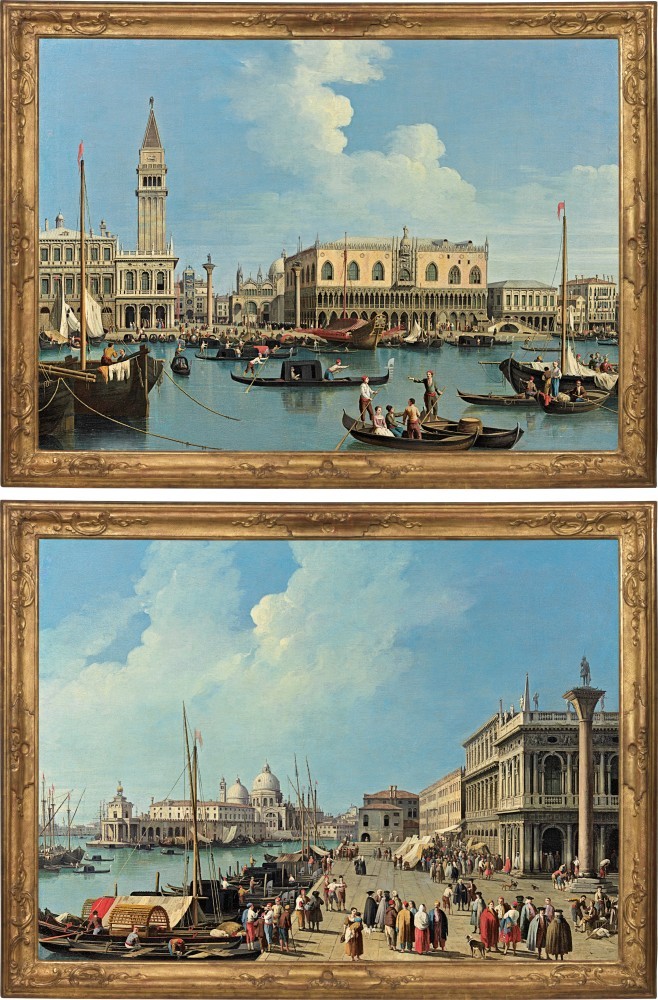
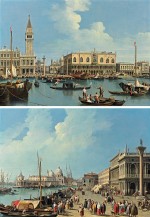
Venice: view of the Molo with the Piazzetta, the Palazzo Ducale, the Zecca and the Libreria Sansoviniana; Venice: view from the Molo looking towards the Dogana and Santa Maria della Salute
A pair
Oil on canvas: 32 ¼ x 44 3/8 in / 81.9 x 112.7 cm
Frame size: 38 x 50 in / 96.5 x 127 cm
Painted circa 1750-55
Provenance:
Knoedler, Paris;
Henry Knapp Skelding Williams (1859-1944), USA and Paris;
his wife Mildred Anna Williams (1873-1939), Paris and San Francisco;
donated by the Williamses in 1940 to the California Palace of the Legion of Honor, San Francisco, inv. no.1940.53-54 (as School of Canaletto);
Butterfield & Butterfield, San Francisco, Collection of the Fine Arts Museums of San Francisco, 9th June 1999, lot 8003 and 8004;
where acquired by Jean-Max Tassel, Paris;
private collection, Switzerland, acquired from the above
Literature:
WG Constable, Canaletto. Giovanni Antonio Canal 1697-1768, 2nd edn. revised by JG Links, Oxford 1989, vol. II, p.232, no.95(c)2; pp.236-7, no.104(b) (as School of Canaletto)
Federica Spadotto, ‘Un artista dimenticato: Giovan Battista Cimaroli’, Saggi e memorie di storia dell’arte, vol. 23, 1999, pp.167; 172, no.33, illus; 178, no.39, illus.
Filippo Pedrocco, Vues de Venise: de Carpaccio à Canaletto, Paris 2002, pp.182-183, illus.
Federica Spadotto, Giovan Battista Cimaroli, Rovigo 2011, pp.250-251, no.86 and 86a, illus.
Giovanni Battista Cimaroli came to Venice from Bologna, probably in the second decade of the eighteenth century. Around 1726 he collaborated with Canaletto on the Allegorical tombs of British worthies commissioned by Owen McSwiny on behalf of the 2nd Duke of Richmond. Cimaroli painted imaginary landscapes and views of the Veneto, but also made delightful views of the city of Venice which proved popular with Grand Tourists, not least because his prices were less outrageous than those charged by Canaletto.
This pair depicts two of the most characteristic views of Venice, made famous by Carlevarijs and Canaletto. The first shows the political and religious heart of the city, with the fourteenth century, pink and white Palazzo Ducale in brilliant sunlight beneath scudding clouds. To its left is the Piazzetta with the columns of St Theodore, the first Patron Saint of Venice, and St Mark. Further left is the Libreria Sansoviniana, Sansovino’s finest achievement, a magnificent flowering of High Renaissance architecture deemed by Palladio to be the most beautiful building since antiquity. It was begun in 1537 and finished by Scamozzi in 1591. It is flanked by the rusticated Doric façade of the Zecca (Mint), finished in 1547 by Jacopo Sansovino on the site of the thirteenth century mint. Behind towers the Campanile. To the right of the Palazzo Ducale are the Prigioni. Beyond the Piazzetta in the Piazza San Marco is St Mark’s Basilica and the Torre dell’Orologio (Clock Tower). The Clock Tower lacks the lateral elevations made after 1755, giving a date for this pair of views circa 1750-55.
The second view shows the Molo looking westwards, with the Dogana (Customs House) and Santa Maria della Salute, the masterpiece of Baldassare Longhena, built from 1631-87 to commemorate the Virgin’s deliverance of the city from the plague of 1630. Along the Molo, from right to left, are the Column of St Theodore, the Libreria Sansoviniana, the Mint and the plain façade of the Republican Granaries (pulled down around 1814 to make way for public gardens).
Cimaroli’s fluent, elegant brushwork bathes the city in sunlight. He employs a clear, bright palette, with a delicious use of pinks, lilac, soft blue, dove grey and warm (but never strident) reds in the figures. In common with most vedute painters, Cimaroli strives to depict the varied populace of Venice for his Grand Tour clients: Dalmatian merchants, Turks, lawyers, senators, fishermen and dogs. Two young women are notable in the foreground of this pair: in the Palazzo Ducale view, one ferried in a gondola; in the other, a young mother holding a child. He is more interested in ‘everyday life’ than in the ceremonial aspects of Venice depicted by Canaletto and Marieschi, and in the many types of craft handled with such skill by the inhabitants of the lagoon city.
GIOVANNI BATTISTA CIMAROLI
Salò, near Brescia 1687 – 1771 Venice
Giovanni Battista Cimaroli was born in 1687 at Salò on Lake Garda, not far from Brescia. He began his artistic training with Antonio Aureggio and then studied in Bologna with the landscape painter Antonio Calza. Lord Annandale bought a Winter landscape on oval panel by Cimaroli from Bologna in 1719 (Hopetoun House, Linlithgow). Probably in the second decade of the eighteenth century Cimaroli went to Venice, where he was in the guild from 1726 until at least 1732. Around 1726 he collaborated with Canaletto, Piazzetta, Pittoni and other artists on a series of Allegorical tombs of British worthies (all Whig party heroes) commissioned by the Irish art agent Owen McSwiney on behalf of the 2nd Duke of Richmond. Cimaroli provided the landscape elements, with sinuous, feathery trees. Four of his oval imaginary landscapes were sold by Consul Smith to George III and three remain in the Royal Collection at Buckingham Palace.
Cimaroli specialised in rustic landscapes with farms, villas and graceful figures in a light, bright palette, reminiscent of the work of Francesco Zuccarelli (1702-1788); capricci of ruins and views of towns in the Veneto, such as Dolo (Staatsgalerie, Stuttgart) and the Villa Negrelli at Strà (Musées Royaux des Beaux-Arts, Brussels), both on the Brenta canal. He also painted views of Venice, influenced by Canaletto. They are characterised by fluent brushwork, airy, luminous compositions and a lively figure groups which capture the complexity and picturesque qualities of Venetian society. The Swedish connoisseur Count Carl Gustav Tessin, writing in 1736, commented that Cimaroli was ‘gaté par les Anglais, qui lui ont imaginé que le plus petit de ces Tableaux vaut 30 sequins’[1]. Several landscapes by Cimaroli were listed in the collection of Marshal Schulenburg, Commander-in-Chief of the Venetian armies and an important collector of Venetian paintings, in 1747. Cimaroli died in Venice in 1771.
The work of Giovanni Battista Cimaroli is represented in Palazzo Taverna, Rome; the Staatsgalerie, Stuttgart; the Musées Royaux des Beaux-Arts, Brussels; the British Royal Collection and the Hunterian Collection, Glasgow.
[1] Letter quoted by O Siren, Dessins et tableaux italiens de la Renaissance dans la collection de Suède, Stockholm 1902.