ALBERT MARQUET
Bordeaux 1875 - 1947 Paris
Ref: CD 235
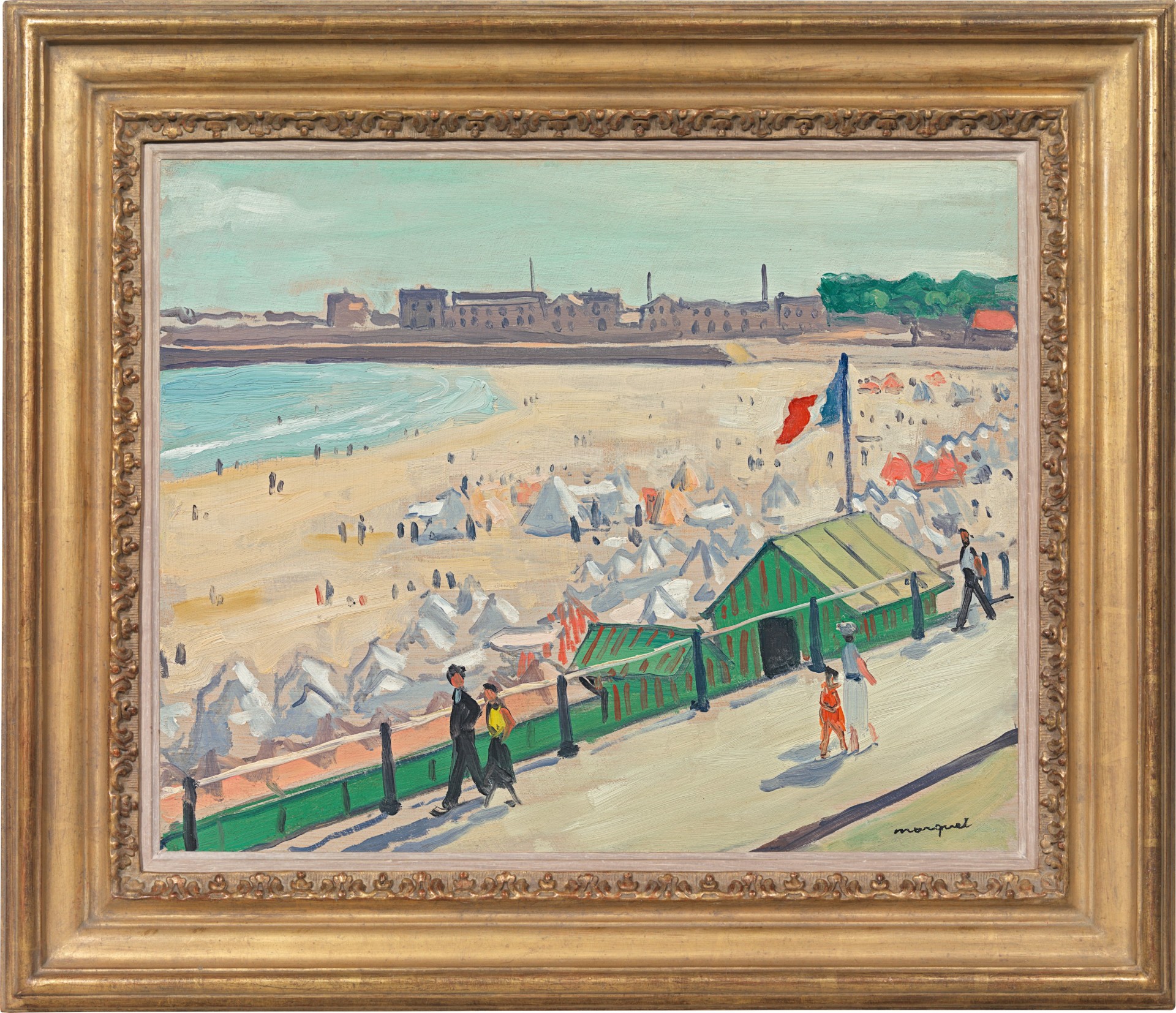
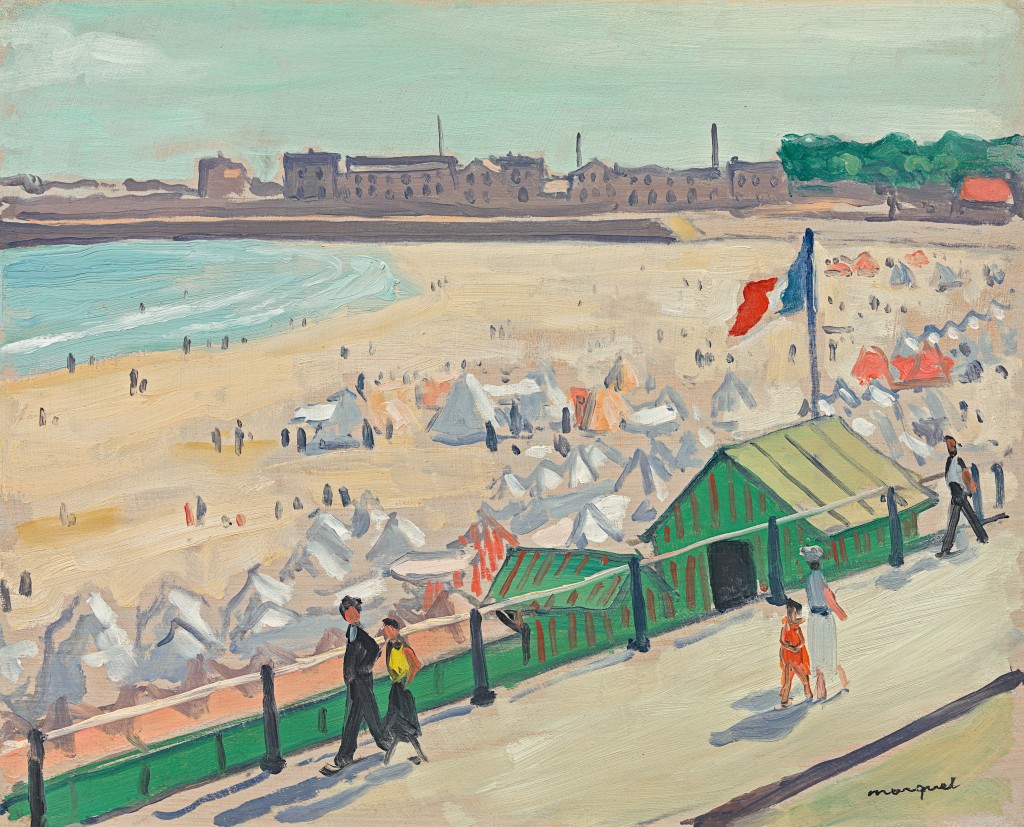
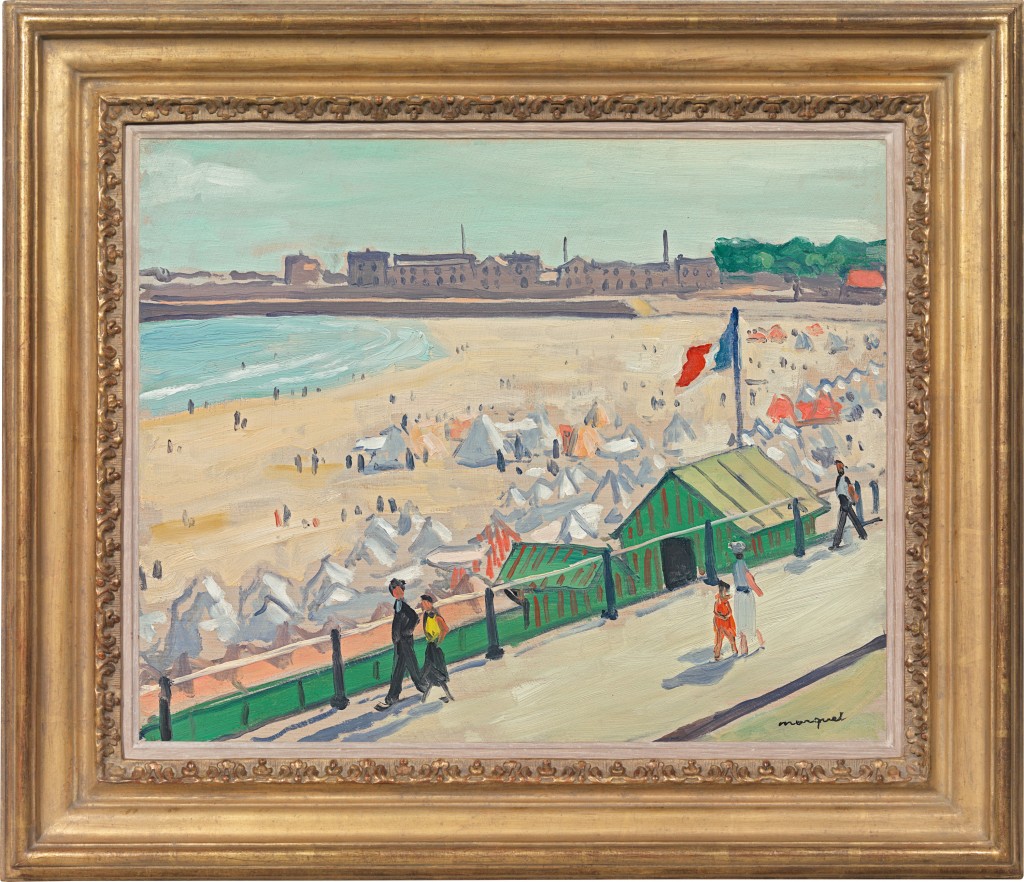
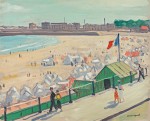
Les Sables d'Olonne
Signed lower right: marquet
Oil on panel: 13 x 16 in / 33 x 40.6 cm
Painted in 1933 (inscribed on the reverse: Sables d'Olonne / 1933)
Provenance:
The artist’s wife Marcelle Marquet, Paris, inherited from the artist in 1947
René Gas, France;
from whom acquired in December 1950 by a private collection, France
Private collection, Boulogne Billancourt, France
To be included in the forthcoming Digital Catalogue Raisonné of the work of Albert Marquet currently being prepared by the Wildenstein Plattner Institute, Inc.
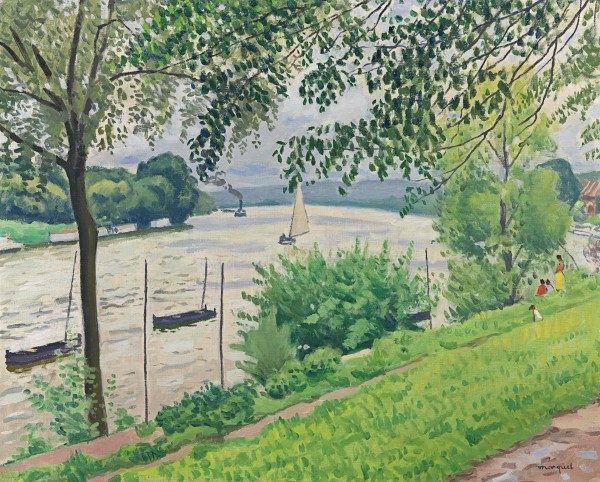
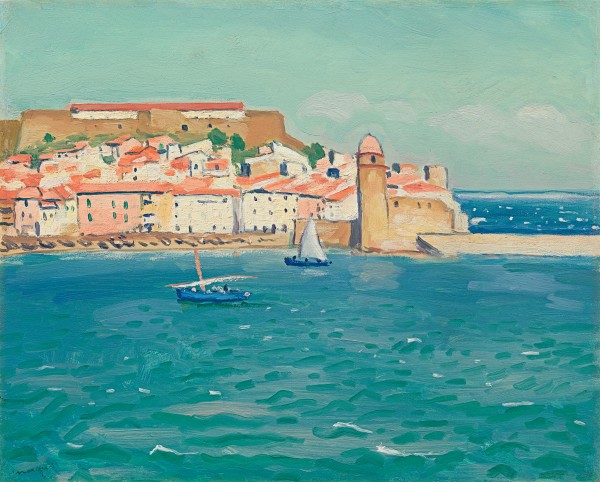
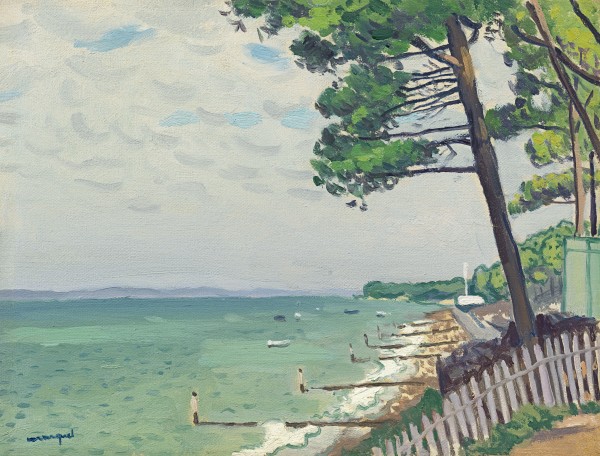
Albert Marquet lived on the banks of the Seine most of his life and became celebrated for his sensitive observation of Paris and its river. Fascinated by water, ports and coastline, he was also an inveterate traveller, visiting England, the USSR and North Africa, among other places, as well as exploring his native France.
As a young man in the studio of Gustave Moreau, Marquet forged friendships with Camoin, Rouault, Manguin and Matisse. They burst upon the Salon d’Automne in 1905 with vibrant colours and bold brushwork, leading a critic to dub them ‘Fauves’ (Wild Beasts). Marquet was closely associated with this group in the early years of the twentieth century. In his later work Marquet forged a highly individual manner influenced by aspects of Impressionism, the work of Cézanne and the graceful economy of Japanese landscape prints.
In the summer of 1933 Marquet stayed at Les Sables d’Olonne in the Vendée, on the Atlantic coast of France north of Bordeaux, accompanied by his wife Marcelle, the diplomat Marcel Ray and his wife Suzanne. Marquet had visited Les Sables d’Olonne in 1921, painting views of the old port, delighted with with its ‘aspect espagnol’, its light ‘puissante et caressante, vibrante et fluide’[1]. He was intrigued by the work of the fisherman-painter Paul-Emile Pajot (1873-1929) and bought twenty of his paintings. Pajot’s direct, naïve seascapes had a similar fascination for French professional artists as did the work of the Cornish fisherman-painter Alfred Wallis (1855-1942) for English Modernists in the 1920s and 30s. Although Pajot’s work did not alter Marquet’s style, it chimed with his instinct to distil the essence of a scene. Marc Sandoz compared Marquet’s approach to that of his friend Signac, writing: ‘Si le “classicisme” de Signac est un classicisme ‘d’élaboration, celui de Marquet serait un classicisme d’instinct, immédiatement donné à son acte créateur d’artiste’[2].
In 1933, for his second and last trip to this seaside resort, Marquet took rooms in a hotel in the middle of the Remblai, the promenade facing the golden sands that were described as the ‘Plus belle plage d’Europe’ in the enticing posters of the railway companies. Sables d’Olonne is one of a group of views painted from Marquet’s hotel window during the summer, all made in the radiance of midday. Marquet’s friend, the writer and politician Marcel Sembat, commented: ‘No artist has the same relationship with light as Marquet. It is if he owned it. He possesses the secret of a pure and intense light which fills all the sky with its uniform and colourless glow….luminous as daylight itself’[3].
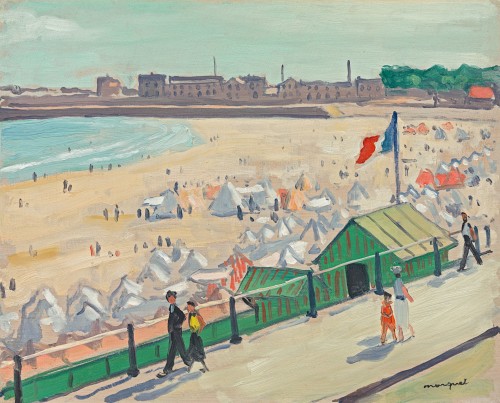
This painting depicts the sweep of golden sand and sea bleached to the palest turquoise by the sun’s rays. The tents of holidaymakers dot the beach. In the foreground, emerald green huts line the promenade in one of Marquet’s trademark strong diagonals, their vibrant colour enhancing the sense of space in the panorama behind. The diagonal is balanced by the opposing line of buildings with shadowed façades on the far side of the bay, the warm brown façades of fish canneries with their tall chimneys. The diagonals meet at a point off to the right of our vision. Marquet thus combines the two aspects of Les Sables d’Olonne: the carefree holiday town, which developed after the railway reached Les Sables d’Olonne in 1866, and the maritime economy. The first sardine cannery was set up at Les Sables d’Olonne in 1838, not long after the technology was invented, pivoting the town away from her declining trade linked to Newfoundland’s cod fisheries towards a burgeoning international industry canning sardines and tuna. These two faces of Les Sables d’Olonne, the leisurely and the workaday, are symbolized by the figures on the promenade. A smartly-dressed mother with her child in a brilliant red frock walk to the right, while to the left march a Sablais fisherman in blue working clothes and beret, with his companion in the traditional long, blue skirt.
Marquet showed his Sables d’Olonne paintings to great acclaim in Paris the year that they were made. L’eté. La plage des Sables d’Olonne, which was shown at the Salon d’Automne in 1933, was bought by the French State and now belongs to the Musée National d’Art Moderne, Centre Georges Pompidou, on loan to the Musée de l’Abbaye Sainte-Croix, Les Sables d’Olonne. La Fête aux Sables d’Olonne, 1933, in the Musée des Beaux-Arts, Bordeaux, shows a similar viewpoint from Marquet’s hotel window to the present Les Sables d’Olonne, but pulls back to depict the road in front of the promenade and the grand hotels to the right of the red building in our picture. Les Sables d’Olonne, a confident, joyous example of Marquet’s genius as a colourist, celebrates the seaside glamour of the 1930s in a town that retains its allure today as the start and finish point for the Vendée Globe, the planet’s toughest single-handed, non-stop, round-the-world yacht race.
.
Sardine canning factory at Les Sables d’Olonne.
La Fête aux Sables d’Olonne, 1933.
Musée des Beaux-Arts, Bordeaux.
ALBERT MARQUET
Bordeaux 1875 - 1947 Paris
Albert Marquet was born in Bordeaux in 1875, the son of a railway employee, Joseph Marquet and his shop-owner wife Marguerite Deyres. A club foot made him sensitive and taciturn. Mother and son were close and Marguerite supported Albert’s artistic ambitions. He went to Paris to study at the Ecole des Arts Décoratifs at the age of fifteen. Six years later he joined the studio of Gustave Moreau, where he met and forged lasting friendships with Camoin, Rouault, Manguin and Matisse. During this period Marquet began to use the vibrant colours and bold brushwork that is characteristic of the Fauves, with whom he was closely associated. He exhibited at Berthe Weill and the Galerie Druet, Paris from 1902 and from 1903 at the Salon d’Automne.
After 1907 Marquet’s interest in Japonisme resulted in more sober works. He travelled extensively, frequently leaving his apartment on the banks of the Seine to visit England, Germany, Italy, the USSR, Scandinavia and North Africa, where he spent the years of the Second World War. Contrasting with the classical calm of Marquet’s landscapes are the realistic, erotic paintings and drawings of nudes that he produced in the first three decades of the twentieth century, including the Sapphic series of lithographs, the Académie des Dames (1920s). Marquet met his wife Marcelle Martinet, whom he married in 1923, on his first stay in Algiers in 1920.
The most profound influence on his work is that of the Impressionists and Post-Impressionists, notably Paul Cézanne. Like the Impressionists his favourite subjects were port scenes, beaches, quaysides, river views and coastal villages; he was particularly fascinated by the effect of light on water.
André Rouveyre, a fellow student in Gustave Moreau’s atelier, wrote: ‘Marquet reigns over the kingdom of light. The light that shines on the things of this world, of course, but also that which belongs to his pictures alone: a strangely regal quality that comes from his sensitivity and wisdom. Skies, hills, houses, streets all bathe in his subtle but intense lights’.
The work of Albert Marquet is represented in the Musée d’Orsay, Paris; the Centre Pompidou, Paris; the Musée des Beaux-Arts, La Rochelle; the Musée de Grenoble; the Hermitage, St Petersburg; Tate, London; the Metropolitan Museum of Art, New York; the Art Institute of Chicago and the National Gallery of Art, Washington DC.
[1] Charles Fegdal, quoted in Paris, Musée National de la Marine, Albert Marquet: itineraries maritimes, 2008, exh. cat. by Véronique Alemany et. al., p.86.
[2] Dibutade 1957, pp.21-22, quoted in Paris, Musée National de la Marine, Albert Marquet: itineraries maritimes, 2008, p.86.
[3] Albert Marquet: itineraries maritimes, op. cit., pp.90-92.