EUGENE BOUDIN
Honfleur 1824 - 1898 Deauville
Ref: CD 233
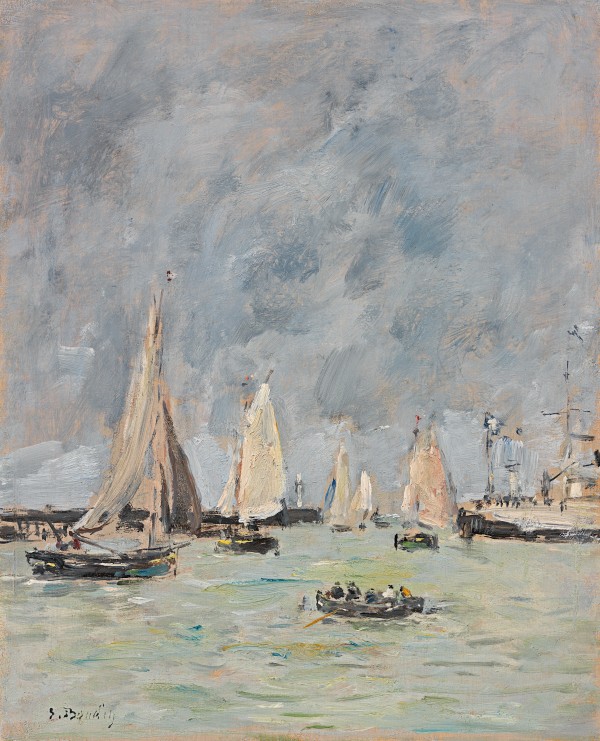
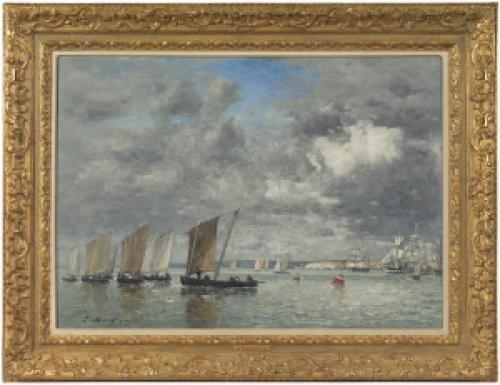
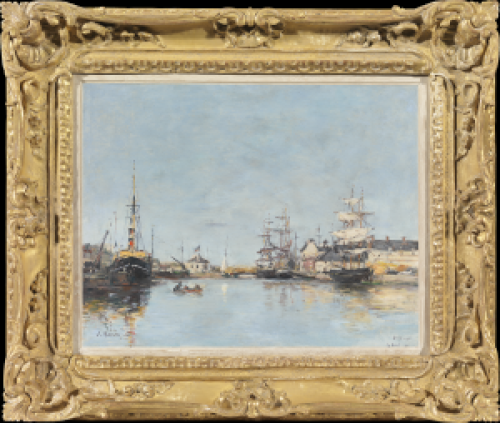
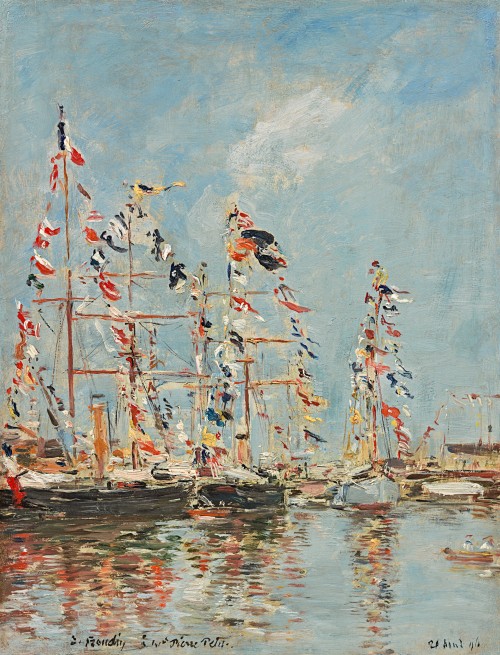
Deauville, bateaux pavoises dans le bassin
Signed and inscribed lower left: E. Boudin A Mr Pierre Petit; dated lower right: 20 Aout 96
Oil on panel: 13 ¾ x 10 ½ in / 34.9 x 26.7 cm
Provenance:
Pierre Petit (1832-1909), Paris
Private collection
Private collection, Switzerland
Exhibited:
Paris, Galerie Charpentier, Autour de 1900, 1950, no.36
Paris, Galerie Charpentier, Tresors du Musée de Caen et Cent Tableaux de Boudin, June-September 1958, no.26
Literature:
R Schmit, Eugène Boudin, Paris 1973, vol. III, p.353, no.3547, illus.
Eugène Boudin was the son of an Honfleur sailor and largely self-taught as a painter. Painting coastal scenes on a modest scale en plein air, he was an important precursor of Impressionism in his mission to capture the myriad moods of water and the sea. Pursuing ‘the simple beauties of nature’, Boudin often expressed his frustration when trying to evoke the ever-changing sea and sky. ‘I feel this vastness, this delicacy, the brilliant light which transforms everything to my eyes into magical brushes and I can’t make my muddle of colours convey this’[1]. Heralded by Corot as ‘the king of the skies’, he encouraged the young Monet to paint out of doors and was invited to take part in the first Impressionist exhibition in 1874. By 1880 Boudin’s work was critically acclaimed but had brought him only a modest income. Early the following year the entire contents of his studio were bought by Paul Durand-Ruel, successful champion of Monet, Sisley and Pissarro, ushering in a new era of prosperity for this quiet and self-effacing genius.
Deauville, with Trouville on the opposite bank of the river Touques, were favourite subjects for Boudin from the 1860s. They were quieter ports than Le Havre at the mouth of the Seine but still provided the maritime themes which delighted him. Trouville-Deauville had burgeoned between 1840 and 1865, with fashionable holidaymakers from Paris attracted to the glorious Normandy beaches and the growth of elegant hotels. A new port at Trouville was inaugurated in 1849 and the energetic sponsorship of the Duc de Morny, half-brother of Napoleon III, ensured that a large floating dock on the left bank, entered by a lock and known as the Bassin Morny, was opened in April 1866. As well as tourism, Trouville-Deauville had a thriving fishing industry, exported cider and hay and imported English coal and cement[2]. Boudin spent his winters in Paris, which he disliked, and his summers in his beloved Normandy. In 1884, at last more financially secure, he built at Deauville ‘une petite cage hollandaise’, La Villa des Ajoncs (Furze Villa), where he died in 1898.
Boudin rarely made a focus of the architecture of Deauville-Trouville, let alone its fashionable casinos. By the 1890s he was less interested in the holidaymakers who had figured in his ‘Crinolines’ of the 1860s and 70s and increasingly fixated on the life of the port. Human activity in these paintings is implied by the presence of the boats rather than showing detailed narratives of maritime life. In Deauville, bateaux pavoises dans le bassin he makes a lively composition of boats ‘dressed overall’, ie from bow to stern, with colourful flags, probably in honour of a regatta. Boudin’s flickering brushwork evokes the flags fluttering in the breeze and their complex reflections in the water. A rowing boat is disappearing to the right, the rowers just indicated by the lightest touches of the brush.
Regattas were an important part of the development of bourgeois leisure on the Seine and the Normandy coast in the late nineteenth century. The Impressionist Gustave Caillebotte (1848-1894), who designed his own yachts, shared the male camararderie of the Cercle de la Voile de Paris and produced yachting scenes, as did Paul-César Helleu (1859-1927). Deauville and Trouville continued to be fashionable venues for yacht races throughout the twentieth century and beyond, inspiring the work of Raoul Dufy (1877-1953) and others.
Note on the provenance
Boudin signed and dedicated this painting to Mr Pierre Petit (1832-1909), one of the most distinguished photographers of the nineteenth century. Having started with daguerreotypes in 1849, Petit experimented with paper negatives on a trip to Rome in 1854. After a brief partnership with Trinquart, Petit became the sole proprietor of a studio at 31 Place Cadet.
In 1861 Petit began to advertise his Galerie des Illustrations Contemporaines, a pantheon of the famous, including Saint-Saëns, Delacroix, Berlioz and Doré, whom he had photographed. Critic Ernest Lacan called the Galerie ‘a monument raised to the history of photography...In general, all these men - those who have arrived, who are arriving and will arrive - carry in them a personal character, an original stamp that M. Petit has grasped and rendered always with rare success’. Petit was the first portrait photographer to use electric light successfully in his work. He received government commissions in 1866 and later photographed events at the time of the Paris Commune.
EUGENE BOUDIN
Honfleur 1824 - 1898 Deauville
Eugène Boudin was one of the most important precursors of the Impressionists, with his emphasis on working directly from nature and free, naturalistic brushwork. His ‘Crinolines’, depicting fashionable holidaymakers enjoying the beaches of northern France, ushered in a new genre, but he was also renowned for coastal and harbour scenes.
Born in Honfleur, Boudin was the son of a harbour pilot and bred to the sea, working as a cabin boy for his father. After a brief period of schooling, in 1835, he worked with a stationer and framer who displayed the work of artists, then set up his own stationery and framing business in 1844. Boudin’s clients included Thomas Couture, Eugène Isabey, Jean-François Millet and Constant Troyon, all of whom had an influence on his efforts to draw and paint. In 1847 Boudin went to Paris to copy Old Masters in the Louvre; he was particularly impressed by the seventeenth century Dutch school and by the Barbizon painters. In 1851 he was awarded a three-year painting scholarship by the city of Le Havre. He drew his subjects from the Normandy and Brittany coasts. In 1858 he met the young Claude Monet, who had grown up in Le Havre, and stressed to him the importance of making oil paintings directly from nature to capture the constantly changing beauties of the landscape.
Boudin made his debut at the Salon in 1859, where his work was admired by Charles Baudelaire. He befriended Courbet, Daubigny and Corot, who heralded him as ‘the king of the skies’. Paris-based in the winter, Boudin spent his summers on painting tours around the coast of Le Havre, Honfleur and Trouville, inspired by the elegant society that flocked to the burgeoning seaside towns and by the busy maritime traffic. At Trouville in 1862 he met Johan Barthold Jongkind and, influenced by his boldness of technique, adopted freer brushwork and a brighter palette. The following year he married Marie-Anne Guédès.
Boudin made several journeys to Belgium and The Netherlands, initially to shelter from the Franco-Prussian War (1870-71). From 1892 to 1895 he visited Venice, making subtle, atmospheric and highly individual views. He also painted in the south of France, where he stayed in the 1890s for the health benefits of the mild winter climate. Boudin exhibited at the Salon from 1863 to 1897 and participated in the First Impressionist Exhibition in 1874.
From the 1870s Boudin enjoyed increasing financial security. In the 1880s he was taken up by the influential art dealer Paul Durand-Ruel, who organised exhibitions of his pictures in 1883, 1889, 1890 and 1891. In 1892 Boudin was awarded the Légion d'Honneur. He died in Deauville in 1898.
Works by Eugène Boudin can be found in the many museums worldwide including The National Gallery of Art, Washington DC; The Metropolitan Museum of Art, New York; The National Gallery, London; Musée d’Orsay, Paris; Musée du Louvre, Paris and The Hermitage, St Petersburg.
[1] Quoted in Vivien Hamilton, Boudin at Trouville, Glasgow 1992, p.9.
[2] See Vivien Hamilton, Boudin at Trouville, Glasgow 1992, pp.101-106.