EUGENE BOUDIN
Honfleur 1824 - 1898 Deauville
Ref: CD 215
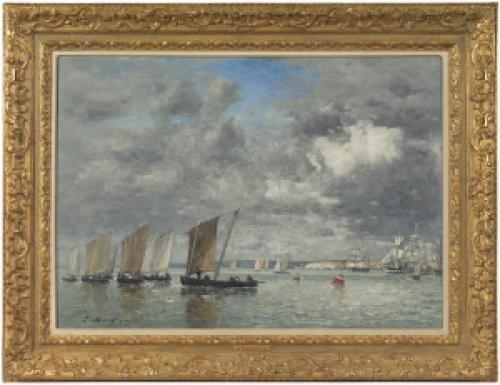
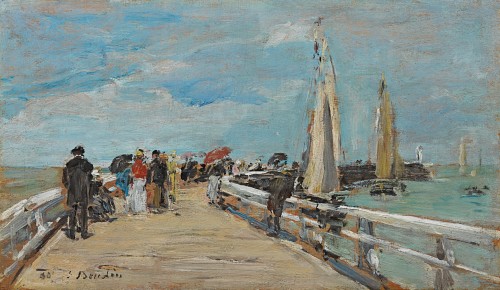
Deauville, la jetée
Signed and dated lower left: 90 E. Boudin
Oil on panel: 5 ¼ x 9 ¼ in / 13.3 x 23.5 cm
Frame size: 11 x 15 in / 27.9 x 38.1 cm
Provenance:
M Gérard, Paris
Arthur Tooth & Sons, London;
from whom acquired by Richard J Robertson, Darien, Connecticut in 1962;
his estate sale, Christie’s New York, 15th May 1997, lot 201;
where acquired by Anne Schlumberger (1905-1993);
by descent
Literature:
R Schmit, Eugène Boudin, Paris 1973, vol. III, p.42, no.2665, illus.
Eugène Boudin was the son of an Honfleur sailor and largely self-taught as a painter. Painting coastal scenes on a modest scale en plein air, he was an important precursor of Impressionism in his mission to capture the myriad moods of water and the sea. Heralded by Corot as ‘the king of the skies’, he encouraged the young Monet to paint out of doors and was invited to take part in the first Impressionist exhibition in 1874.
Boudin first visited Trouville, on the river Touques south of Le Havre, in 1861 or 1862 and returned there every summer for the rest of his life, wintering in Paris, which he disliked. Over forty years he saw the place develop from a quiet fishing village into a busy port which attracted fashionable visitors from the metropolis, drawn to its Casino and fine hotels. It was mirrored by Deauville on the opposite bank of the Touques, another favourite painting spot for Boudin. Whereas Trouville had grown organically, attracting artists and writers from the 1820s, Deauville was developed in 1860 by the Duc de Morny, the half-brother of Emperor Napoleon III, as a resort catering specifically to high society.
Boudin knew the poet Charles Baudelaire and his theories about the painting of ‘Modern Life’, the cool gaze of the artist on the urban scene. Baudelaire declared: ‘I detest the countryside, especially in fine weather…When I bathe, it’s in my bath-tub’[1]. In choosing the thoroughly contemporary phenomenon of the beach scene, where all the artificialities of Paris met the Normandy seascape, Boudin was also staking a claim to be a ‘Painter of Modern Life’, as he half-humorously admitted in a letter of 1868 to his friend Ferdinand Martin. ‘[I have been congratulated] for daring to include the things and people of our own time in my pictures, for having found a way of making acceptable men in overcoats and women in waterproofs…But don’t these bourgeois, who stroll on the jetty towards the sunset, have the right to be fixed on canvas, to be brought to the light’[2].
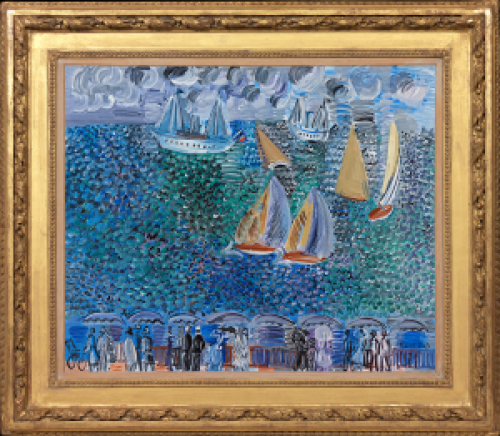
This lively, colourful painting does indeed bring the bourgeois ‘who stroll on the jetty’ towards the light. By 1890, when it was made, Boudin was less interested in the prominent figures of his 1860s ‘Crinoline’ beach scenes and more focussed on shipping or jetties with human presence merely implied. Here he delights in the holidaymakers who throng the jetty, their black, blue, red, white and yellow clothing creating a rhythm which leads the eye far into the distance. The freedom and confidence of his brushwork reflect the experiments of his younger, Impressionist friends. Boudin is unrivalled in creating the sense of exhilarating sea breezes and scudding clouds, which tear off to reveal patches of sapphire sky. The yachts counterbalance the horizontal of the jetty and provide a reason for the number of people on the jetty, as regattas were a regular feature of Deauville life.
Boudin treated the theme of a jetty with holidaymakers in other paintings made around this time, including Trouville, la jetée, 1890 (private collection)[3] and Deauville, la jetée, 1890 (private collection)[4].
EUGENE BOUDIN
Honfleur 1824 - 1898 Deauville
Eugène Boudin was one of the most important precursors of the Impressionists, with his emphasis on working directly from nature and free, naturalistic brushwork. His ‘Crinolines’, depicting fashionable holidaymakers enjoying the beaches of northern France, ushered in a new genre, but he was also renowned for coastal and harbour scenes.
Born in Honfleur, Boudin was the son of a harbour pilot and bred to the sea, working as a cabin boy for his father. After a brief period of schooling, in 1835, he worked with a stationer and framer who displayed the work of artists, then set up his own stationery and framing business in 1844. Boudin’s clients included Thomas Couture, Eugène Isabey, Jean-François Millet and Constant Troyon, all of whom had an influence on his efforts to draw and paint. In 1847 Boudin went to Paris to copy Old Masters in the Louvre; he was particularly impressed by the seventeenth century Dutch school and by the Barbizon painters. In 1851 he was awarded a three-year painting scholarship by the city of Le Havre. He drew his subjects from the Normandy and Brittany coasts. In 1858 he met the young Claude Monet, who had grown up in Le Havre, and stressed to him the importance of making oil paintings directly from nature to capture the constantly changing beauties of the landscape.
Boudin made his debut at the Salon in 1859, where his work was admired by Charles Baudelaire. He befriended Courbet, Daubigny and Corot, who heralded him as ‘the king of the skies’. Paris-based in the winter, Boudin spent his summers on painting tours around the coast of Le Havre, Honfleur and Trouville, inspired by the elegant society that flocked to the burgeoning seaside towns and by the busy maritime traffic. At Trouville in 1862 he met Johan Barthold Jongkind and, influenced by his boldness of technique, adopted freer brushwork and a brighter palette. The following year he married Marie-Anne Guédès.
Boudin made several journeys to Belgium and The Netherlands, initially to shelter from the Franco-Prussian War (1870-71). From 1892 to 1895 he visited Venice, making subtle, atmospheric and highly individual views. He also painted in the south of France, where he stayed in the 1890s for the health benefits of the mild winter climate. Boudin exhibited at the Salon from 1863 to 1897 and participated in the First Impressionist Exhibition in 1874.
From the 1870s Boudin enjoyed increasing financial security. In the 1880s he was taken up by the influential art dealer Paul Durand-Ruel, who organised exhibitions of his pictures in 1883, 1889, 1890 and 1891. In 1892 Boudin was awarded the Légion d'Honneur. He died in Deauville in 1898.
Works by Eugène Boudin can be found in the many museums worldwide including The National Gallery of Art, Washington DC; The Metropolitan Museum of Art, New York; The National Gallery, London; Musée d’Orsay, Paris; Musée du Louvre, Paris and The Hermitage, St Petersburg.
[1] Quoted in Vivien Hamilton, Boudin at Trouville, London 1992, p.19.
[2] Quoted in Hamilton, op. cit., p.20.
[3] R Schmit, op. cit., vol. III, p.41, no.2663, illus.
[4] R Schmit, op. cit., vol. III, p.42, no.2664, illus.