JEAN BERAUD
St Petersburg 1849 - 1935 Paris
Ref: CD 222
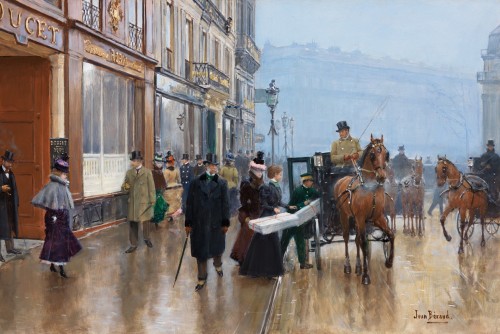
La Maison Doucet, rue de la Paix, Paris
Signed lower right: Jean Béraud
Oil on panel: 15 x 21 3/8 in / 38.1 x 54.3 cm
Frame size: 21 x 28 in / 53.3 x 71.1 cm
Painted circa 1903
Provenance:
Acquired from the artist by Alexander Blumenstiel (1843-1905), New York;
his estate sale, The American Art Association, Mendelssohn Hall, New York, 15th-16th February 1906, lot 76, illus. (as Rue de la Paix; $565 to Thomas F Manning)
Thomas F Manning
John Fitch, New York;
from which purchased by Schweitzer Gallery, New York, 1969;
from which purchased by Richard Green Gallery, London, 1973;
private collection, UK
MacConnal-Mason & Son, London;
from which purchased by a private collector, UK
Literature:
Patrick Offenstadt, Jean Béraud, 1849-1935: The Belle Epoque: A Dream of Times Gone By, Catalogue Raisonné, 1999, pp.154-5, no.154, illus.
Marcel Proust, a friend and fellow scholar at the Lycée Bonaparte, praised Jean Béraud for ‘his fame, his talent, his influence, his charm, his heart and his intelligence’. Chronicler of Paris par excellence, Béraud followed in the tradition of Louis-Lépold Boilly (1761-1845) in depicting the social groups, fashions, foibles, pastimes and architecture of Baron Haussmann’s dazzling modern city. A superlative draughtsman, Béraud studied his Parisians from the windows of hansom cabs, incorporating them in works which show all the vivacity and variety of the city, painted in a style which combines an Impressionist virtuosity of brushwork with precise and witty observation.
This painting reflects Paris as a consumer’s paradise, depicting La Maison Doucet at 21 Rue de la Paix, premises of the famous couturier Jacques Doucet (1853-1929). The equally renowned ateliers of Charles Worth and Jeanne Paquin were nearby. It is a wintry day of mist and rain-slicked pavements. A smartly-dressed assistant from Doucet hurries a pair of boxes to a waiting carriage, while the purchaser stands nearby. Béraud brilliantly evokes the bustle of the streets and the elegant silhouettes of the passers-by, proclaiming Paris as the fashion capital of the world. The painting employs tones of chestnut, burgundy, beige and midnight blue to bind the composition together, with the occasional touch of emerald green in a skirt, vivid red hair or pink hat. We can almost hear the clatter of horses’ hooves on the boulevard and can certainly see the haze of their warm breath hitting the cold air. The buildings in the distance are at the corner of the Place de l’Opéra and Rue du Quatre-Septembre.
Jacques Doucet’s family firm began as a supplier of lace and lingerie at the beginning of the nineteenth century. When Béraud made this view, around 1903, the shop was divided into the department which sold lingerie (out of sight to the left) and the premises for exquisite dresses, emblazoned Robes in the painting. From 1912 Doucet’s wares appeared in the ultra-exclusive Gazette du Bon Ton. Among his clients was the famous actress Sarah Bernhardt, for whom he designed the daring white uniform for her portrayal of the Emperor Napoleon’s young son, briefly Napoleon II, in Edmond Rostand’s play L’Aiglon (1900). Doucet was a major art collector, delighting in eighteenth century furniture and objets d’art which influenced his fashion designs. Among the paintings that he owned was Jean-Baptiste-Siméon Chardin’s House of cards (Sammlung Oskar Reinhart, Winterthur). After 1912 Doucet changed direction, becoming a champion of avant-garde designers such as Eileen Gray and Paul Iribe and painters including Max Ernst and Francis Picabia. He bought the revolutionary Les demoiselles d’Avignon, 1907 (MOMA, New York), directly from Picasso, paying 25,000 francs in 1924.
The first owner of this painting by Béraud was a prominent New York lawyer and patron of the arts, Alexander Blumenstiel (1843-1905), who acquired the work directly from the artist. Béraud made a number of paintings featuring Maison Doucet, including Elegante sortant de chez Doucet and Le devanture du couturier, c.1905 (both in private collections)[1].
La Maison Doucet, Rue de la Paix, 1908.
JEAN BÉRAUD
St Petersburg 1849 - 1935 Paris
Jean Béraud was born in St Petersburg in 1849, the son of a French sculptor, Jean Béraud, who had probably moved to the city to work on the cathedral of St Isaac. His mother took the family to Paris after her husband’s death in 1853. Jean, like his future friend Marcel Proust, was educated at the Lycée Bonaparte (today the Lycée Condorcet). He briefly studied law at the University of Paris and in 1870-71 served in the Garde Nationale during the Siege of Paris. Abandoning law for art, in 1872-3 he studied in the studio of the portrait painter Léon Bonnat. Béraud exhibited two portraits at the Salon in 1873, showing there until 1889.
Béraud’s Salon exhibit of 1876, After the funeral (private collection), established his reputation as a chronicler of Parisian life in paintings which combine an Impressionistic freedom of brushwork with acute and witty observation of fashions, physiognomies, class and personalities in the ordered chaos of the teeming modern city. Once declaring ‘I find everything but Paris wearisome’, Béraud painted both high life and low life, from aristocratic salons and racing at Auteil to Insoumises in the lock-up, 1886 (private collection), which depicts prostitutes rounded up by the police in the cold light of dawn. A brilliant draughtsman and illustrator, Béraud sketched his Parisians from the windows of horse-drawn cabs.
Béraud’s work was greeted with great enthusiasm and he was welcomed into Parisian society, receiving commissions for portraits from famous figures such as the Prince d’Orléans and Prince Troubetskoy. Urbane and exquisitely dressed, he frequented the salons of the Countesses Potocka, de Noailles and d’Agoult, and in 1897 was Proust’s Second in a duel. Béraud, who never married, was also happy in theatrical company: his closest friend was the celebrated actor Coquelin the Elder.
Jean Béraud was a founding member and Vice President of the Sociéte Nationale des Beaux-arts, where he exhibited between 1910 and 1929. He was awarded a gold medal from the Society of French Artists in 1889 and a gold medal at the Universal Exhibition in 1889. In 1887 he was made a Chevalier of the Légion d’Honneur.
In 1891 Béraud caused a scandal by exhibiting at the Salon Mary Magdalene visiting the Pharisee (Musée d’Orsay, Paris), which transposed the Biblical story into a contemporary setting and shone a harsh light on modern morals. Several paintings of subsequent decades show the inhabitants of modern Paris taking part in the events of the Bible, such as the Mocking of Christ, or allude to the gap between rich and poor, such as The insurgence, 1896 (private collection). Béraud’s satires were coldly received, although he remained an important figure in the artistic life of Paris. Following his death in 1935, the Musée Carnavalet held a retrospective of his work.
The work of Jean Béraud is represented in museums in the Musée du Louvre, Paris; the Musée d’Orsay, Paris; the National Gallery, London; the Metropolitan Museum of Art, New York; the National Gallery of Art, Washington DC and the Pushkin Museum, Moscow.
[1] Offenstadt, op. cit., pp.154-5, nos.151 and 153.