EUGENE BOUDIN
Honfleur 1824 - 1898 Deauville
Ref: CD 200
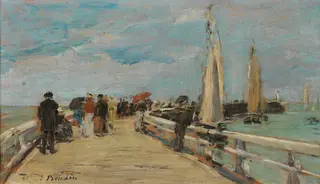
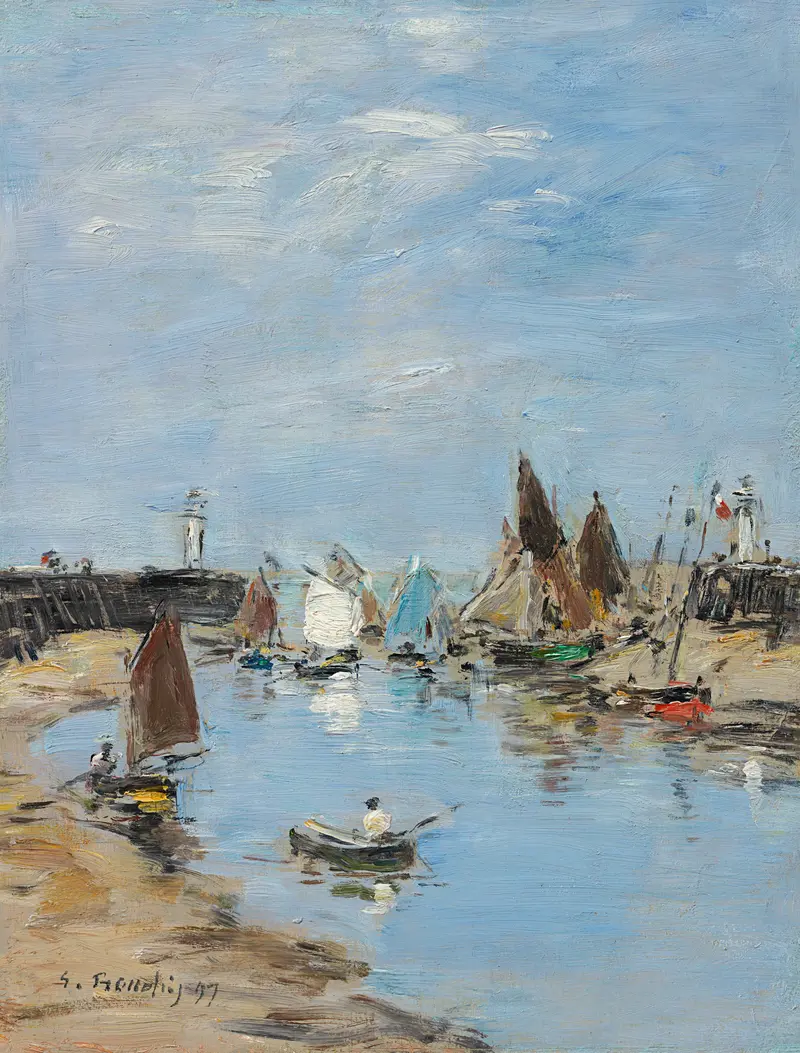
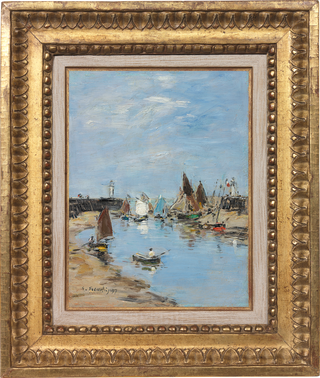
Trouville, les jetees, marée basse
Signed and dated lower left: E.Boudin '97
Oil on panel: 9 5/8 x 7 3/8 in / 24.4 x 18.7 cm
Frame size: 15 x 12 ¾ in / 38.1 x 32.4 cm
Provenance:
Galerie Charpentier, Paris, 11th-12th June 1959, lot 29
Max Kaganovitch, Paris;
from which acquired by Nehama Jaglom, New York;
by descent;
Sotheby’s New York, 4th May 2005, lot 125
Noortman Master Paintings, London;
from which acquired by a private collection, Europe;
Christie’s London, 7th February 2013, lot 457;
private collection, UK
Literature:
R Schmit, Eugène Boudin, Paris 1973, vol. III, p.385, no.3630, illus.
Eugène Boudin was the son of an Honfleur sailor and largely self-taught as a painter. Painting coastal scenes on a modest scale en plein air, he was an important precursor of Impressionism in his mission to capture the myriad moods of water and the sea. Pursuing ‘the simple beauties of nature’, Boudin often expressed his frustration when trying to evoke the ever-changing sea and sky. ‘I feel this vastness, this delicacy, the brilliant light which transforms everything to my eyes into magical brushes and I can’t make my muddle of colours convey this’[1]. Heralded by Corot as ‘the king of the skies’, he encouraged the young Monet to paint out of doors and was invited to take part in the first Impressionist exhibition in 1874. By 1880 Boudin’s work was critically acclaimed but had brought him only a modest income. Early the following year the entire contents of his studio was bought by Paul Durand-Ruel, successful champion of Monet, Sisley and Pissarro, ushering in a new era of prosperity for this quiet and self-effacing genius.
Boudin first visited Trouville in 1861 or 1862 and returned there every summer for the rest of his life, wintering in Paris, which he disliked. Over forty years he saw the place develop from a quiet fishing village into a busy port which attracted fashionable visitors from the metropolis, drawn to its Casino and fine hotels.
The jetties at Trouville-Deauville were favourite motifs in Boudin’s paintings, particularly in the period from 1876[2]. Constructed in 1840-50 as the result of a subscription launched by the sailors of Trouville and lengthened in 1858-9, they served to shorten and deepen the channel to the port. Three-quarters of Boudin’s jetty paintings show the channel at low tide, with beached fishing boats and holidaymakers strolling along the jetty enjoying the exhilarating sea air.
By 1897, when Trouville, les jetées marée basse was made, Boudin’s brushwork had become looser and more expressive than in his ‘Crinoline’ paintings of the 1860s, influenced by the experiments of his younger, Impressionist friends. Flickering brushwork evokes the rust-brown sails and colourful hulls of the traditional, small fishing craft, the jetties and lighthouses. The focal point of the painting is a brilliant white sail and its reflection at the entrance to the channel. Beside it, a boat with a blue sail provides the compositional link between the pale blue, cloud-flecked sky and the water which mirrors it. Painted en plein air, the panel depicts the everyday life of the bustling Normandy port through the eyes of a true lover of the sea.
Eugène Boudin, The jetties at low tide, 1888.
The National Gallery, London.
EUGENE BOUDIN
Honfleur 1824 - 1898 Deauville
Eugène Boudin was one of the most important precursors of the Impressionists, with his emphasis on working directly from nature and free, naturalistic brushwork. His ‘Crinolines’, depicting fashionable holidaymakers enjoying the beaches of northern France, ushered in a new genre, but he was also renowned for coastal and harbour scenes.
Born in Honfleur, Boudin was the son of a harbour pilot and bred to the sea, working as a cabin boy for his father. After a brief period of schooling, in 1835, he worked with a stationer and framer who displayed the work of artists, then set up his own stationery and framing business in 1844. Boudin’s clients included Thomas Couture, Eugène Isabey, Jean-François Millet and Constant Troyon, all of whom had an influence on his efforts to draw and paint. In 1847 Boudin went to Paris to copy Old Masters in the Louvre; he was particularly impressed by the seventeenth century Dutch school and by the Barbizon painters. In 1851 he was awarded a three-year painting scholarship by the city of Le Havre. He drew his subjects from the Normandy and Brittany coasts. In 1858 he met the young Claude Monet, who had grown up in Le Havre, and stressed to him the importance of making oil paintings directly from nature to capture the constantly changing beauties of the landscape.
Boudin made his debut at the Salon in 1859, where his work was admired by Charles Baudelaire. He befriended Courbet, Daubigny and Corot, who heralded him as ‘the king of the skies’. Paris-based in the winter, Boudin spent his summers on painting tours around the coast of Le Havre, Honfleur and Trouville, inspired by the elegant society that flocked to the burgeoning seaside towns and by the busy maritime traffic. At Trouville in 1862 he met Johan Barthold Jongkind and, influenced by his boldness of technique, adopted freer brushwork and a brighter palette. The following year he married Marie-Anne Guédès.
Boudin made several journeys to Belgium and The Netherlands, initially to shelter from the Franco-Prussian War (1870-71). From 1892 to 1895 he visited Venice, making subtle, atmospheric and highly individual views. He also painted in the south of France, where he stayed in the 1890s for the health benefits of the mild winter climate. Boudin exhibited at the Salon from 1863 to 1897 and participated in the First Impressionist Exhibition in 1874.
From the 1870s Boudin enjoyed increasing financial security. In the 1880s he was taken up by the influential art dealer Paul Durand-Ruel, who organised exhibitions of his pictures in 1883, 1889, 1890 and 1891. In 1892 Boudin was awarded the Légion d'Honneur. He died in Deauville in 1898.
Works by Eugène Boudin can be found in the many museums worldwide including The National Gallery of Art, Washington DC; The Metropolitan Museum of Art, New York; The National Gallery, London; Musée d’Orsay, Paris; Musée du Louvre, Paris and The Hermitage, St Petersburg.
[1] Quoted in Vivien Hamilton, Boudin at Trouville, Glasgow 1992, p.9.
[2] See Hamilton, op. cit., pp.91-96.