GUSTAVE CAILLEBOTTE
Paris 1848 - 1894 Petit Gennevilliers
Ref: CD 214
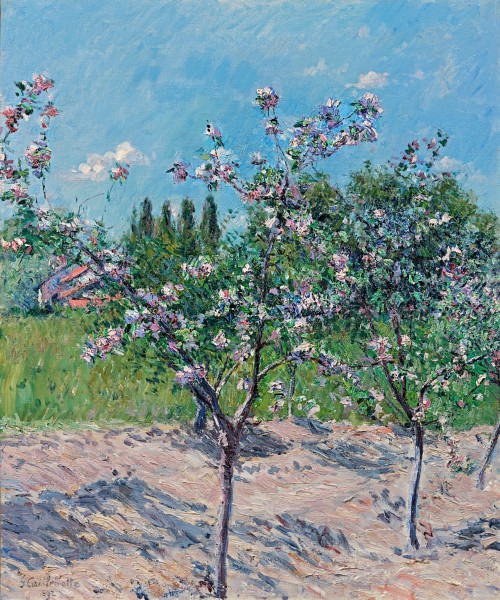
Pommiers en fleurs, Petit Gennevilliers
Signed and dated lower left: G. Caillebotte / 1892
Oil on canvas: 25 5/8 x 21 3/8 in / 65.1 x 54.3 cm
Frame size: 29 x 33 in / 73.7 x 83.8 cm
Provenance:
Paul Hugot (1841-1896), Paris, 1892 (label on the reverse: No. 9 Appartenant / à / Mr P. Hugot);
Mrs Hugot, 1895
Sotheby’s London, 23rd November 1960, lot 47F
Wildenstein
A Charles, Paris;
by family descent in a private collection, France
Exhibited:
Paris, Galerie Durand-Ruel, Exposition Rétrospective d’Oeuvres de Gustave Caillebotte, 1894, no.79
Literature:
Recorded in the Archive of Caillebotte’s brother Martial Caillebotte
Marie Berhaut, Gustave Caillebotte Catalogue Raisonné des Peintures et Pastels, Paris 1978, p.236, no.300, illus.
Marie Berhaut, Gustave Caillebotte Catalogue Raisonné des Peintures et Pastels, Paris 1994, p.236, no.444, illus.
The Comité Caillebotte has confirmed the authenticity of this work, which is included in its database on the artist
Born into a wealthy Normandy family, Gustave Caillebotte was a lynchpin of Impressionism, exhibiting with the group from 1876 to 1882. He inherited a fortune from his father in 1874 and had no need to sell his paintings, but was a generous benefactor to fellow artists, including Monet, Renoir and Pissarro. Caillebotte amassed a superb group of Impressionist works which he bequeathed to the French nation in 1894; today they form the core collection of the Musée d’Orsay. Because he had no need of promotion by a dealer such as Paul Durand-Ruel, who spread the gospel of Monet and his circle, many of Caillebotte’s own paintings remained in the collection of his family and friends. It was not until the 1970s that his work attracted serious scholarly attention and he was revealed as one of the most innovative and original painters of the Impressionist group. His output was relatively modest – he died aged just forty-six – and his financial independence enabled him to choose more radical subjects than some of his contemporaries.
Caillebotte was an urban sophisticate with an intense response to the countryside, and his work reflects this. Earlier in his career he had painted the landscape around the family estate at Yerres in the Ile de France and Parisian life on the doorstep of his well-appointed apartment on the Boulevard Haussmann: flâneurs strolling the straight, uniform streets of the newly-modernized city; bourgeois interiors. After their mother’s death in 1878, the bachelor brothers Gustave and Martial Caillebotte sold up the family properties and in 1881 bought a house right on the Seine at Petit Gennevilliers, opposite Argenteuil, about half an hour by train from Paris. There Gustave could indulge his passion for yachting, even designing his own vessels.
From 1882 Petit Gennevilliers and its environs provided Caillebotte’s chief artistic inspiration. Frustrated by the squabbles among the Impressionists, he ceased to exhibit with the group after that year, although he never abandoned old friends. Caillebotte’s work evoked the area’s stimulating mix of the rural, the suburban and the industrial, which had also captivated Renoir and Monet, who lived there from 1871 to 1878. Like Monet, Caillebotte painted Argenteuil’s road and railway bridges, the boat basin, the leafy promenade of chestnut trees[1]. He also unflinchingly portrayed its industrial aspect in such works as Factories at Argenteuil, 1888 (private collection)[2].
In 1887 Martial Caillebotte married and no longer shared the house at Petit Gennevilliers. Gustave took the opportunity to enlarge the dwelling and to add a studio, greenhouse and outbuildings. The house was of rustic stone, with wooden balconies and red roofs, a bourgeois villa with a nod to vernacular architecture. Around it, Caillebotte created a formal garden with gravel paths containing beds of roses, chrysanthemums and sunflowers. It was planned with a precision that mirrored the detail of his yacht designs. Although a rentier and a gentleman of leisure all his life, Caillebotte approached all of his hobbies – philately, yachting, gardening and painting – with the passion of a professional. He corresponded with Monet, himself busy creating his paradise at Giverny, about gardening matters and even followed Impressionist theories of complementary colours in his planting. He chose to fill his greenhouse with orchids, rare, exotic and difficult to grow.
Paintings such as Les dahlias, jardin du Petit Gennevilliers, 1893 (private collection, USA)[3] balance the inchoate fertility of nature with the neatness of Caillebotte’s house and garden design. This work evokes hot sunshine and the vivid colours of late-summer blooms. A similar spirit infuses Pommiers en fleurs, Petit Gennevilliers, although the light is the cooler hue of spring and the composition is more airy. Caillebotte’s orderly mind is evident in the mirroring of the young apple trees which march diagonally across the canvas, their carefully pruned branches reaching towards the sky in v-shapes. The composition is divided into three equal, horizontal bands – the warm pink of the bare orchard soil, with its slate-blue shadows; the lush spring green of the meadow and four distant poplars; and the radiant blue of the sky with its wisps of white cloud. This geometry is however undermined by the rich impasto of the brushwork, the pink earth described in diagonal strokes flowing in the opposite direction to the trees and the meadow grass intricately interwoven. The apple blossom is composed from myriad blobs and curlicues of pink and white oil paint which stand proud from the canvas in an exuberant celebration of the fecundity of spring. Its warm hue is picked up in the soil and the salmon-red roof of the distant house. To show that nature is unconfined, Caillebotte allows a slender apple tree trunk to wander off the right of the canvas and slices the edge of a branch at the left which stretches, blossom-laden, to the sky.
Caillebotte’s garden at Gennevilliers was a re-creation, on his own very different terms, of the garden of the family mansion at Yerres, south-east of Paris, the tranquil, pastoral paradise of his youth. The critic Gustave Geoffroy, visiting Petit Gennevilliers shortly after Caillebotte’s sudden death in the spring of 1894, expressed a sad admiration for ‘this little vegetal world that was labelled, pampered, adored by Caillebotte’[4]. Pommiers en fleurs, Petit Gennevilliers epitomizes the hope and joy of spring, but also acknowledges that blossom falls, the seasons change and that nothing is permanent.
Note on the provenance
Like so many of Caillebotte’s works, Pommiers en fleurs was destined to pass into the hands of a friend, rather than being sold on the open market. The first owner of this painting, immediately after it was made, was Caillebotte’s friend Paul Hugot (1841-1896), a member of his Parisian circle who appears in the background of his La partie de bézigue, 1881 (Louvre Abu Dhabi)[5]. The son of a lawyer in the Foreign Ministry, Hugot had known the Caillebotte brothers since at least 1876. Until his marriage in 1883 he lived at 1 Rue La Fayette, almost opposite Gustave and Martial Caillebotte’s apartment at 31 Boulevard Haussmann. Although he was, like Gustave, recorded as ‘sans profession’ in official documents, Hugot was one of those Parisian men-about-town deeply involved in its cultural life, as well as more frivolous pursuits such as playing bezique. His wife Estelle’s father, Alfred Wittersheim, was editor of the Journal Officiel, while his maternal aunt-by-marriage, née Inès Didot, came from the celebrated family of printers.
In 1878 Caillebotte painted a portrait of Hugot as a sensitive, elegant dandy (private collection)[6], which, characteristically, he gave to the sitter. He also made a drypoint etching after this portrait (Musée du Petit Palais, Paris)[7]. In 1885 Caillebotte made a portrait of Hugot’s infant son, Maurice[8]. Altogether, Hugot owned eighteen paintings by the artist, more than any other individual apart from members of Caillebotte’s own family. Poignantly, Pommiers en fleurs was the last work that Hugot acquired, testament to a friendship that endured from Caillebotte’s twenties until the end of his all-too-brief life[9].
Gustave Caillebotte, Pommier en fleurs, c.1885. Brooklyn Museum, USA.
Gustave Caillebotte, Portrait of Paul Hugot, 1878, drypoint etching.
Musée du Petit Palais, Paris.
GUSTAVE CAILLEBOTTE
Paris 1848 - 1894 Gennevilliers
The son of a wealthy textile manufacturer of Norman descent, Gustave Caillebotte gained a law degree before studying with Léon Bonnat in 1872 and briefly at the Ecole des Beaux Arts the following year. He was attracted by the radical work of the young painters who would become known as the Impressionists after meeting Degas at the house of Giuseppe de Nittis in 1874. He joined the group for the second Impressionist exhibition of 1876 and showed with them until 1882, making great efforts to keep the squabbling painters united. Having inherited a large fortune from his father in 1874, Caillebotte had no need to sell his work and could help his friends financially, amassing a superb collection of Impressionist paintings which he bequeathed to the nation in 1894. Including masterpieces such as Manet’s Balcony, 1869 and Monet’s Gare St-Lazare, 1877, it today forms the core collection of the Musée d’Orsay, Paris.
Planing the floor, 1875 (Musée d’Orsay) combines the sombre palette and traditional execution that Caillebotte would have learned from Bonnat with a working-class subject and strikingly unusual composition that indicates his search for a ‘new Realism’. It was shown at the Impressionist exhibition of 1876. Until 1881 Caillebotte’s subjects were contemporary modern life and the domestic life of his family, as well as plein-air studies at his family’s country house at Yerres. Critics praised the parallels in his work with Realist writers; Zola called him ‘a painter of the highest courage’. In 1878 Caillebotte moved to 31 Boulevard Haussmann, behind the Opéra, in the heart of Baron Haussmann’s sleek, contemporary Paris. It inspired him to capture the light and shade, the compelling severity of the city’s architecture. Top-hatted dandies are often turned from the viewer, mysterious ‘modern men’ as unemotional as their surroundings.
Disillusioned by the discord surrounding the Impressionists, Caillebotte in 1881 bought a house in Petit-Gennevilliers near Argenteuil, where he could indulge his passion for rowing and later for yachting. He painted the Normandy coast and the Seine, evoking light and atmosphere with broken Impressionist brushwork and a high-key palette much influenced by Monet. At Petit-Gennevilliers, Caillebotte became an enthusiastic gardener. Works such as Dahlias, the garden at Petit-Gennevilliers, 1893 (private collection; Berhaut no.443) are boldly and freely executed. Caillebotte was engaged in a series of panels portraying exotic plants from his greenhouse, intended for his dining room, when he died in 1894. As most of his work remained in the collections of his family and friends, Caillebotte’s extraordinary contribution to Impressionism remained less well known than that of his peers, but has gradually been rediscovered since the 1970s.
The work of Gustave Caillebotte is represented in the Musée d’Orsay, Paris; the Musée du Petit Palais, Geneva; the National Gallery, London; the Museum of Fine Arts, Boston; the National Gallery, Washington DC and the Art Institute of Chicago.
[1] See Paul Hayes Tucker, The Impressionists at Argenteuil, exh. cat. Washington DC, National Gallery of Art/Hartford, Wadsworth Atheneum, 2000, p.16.
[2] Berhaut, 1994, p.217, no.390, illus.
[3] Berhaut, 1994, p.242, no.462, illus.
[4] Quoted in Paris, Grand Palais/Art Institute of Chicago/Los Angeles County Museum of Art/London, Royal Academy of Arts, Gustave Caillebotte: the Unknown Impressionist, 1994-6, p.174.
[5] Berhaut 1994, op. cit., no.183.
[6] Berhaut, ibid., no.111.
[7] Berhaut, ibid., no.111A.
[8] Berhaut, ibid., no.321.
[9] See Paris, Musée d’Orsay, Caillebotte Peindre les Hommes, 2024-25, exh. cat. by Scott Allan, Gloria Groom and Paul Perrin, p.219.